

Inspiration isn’t a rousing speech or a burst of enthusiasm that fades by Monday. Effective inspirational leadership training helps you turn motivation into everyday behaviours people can see and rely on, from listening carefully to following through on commitments.
If leadership development has felt abstract or disconnected from the pressures of daily work, you’re not alone. Enthusiasm matters, but it won’t tell you what motivates each person, how to connect their contribution to shared goals or what support they need to do their best work.
This article explores practical behaviours that help people feel motivated and supported, and ways to connect individual motivation with team priorities. You’ll also learn what helps those behaviours last beyond a single learning session, so inspiration becomes part of how you lead, not just something you talk about.
Key Takeaways
- See inspirational leadership as behaviours you can practise, not a personality trait you either have or don’t.
- Use inspirational leadership training to connect people’s motivations with meaningful work, shared goals and the right level of ownership.
- Make everyday conversations more motivating by listening, clarifying the goal, agreeing ownership, offering support and following up.
- Help new leadership behaviours last through regular practice, feedback and workplace conversations, rather than relying on a one-off burst of enthusiasm.
What Does Inspirational Leadership Training Actually Develop?
Inspirational leadership isn’t a personality type reserved for the loudest person in the room. It’s a set of behaviours that help people find meaning in their work, trust their leader and understand how their contribution connects to a shared goal.
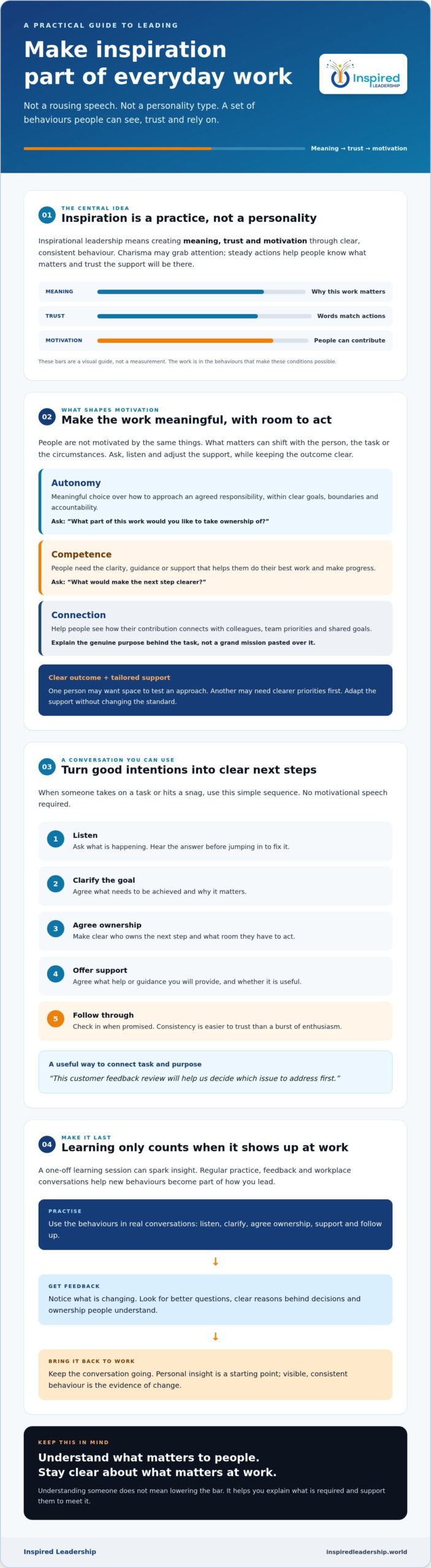
Inspirational leadership is the practice of creating meaning, trust and motivation through clear, consistent behaviour. That’s different from a burst of enthusiasm, pressure to “get on board” or charisma that performs well in a meeting but disappears when work gets difficult. Transformational leadership theory also identifies inspirational motivation as a core element of leadership.
Understand what matters to the people you lead while staying clear about expectations and priorities. Understanding someone doesn’t mean lowering the bar. It helps you explain what’s required and support them to meet it. If you’re considering what leadership development could look like in your organisation, you can contact Inspired Leadership.
Can you learn to lead inspirationally without being naturally charismatic?
Yes. Listening without rushing to fix things, explaining the purpose behind a task and following through on agreements are all behaviours you can practise. They don’t require a booming voice or a motivational quote on every slide.
Picture a team facing a tight deadline. One manager delivers an energetic speech, then leaves people guessing about priorities. Another calmly hears their concerns, clarifies what matters most and checks in when promised. That steady approach makes expectations and support easier to trust.
What should inspirational leadership development change?
Look for visible changes at work. Conversations include better questions, decisions come with clear reasons and people know who owns the next step. Accountability should be clear from the outset, not feel like a surprise audit after the fact.
Personal insight is a starting point, not proof of change. A leader may understand that they need to delegate, for example. Evidence comes when they agree who owns the work, give that person room to act and follow up constructively. Inspirational leadership training should help leaders practise and notice these changes in real work.
How Motivation, Autonomy and Meaning Shape Inspirational Leadership
Motivation isn’t a button you can press with a bonus, a pep talk or one enthusiastic team meeting. Intrinsic motivation means doing something because it feels interesting or worthwhile. What matters varies between people and can change with the task or circumstances. Deci and Ryan’s research on self-determination theory explores how autonomy, competence and connection relate to motivation.
At work, autonomy is having meaningful choice over how you approach an agreed responsibility, within clear goals, boundaries and accountability. It isn’t being left alone to guess what matters. Inspirational leadership training should help leaders balance room to act with clarity about the outcome and support when barriers arise.
How can leaders discover what motivates different people?
Ask open questions, listen to the answer and revisit the conversation. Try, “What part of this work would you like to take ownership of?” or “What would make the next step clearer?” Then agree what support you’ll provide and check whether it helped. Don’t assume the same reward or responsibility will motivate everyone.
For example, one team member may want space to test an approach, whilst another needs clearer priorities before starting. You can adapt the support without changing the standard: agree the required outcome, then tailor the guidance or freedom each person needs to work towards it.
How do shared goals make work feel meaningful?
A task can feel like a box to tick until you explain what it enables. Connect the work to a team priority: “This customer feedback review will help us decide which issue to address first.” The link should be genuine, not a grand mission statement pasted over an ordinary spreadsheet.
Leaders can explore how leaders inspire through practical behaviours, then bring those ideas into everyday conversations. If you’re considering how to develop these habits across your organisation, discuss your leadership development needs.
How to Practise Inspirational Leadership in Everyday Conversations
Inspiration becomes useful in the small conversations where work gets done. Try this sequence when someone takes on a task or hits a snag:
- Listen: Ask what’s happening and hear the answer before jumping in.
- Clarify the goal: Agree what needs to be achieved and why it matters.
- Agree ownership: Confirm who will take the next step and by when.
- Offer support: Ask what would help, then agree what you’ll do.
- Follow up: Check progress as agreed, not only when something goes wrong.
Suppose a colleague’s report is behind schedule. Instead of taking it back or saying, “You’ve got this!” and disappearing, ask what’s holding it up, clarify the deadline and agree a next step together. Recognise their contribution specifically: “Your summary made the customer feedback easier to act on,” rather than just “Great job.” Consistent follow-up turns encouragement into practical support by making progress, ownership and help visible.
What can you say to encourage ownership without taking over?
Try, “What do you think the next step should be?” or “What support would help you move this forward?” Then agree who owns each action, what help you’ll provide and when you’ll check in. This keeps accountability clear without taking it away from the person doing the work.
How can you practise these behaviours after a learning session?
Choose one behaviour to practise in a real conversation, such as asking before offering advice. Afterwards, note what you said, how the other person responded and what you’d adjust next time. If you use a leadership assessment, treat it as one prompt for reflection alongside what you observe in your day-to-day conversations.
How to Make Inspirational Leadership Development Last at Work
A motivating session can spark useful ideas, but the real test comes when leaders return to work. If the same pressures, habits and expectations remain, inspiration can quickly become a nice memory rather than a change in how they lead.
To assess whether development is taking hold, look for observable behaviour over time. Are managers asking more thoughtful questions, clarifying ownership and following through? Compare your observations with team feedback and regular conversations with the leaders themselves. Look for patterns and areas to practise, not a promise of instant business results.
Managers and senior leaders have an important role in reinforcing learning. Make space in regular conversations to discuss what leaders are trying, what’s getting in the way and what support would help. Clear expectations matter too. If collaboration is a priority, leaders need to see it reflected in the behaviours you recognise and encourage.
What should you look for in an inspirational leadership journey?
Choose development that starts with real work challenges and gives leaders opportunities to practise, receive feedback and apply what they learn on the job. A single event might introduce an idea. A structured journey gives leaders space to test it, reflect and keep working at it. Inspirational leadership training should connect learning to the everyday expectations of your organisation.
For new managers, Inspired Leadership’s First Line Manager Program is a relevant option to explore.
When should you explore structured leadership support?
Consider it when managers need consistent development that reflects your organisation’s priorities, especially if leaders are receiving mixed messages about how to guide their teams. Inspired Leadership designs structured leadership journeys for medium-sized enterprises, with a focus on translating insight into action at work.
Start by discussing the leadership behaviours your organisation wants to strengthen, then consider what kind of development could support that need. A practical conversation can help clarify where to begin.
Make inspiration part of how you lead
Inspirational leadership isn’t a performance reserved for naturally charismatic people. It’s built through everyday behaviours: understanding what helps people contribute, making shared goals clear, agreeing ownership and following through. The value of inspirational leadership training lies in helping leaders practise those behaviours consistently, not simply feel motivated for a day.
For your organisation, lasting development means looking beyond what leaders learned to what they do at work. Make room for practice, feedback and honest conversations about what’s changing and where support is still needed. Inspired Leadership designs leadership journeys for medium-sized enterprises, focused on translating leadership insight into action across organisations.
You don’t need a grand speech to make a difference. Start with one useful conversation, follow through on what you agree, and build from there.
Frequently Asked Questions
Can inspirational leadership be learned, or is it a natural personality trait?
Inspirational leadership can be learned; it isn’t reserved for naturally charismatic people. You can practise behaviours such as listening carefully, explaining priorities clearly, inviting people to take ownership and following through on agreements. For example, a quieter manager can build trust by asking thoughtful questions and keeping commitments. The aim isn’t to copy someone else’s style, but to lead consistently in a way that helps your team understand and contribute.
What does inspirational leadership training teach you to do?
Inspirational leadership training helps you turn ideas about motivation and trust into practical leadership behaviours. You can learn to connect individual contributions with shared goals, set clear expectations, invite ownership and offer useful support. It should also help you practise these behaviours in workplace situations and reflect on what changes in your conversations and decisions. The focus is not on performing confidence, but on leading in ways your team can experience.
How can you inspire a team without relying on motivational speeches?
You can inspire people through everyday actions, not just speeches. Explain why a task matters, ask what would help someone contribute and recognise their specific contribution. If progress stalls, listen to what’s getting in the way, agree a manageable next step and follow up when you said you would. That combination of purpose, support and accountability gives people something more useful than a rousing speech: clarity about what to do next.
How do you know whether inspirational leadership development is working?
Look for observable changes in how leaders work with people, then compare your observations with team feedback. Are leaders making expectations clearer, inviting input, agreeing ownership and following through? Review these behaviours regularly rather than relying on how energised people felt immediately after a learning session. Personal insight is valuable, but development is taking root when leaders apply what they’ve learned in real conversations and decisions.
Is inspirational leadership training suitable for first-line managers?
Yes, it can be relevant for first-line managers who need to guide people through everyday priorities, conversations and decisions. Inspired Leadership offers a First Line Manager Program as part of its leadership development journeys for medium-sized enterprises. The focus is on translating leadership insight into action across organisations. If you’re developing new managers, consider whether the journey addresses the responsibilities they face and gives them ways to practise leadership in their day-to-day work.