

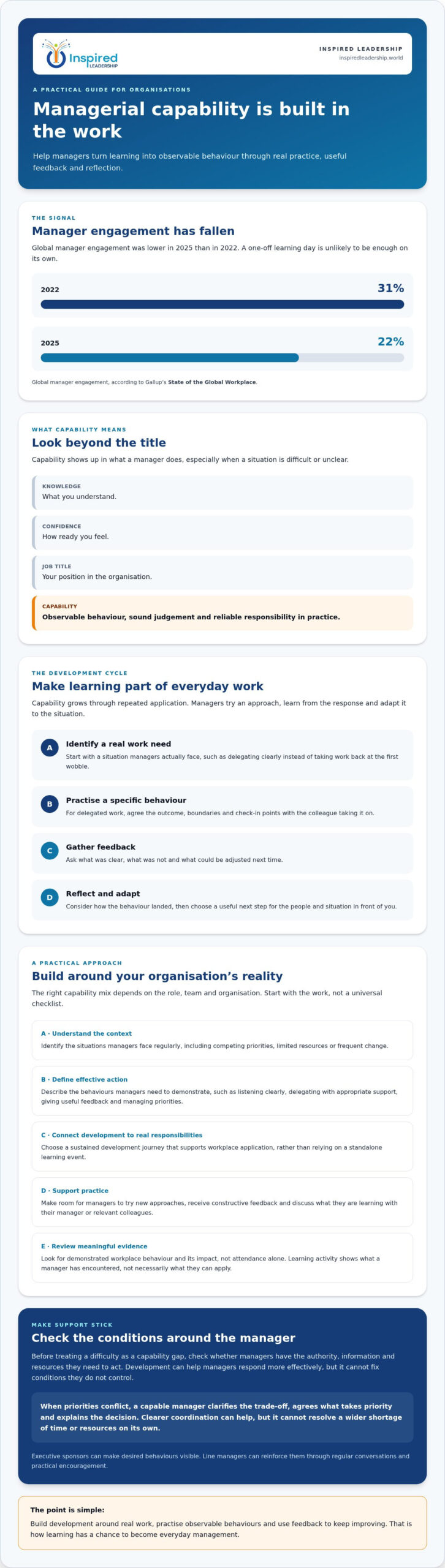
Global manager engagement fell to 22% in 2025, down from 31% in 2022, according to Gallup’s State of the Global Workplace 2026. That should give organisations pause: managerial capability building can’t be left to a one-off training day and a hopeful “you’ve got this” on Monday.
Managers need to lead people, set priorities and deliver results, often whilst finding their feet in a demanding role. The challenge is making development useful after a session ends, so new insight becomes everyday behaviour rather than another forgotten set of notes.
This article explains how to identify the capabilities managers actually need, connect development to organisational priorities and support people to practise new behaviours at work. It also covers how to review progress using meaningful evidence, not attendance alone, and build a coherent approach that supports managers and their teams.
Key Takeaways
- Distinguish managerial capability from knowledge, confidence and title by looking for observable behaviour, sound judgement and reliable responsibility.
- Use managerial capability building as an ongoing cycle: identify a real work need, practise a behaviour, gather feedback and reflect on its impact.
- Set development priorities around your organisation’s context, then define the specific behaviours managers need to demonstrate.
- Choose a sustained development journey that supports workplace application and makes intended outcomes clear, rather than relying on a standalone learning event.
What managerial capability building means in the day-to-day reality of management
Managerial capability building is the ongoing development of a manager’s ability to apply knowledge, judgement and practical behaviours to the responsibilities of leading people and work. Knowledge is what you understand, confidence is how ready you feel, and a job title is simply your position. Capability shows up in what you do, particularly when a situation is difficult or unclear.
That might mean communicating expectations clearly, making considered decisions, taking responsibility for outcomes and responding constructively when plans change. Management involves coordinating work towards shared goals, as outlined in this definition of management, but the capabilities a manager needs depend on their role, team and organisation.
Which capabilities matter in a manager’s role?
Practical capabilities may include listening and communicating clearly, delegating with appropriate support, giving useful feedback and managing competing priorities. The right mix isn’t a universal checklist. A manager leading a specialist team may need to handle technical trade-offs, whilst another may spend more time aligning work across teams. Start by identifying the situations managers face regularly, then consider what effective action looks like in each one.
Context matters, too. Managers may be expected to support their teams whilst dealing with unclear priorities, limited resources or frequent change. Development can help them respond more effectively, but it can’t fix organisational conditions they don’t control. Before treating a difficulty as a capability gap, check whether managers have the authority, information and resources needed to act.
Why does managerial capability affect the wider organisation?
Managers shape how priorities, decisions and expectations reach the people doing the work. Their everyday actions can help a team understand what matters, ask questions and raise problems early. These are plausible effects, not guaranteed business outcomes: workload, systems and senior leadership decisions matter too.
Illustrative example: A team receives two urgent requests with conflicting deadlines. A capable manager clarifies the trade-off, agrees what takes priority and explains the decision, rather than leaving people to guess. That behaviour can support clearer coordination, but it won’t resolve a wider shortage of time or resources on its own.
How managerial capability develops through learning, practice and feedback
Managerial capability develops through repeated application, not a single learning event or a guaranteed progression. Learning activity shows what a manager has encountered; demonstrated workplace behaviour shows what they can apply.
For your organisation, the value lies in connecting learning to real responsibilities and giving managers the conditions to test new approaches. The process is iterative: a manager tries a behaviour, learns from the response and adapts it to suit the people and situation in front of them.
- Identify a work-based need: for example, a manager wants to delegate more clearly instead of taking tasks back at the first wobble.
- Practise a behaviour: agree the outcome, boundaries and check-in points with the colleague taking on the work.
- Get feedback and reflect: ask what was clear, what wasn’t and what to adjust next time.
Why practice and reflection belong in development
Practice gives a manager the chance to try a new approach in a real situation. Before a feedback conversation, they might prepare one specific observation and a question that invites the other person’s perspective. Afterwards, reflection helps them consider how the conversation landed and choose a useful next step, rather than simply ticking “feedback” off a learning list.
What support helps managers apply new behaviours?
Managers need room to practise, constructive feedback and time to discuss what they’re learning with their own manager or relevant colleagues. Executive sponsors can make desired behaviours a visible priority, whilst line managers can reinforce them through regular conversations and practical encouragement.
Keep that support connected to the work, rather than adding another disconnected task. If you’re considering structured support, explore the manager-to-leader development journey, or contact Inspired Leadership to discuss your needs.
How to build managerial capability: a practical framework for your organisation
Effective managerial capability building starts with the work managers are expected to do, not a generic competency model imported from somewhere else. Use this sequence to keep development relevant and grounded:
- Clarify the need: connect a real challenge in managers’ roles to an organisational priority.
- Define observable behaviours: describe what managers should do differently, such as agreeing clear ownership when delegating.
- Choose work-based practice: give managers opportunities to apply that behaviour in situations they already face.
- Review progress: consider what has changed, what evidence supports that view and what should happen next.
How can you identify the capability gaps that matter?
Start with role expectations and business priorities, then ask managers where they’re getting stuck. Compare their accounts with relevant observations from colleagues and leaders. This can help distinguish a development need from barriers such as unclear authority or competing demands.
A leadership assessment can contribute useful insight, but it’s one input, not a complete diagnosis. Be clear about how feedback will be used and who will see it. People are more likely to speak candidly when they know where their responses are going.
How should you review whether development is working?
Choose a small set of behaviours linked to the original need, then review them at sensible intervals. Combine the manager’s reflection with relevant observations from people who see the behaviour at work. Consider organisational indicators only when they genuinely relate to the goal.
For example, if the focus is clearer delegation, look for evidence that responsibilities and check-ins are being agreed, not just whether managers say they feel more confident. Establish a baseline only when suitable information exists; don’t invent a benchmark to make a neat-looking chart.
Measurement helps you decide what to continue, adapt or stop. On its own, it doesn’t prove that development caused an organisational result or delivered a return on investment; other factors may have contributed.
Choosing a managerial capability building journey that can last beyond the launch
A standalone learning activity can introduce useful ideas, but managers also need opportunities to apply and revisit them in the flow of work. A sustained journey connects development with real role expectations, supports practice and gives you a way to review progress. The launch is a starting point, not the finish line.
What should you look for in a development partner?
Ask how the approach reflects your managers’ responsibilities and working context. How will participants turn insight into action? How will you discuss progress and review evidence? Look for clear intended outcomes and a practical way to assess fit, rather than promises of results that depend on factors outside the journey.
Inspired Leadership designs leadership journeys for medium-sized enterprises, including a First Line Manager Program. Consider whether its First Line Manager journey suits the group and needs you’ve identified.
What is a useful next step for your organisation?
Start by identifying the manager group, the business need and the behaviour you want to strengthen. Then invite relevant stakeholders to discuss expectations, fit and how you’ll review progress before making a commitment.
A clear conversation can help you decide whether a structured journey is right for your organisation and what support managers need to apply their learning at work.
Build manager capability into the work, not around it
Managers don’t become capable simply by knowing more or attending a learning event. They develop through role-relevant expectations, opportunities to practise, useful feedback and support to apply what they learn in real work.
For your organisation, effective managerial capability building starts with the behaviours that matter most, connects development to those behaviours and reviews meaningful evidence of progress. This creates a clearer picture than attendance alone, whilst recognising that development can support managers without fixing every organisational barrier they face.
Inspired Leadership designs leadership journeys for medium-sized enterprises, with an approach focused on translating insight into action across organisations. If you’re considering a structured way to support managers, a conversation can help clarify your needs, expectations and suitable next steps.
You don’t need to solve everything at once. Start with one meaningful capability, and give managers the support to put it into practice.
Frequently Asked Questions
What is managerial capability building?
Managerial capability building is the ongoing development of a manager’s ability to lead people and work effectively in their actual role. It goes beyond knowing management concepts or feeling confident: capability is evident in behaviour, judgement and how consistently responsibilities are handled. For example, a manager might clarify priorities, delegate appropriately and give useful feedback, adapting their approach to the needs of their team and organisation.
How do you build managerial capability in an organisation?
Build managerial capability by linking development to real role expectations and organisational priorities. Identify a specific need, define the behaviour managers should demonstrate, create opportunities to practise it at work, then review what happens. For example, if delegation is a priority, managers can agree responsibilities and check-ins with their teams, then reflect on what worked. Support from senior leaders and line managers helps make that practice part of everyday work.
Can managerial capability be developed through training alone?
Training can introduce useful ideas, but it rarely demonstrates on its own that a manager can apply them at work. Managers also need chances to practise, receive constructive feedback and reflect on how a behaviour landed. A learning session might explain how to give feedback; using that approach in a real conversation, then considering what to adjust next time, helps connect the idea to day-to-day management.
How can you measure managerial capability building?
Measure managerial capability building by reviewing a small set of observable behaviours linked to a clear development need. Combine managers’ reflections with relevant observations from colleagues or stakeholders, and use organisational indicators only when they meaningfully relate to the intended outcome. Compare progress with a baseline if suitable information is available. Measurement can guide decisions about what to continue or change, but it doesn’t prove development alone caused wider results.
How long does it take to build managerial capability?
There’s no fixed timeframe for building managerial capability, because progress depends on the behaviour being developed, opportunities to practise and the support available at work. A manager may apply a new approach in one situation, but using it consistently across different pressures can take further practice and feedback. Set review points that suit the work, look for evidence of application over time and adjust support as needs change.