

What happens when teams hear the same strategy but make different calls about what matters most? That’s where leadership and strategy either connect in everyday decisions or drift apart. Direction may be clear at the top, yet it won’t turn into progress unless leaders make it meaningful in the work people do each day.
If you’ve watched priorities get interpreted differently across teams, you know the issue isn’t always a lack of commitment. People need clear choices, ownership and room to act, while leaders need to reinforce what matters through their own behaviour. Otherwise, even a well-designed strategy can become a set of slides everyone nods at and few use.
This article explores how leaders translate strategic direction into practical expectations, aligned decisions and measurable progress. You’ll find ways to clarify priorities, build shared accountability and connect leadership development with organisational outcomes, rather than treating it as a separate activity. We’ll also look at when a structured leadership journey may help strengthen the capability your strategy depends on.
Key Takeaways
- Spot where strategic priorities are being interpreted differently, then make the connection between leadership choices and organisational action clearer.
- Use leadership and strategy together to turn priorities into practical decisions, role clarity and shared ownership.
- Apply a simple alignment cycle: clarify priorities, translate them into decisions, assign ownership and review what you learn.
- Connect leadership development to real organisational priorities, recognising that first-line managers, technical talent and senior leaders may need different capabilities.
Why leadership and strategy drift apart, even when the plan is clear
A strategy can be clear on paper and still mean different things to the people expected to deliver it. Strategic alignment is the working connection between agreed priorities, leadership choices and organisational action. It depends on leaders making the direction visible in the decisions they make, the trade-offs they accept and the work they ask people to prioritise.
That connection is easy to lose when new requests keep arriving, teams compete for time or nobody knows who has the authority to decide. Repeating the strategy statement may create familiarity, but it won’t resolve those practical questions. Agreement is a starting point, not proof that people know what to do differently. A useful check is to ask people in different roles what the priority means for their work, and compare their answers.
What does leadership and strategy alignment mean in practice?
In practice, alignment means a leader can explain what a priority requires in their area, what may need to wait and how their team can contribute. Their behaviour reinforces the message. If collaboration matters, for example, leaders need to make decisions that support joined-up work, not reward teams for protecting their own patch.
Strategic leadership describes the broader work of guiding an organisation towards its objectives. A useful distinction is: strategy sets the direction; leadership turns it into choices, ownership and action.
Why do strategic priorities get lost between decisions and delivery?
Hypothetical example: An organisation names improving customer experience as a priority. One team is told to resolve issues faster, while another is asked to reduce support costs, with no shared guidance on how to balance the two.
Both teams may be acting reasonably, yet their choices pull in different directions. If it’s also unclear who can approve a change or who owns the result, decisions stall or work gets passed along. The problem isn’t necessarily a lack of effort; it’s a missing link between the priority and the authority to act. To explore where that link may be breaking down, discuss leadership alignment with Inspired Leadership.
How leadership connects strategic direction to everyday behaviour
A strategic priority only guides work when people can see what it means for their decisions. Leaders interpret the direction, make trade-offs and explain why some work takes precedence. That calls for more than a polished announcement: teams need to understand what they’re responsible for, what they can decide and when to raise a conflict.
Everyday leadership choices make strategy tangible by showing people what to prioritise, how to act and where they own the next step. This is where leadership and strategy meet in practice. Guidance on successful strategy execution also points to the value of connecting roles and communication with the chosen direction.
Which leadership behaviours help make strategy actionable?
Start by communicating the priority in plain language, then connect it to the decisions your team faces. If simplifying internal handovers is a strategic focus, for instance, explain which checks remain essential and where teams can remove duplication. Clear expectations help people make consistent choices without needing a leader to approve every small step.
Good leaders also invite questions. When teams see a clash between a new priority and existing commitments, make room to surface it, agree who will decide and follow through on that responsibility. A common mistake is to imply that every demand can fit alongside existing work. That won’t make the tension disappear. Leaders need to state what takes precedence and what may need to wait.
How does leadership behaviour shape organisational culture?
Culture takes shape through repeated signals: what leaders praise, what they challenge, which trade-offs they make and whether they honour agreed responsibilities. If collaboration is stated as a priority but decisions consistently reward isolated results, people may reasonably conclude that actions matter more than words.
There isn’t one leadership style that suits every organisation or moment. The useful test is whether your approach gives people enough clarity, trust and support to act on the priorities in front of them. If you’re considering how to strengthen that capability, you can discuss your leadership development needs with Inspired Leadership.
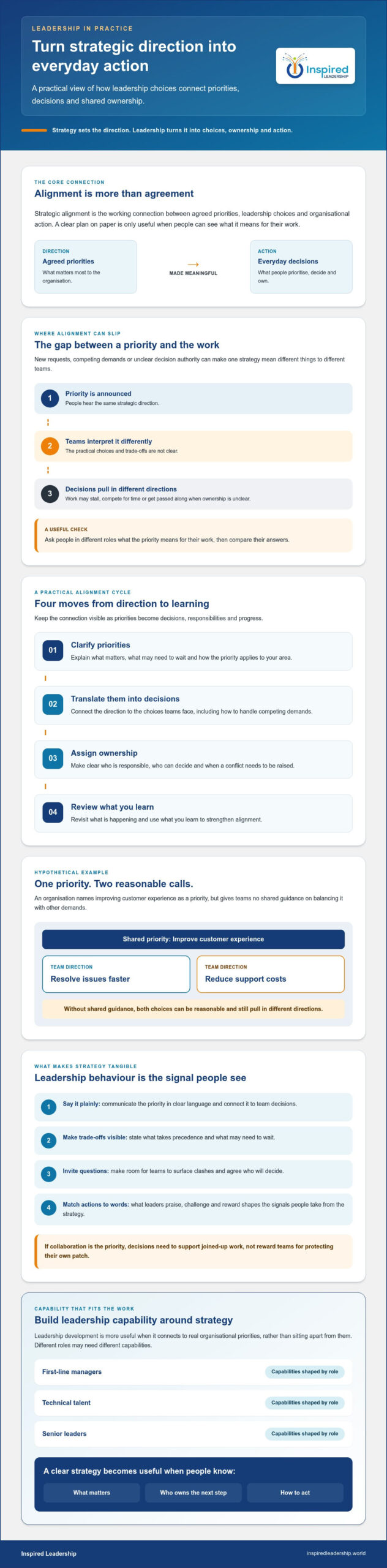
A practical leadership and strategy alignment cycle for your organisation
To connect leadership and strategy, make alignment a regular working practice, not a launch-day speech that fades by Monday. Start by choosing a small number of priorities people can act on together. There’s no universal right number: select those that matter most to your organisation now, and be clear about what will receive less attention.
Clarify priorities, translate them into decisions, assign ownership and review what you learn. Then repeat the cycle as conditions change. It helps to use the same questions in team discussions, so leaders can spot where interpretations differ and resolve them before work gets duplicated or delayed.
- Clarify priorities: State what each priority means and how it relates to your organisation’s direction.
- Translate them into decisions: Identify recurring choices that should reflect each priority, such as how to allocate team time or respond to competing requests.
- Assign ownership: Name who is responsible for each decision and outcome, and agree how unresolved trade-offs will be raised.
- Review learning: Check progress against agreed indicators, listen to feedback and adjust actions when assumptions no longer hold.
How can you translate strategic priorities into leadership decisions?
Ask leaders to name the everyday decisions where a priority should make a difference. For example, if reliability is a focus, which decisions about quality checks, deadlines or resources need to reflect it? Make decision ownership explicit, including who has the authority to act and who needs to be consulted when priorities compete. If two priorities point towards different choices, state who will resolve the conflict and how the decision will be communicated.
How can you tell whether alignment is improving?
Look for evidence in your own organisation: are similar decisions being made in ways that support the agreed priorities? Can people explain who owns the next step, and are relevant indicators moving in the intended direction? Use verified internal measures and feedback, not an unsupported benchmark pulled from a slide deck. If evidence shows a gap, discuss what needs to change, then review again. Avoid treating activity, such as holding more meetings or sending more updates, as proof of progress unless it helps clarify decisions or improve outcomes.
Discuss aligning leadership with your strategic priorities
Build leadership capability around strategy, not apart from it
Leadership development is most useful when it helps people meet real responsibilities and strategic priorities, rather than sitting alongside them as a separate activity. A general session may offer useful ideas, but unless leaders can apply those ideas to decisions they face at work, the link to organisational outcomes can remain unclear.
Capability needs also vary by role. First-line managers may need to turn priorities into clear team expectations; technical talent may need to influence beyond their specialist expertise; senior leaders may need to make trade-offs across the organisation. The focus is not to teach everyone the same thing, but to build the capabilities your direction requires. This makes it easier to choose development that addresses a real leadership challenge rather than a topic that is simply familiar.
What should you look for in a strategy-linked leadership journey?
Look for a clear connection to actual responsibilities, opportunities to apply insight to current work and ways to reflect on progress. You might ask: which decisions should participants handle differently, what support will help them practise, and what evidence will show whether their approach is developing? These questions keep development grounded without pretending it can guarantee a particular business result.
Where can you explore relevant leadership support?
If your priorities call for leaders to move beyond command-and-control habits, explore the Beyond Command Journey. Consider how any leadership development approach connects to the decisions people need to make and the capabilities your organisation wants to build.
Inspired Leadership designs transformational leadership journeys for medium-sized enterprises, connecting leadership insight with organisational action. Its programmes include journeys for first-line managers, high-potential technical talent and senior leaders, as well as specialist development for women talent and graduate leaders. If you’re weighing up what your strategy asks of leaders, a conversation can help you explore what may fit your organisation’s needs.
Make your strategic direction visible in the work
Strategy becomes meaningful to people when they can see how it shapes the choices they make. The connection between leadership and strategy is built through clear priorities, decisions that reflect those priorities and ownership people understand.
You can strengthen that connection by checking whether teams know what matters most, whether leaders’ actions support the stated direction and whether responsibility for next steps is clear. Reviewing what you learn helps you adapt when assumptions change, rather than asking people to follow a plan that no longer fits.
Leadership development can support this work when it is connected to the capabilities your organisation needs. Inspired Leadership designs transformational leadership journeys for medium-sized enterprises, aiming to build capability at scale and translate insight into action.
Explore Inspired Leadership’s First Line Manager Program if your organisation wants to connect manager development with the priorities leaders need to put into practice.
You don’t need every answer before taking the next step. A thoughtful conversation can help you identify where leadership capability could better support your organisation’s direction.
Frequently Asked Questions
What is the relationship between leadership and strategy?
Strategy sets the organisation’s direction, while leadership helps people act on it. Leaders interpret priorities, make choices about competing demands and clarify how different roles contribute. This means leadership and strategy are connected through everyday decisions, not simply through a strategy document or a message from the top. When leaders’ actions support the stated direction, people have a clearer basis for deciding what to focus on.
Why do organisations struggle to turn strategy into action?
Organisations can struggle because priorities are unclear, ownership is uncertain or leaders send mixed signals. For example, one team may be asked to improve service whilst another is told to reduce the time spent resolving issues, with no guidance on how to balance those aims. People may work hard, but without clear decision rights and shared expectations, effort can become fragmented rather than coordinated.
How can leaders align their teams with organisational strategy?
Explain what each priority means for the team’s work, then make responsibilities and decision boundaries clear. Connect the direction to real choices, such as which requests take precedence or when a trade-off needs to be escalated. Invite questions so tensions surface early, and follow through on agreed actions. You can then check whether team decisions and feedback remain consistent with the organisation’s priorities.
What is the role of a board in leadership and strategy alignment?
A board can help maintain a clear connection between strategic direction, executive decisions and oversight of progress. It can ask whether priorities are understood, whether leaders have identified material trade-offs and whether measures provide a useful view of progress. Executives and managers then translate the direction into decisions and responsibilities across the organisation. Clear discussion between the board and leadership team helps surface gaps before assumptions go unchallenged.
Can leadership development improve strategic execution?
Leadership development can build capabilities relevant to strategic execution, but it can’t replace a clear strategy or guarantee results. It is more likely to be useful when connected to real responsibilities and organisational priorities, with opportunities to apply and review learning. Inspired Leadership designs leadership journeys for medium-sized enterprises, aiming to build capability at scale and translate insight into action across the organisation.