

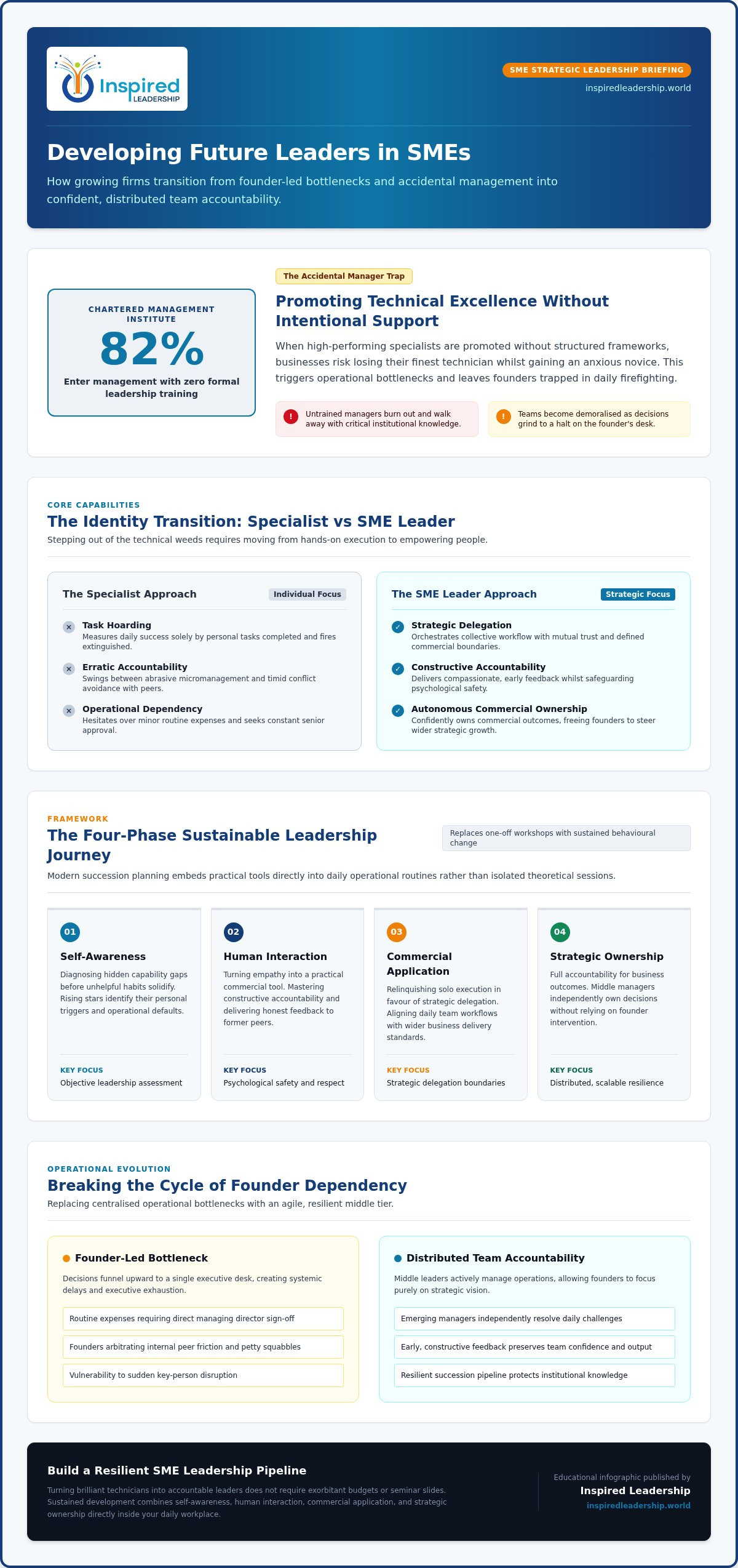
According to the Chartered Management Institute, a staggering 82% of people entering management have received zero formal leadership training. If your current strategy for developing future leaders in SMEs relies on handing your star specialist a promotion and crossing your fingers, you’re not alone. You inevitably lose your finest technician whilst gaining an anxious novice who burns out trying to keep everyone happy.
You likely know the quiet exhaustion of daily firefighting because your middle managers still hesitate to make simple decisions without your blessing. Fortunately, turning top performers into accountable leaders doesn’t require an exorbitant corporate budget or another shelf of forgettable seminar slides. In this guide, you’ll discover how to build a resilient leadership pipeline and transform tactical specialists into confident, strategic decision-makers.
Here is your practical, no-nonsense roadmap to transition smoothly from founder-led control to distributed, scalable team accountability.
Key Takeaways
- Understand why promoting brilliant specialists without intentional support creates an operational bottleneck and traps you in endless daily firefighting.
- Unpack the critical mindset shift required to move from hands-on execution to empowering people, turning empathy into your sharpest commercial tool.
- Discover the four-phase roadmap for developing future leaders in SMEs that replaces forgettable one-off workshops with sustained behavioural change.
- Protect your organisation against sudden key-person disruption by cultivating a diverse, resilient leadership pipeline that drives distributed accountability.
The SME Leadership Bottleneck: Why Organic Growth Stalls
Growing an enterprise feels electric until every operational decision grinds to a halt at your desk. This bottleneck happens when an expanding firm outgrows casual corridor chats, leaving technical high-achievers stranded in supervisory roles without proper preparation. Without intentional frameworks for developing future leaders in SMEs, accidental succession turns your most reliable contributors into overwhelmed operational bottlenecks.
The hidden commercial toll is steep. When untrained managers burn out and walk away, they take irreplaceable institutional knowledge with them whilst leaving behind demoralised, disengaged teams.
The Perils of the Accidental Manager in Growing Firms
Promoting your top specialist feels like an obvious reward, yet subject matter excellence rarely equates to genuine leadership capability. Managing former teammates demands emotional nuance, honest feedback, and active delegation rather than solo execution. Applying structured principles of leadership development helps technical stars resist the natural urge to micromanage when operational pressures mount.
Without that shift, your newly minted manager simply hoards tasks, alienates peers, and wonders why output continues to drop. It is a costly pattern that stalls momentum and drains team confidence.
Breaking the Cycle of Founder Dependency
If you spend your afternoons arbitrating petty squabbles or signing off routine expenses, you’ve accidentally built an expensive day-care rather than an agile enterprise. Managing directors get trapped in tactical firefighting simply because middle managers lack the confidence to take real accountability. Investing intentionally in developing future leaders in SMEs dismantles this bottleneck, empowering your middle tier to own commercial decisions whilst you steer the wider strategy.
Core Capabilities: From Specialist to SME Leader
Stepping out of the technical weeds requires a profound identity overhaul for any ambitious specialist. Your rising stars must stop measuring daily success by individual tasks ticked off or personal fires extinguished. Grounding the transition from specialist to leader in human empathy creates a distinct commercial advantage, balancing rigorous delivery with genuine team well-being.
Diagnosing hidden capability gaps before unhelpful habits take root is essential for scaling businesses. Running an objective leadership assessment offers immediate clarity on where your emerging leaders require targeted developmental support.
Mastering the Art of Constructive Accountability
Holding former teammates accountable can feel intensely awkward for newly promoted managers. Without structured guidance, people often swing erratically between abrasive micromanagement and timid conflict avoidance. When developing future leaders in SMEs, we must equip them with practical frameworks for delivering clear, compassionate feedback that actually shifts workplace behaviour.
This disciplined approach establishes psychological safety without compromising operational delivery standards. It empowers emerging leaders to address performance issues early whilst preserving positive team relationships and mutual respect.
Strategic Delegation and Commercial Perspective
Effective leaders orchestrate collective workflow rather than hoarding individual execution. To scale operations sustainably, emerging managers must learn to relinquish tactical tasks and focus on wider commercial priorities. Successful delegation requires mutual trust, clearly defined boundaries, and genuine shared ownership of business outcomes.
If you want to tailor this leadership development to your firm’s immediate commercial challenges, speak with our team to explore the best path forward for your people.
How to Structure a Sustainable Leadership Development Journey in an SME
One-off corporate workshops fail growing firms because they treat behavioural transformation like a quick theoretical tick-box exercise. Sustainable capability requires a coherent four-phase progression: self-awareness, human interaction, commercial application, and strategic ownership. Modern research from the CIPD highlights that structured succession planning thrives when practical tools embed directly into daily routines rather than isolated classroom events.
By establishing transparent operational milestones, you make leadership growth visible and measurable across your entire business.
Moving from Theory to Action in Real Workplaces
Real learning happens on the shop floor, not in sterile seminar rooms. Assigning actionable projects allows emerging talent to resolve genuine enterprise bottlenecks whilst practising delegation under supportive conditions. Stepping onto an emerging leader journey provides the structured pacing that rising managers need to build lasting confidence.
Pairing these rising contributors with senior internal mentors anchors everyday decisions in your company’s core values.
Cultivating Commercial Ownership and Initiative
You cannot expect managers to make sound commercial calls if the company finances remain a mystery. Teach your rising stars to interpret departmental margins, resource trade-offs, and basic cost drivers. Developing future leaders in SMEs means encouraging staff to bring viable commercial options rather than simply dumping problems back onto your desk.
Securing Your SME Leadership Pipeline for Long-Term Resilience
Relying on a single operational linchpin makes any growing business remarkably fragile. If a sudden resignation threatens to derail key accounts or stall delivery, your business is operating on borrowed time. Proactive succession planning shields your balance sheet from disruption, ensuring trusted hands immediately steady the ship whenever critical personnel move on.
Exploring authentic client experiences reveals how deliberate coaching converts chaotic founder dependency into calm, predictable performance. Making a sustained commitment to developing future leaders in SMEs equips your business with its most reliable operational safeguard. It protects your hard-won momentum whilst fostering deep loyalty among your most ambitious people.
Nurturing Diverse Talent and Specialist Accelerators
Resilience requires varied perspectives, which means you shouldn’t just look for the loudest voices in the room. Exceptional potential often hides within specialist technical teams or frontline operations, simply waiting for structured encouragement and a clear progression pathway. Tailored accelerators empower women leaders to step up, infusing your leadership table with vital cognitive diversity and superior problem-solving.
Partnering for Sustainable Capability at Scale
Mid-sized enterprises rarely hold the internal capacity to design and sustain comprehensive leadership architectures alone. Tasking overstretched directors with ad-hoc mentoring typically leads to rushed, superficial conversations that collapse under daily commercial deadlines. An experienced external partner provides the objective, battle-tested enterprise tools required to turn tactical specialists into confident, autonomous managers.
True enterprise resilience emerges when your middle tier independently protects margins, resolves team conflicts, and champions daily execution. When you’re ready to construct a self-sustaining management tier, contact Inspired Leadership to design an experiential development journey tailored to your firm’s distinct commercial reality.
Transforming Your Leadership Pipeline into Commercial Momentum
Escaping the daily firefighting trap begins when you stop relying on accidental succession. Sustainable commercial growth demands turning your finest technical stars into empathetic decision-makers who confidently shoulder operational accountability. Prioritising a structured approach to developing future leaders in SMEs replaces temporary corporate workshop fixes with lasting, measurable behavioural transformation across your business.
Backed by over 20 years of hands-on leadership experience, our tailored development journeys focus entirely on commercial results. We provide the practical enterprise architecture needed to translate high-level strategic insight into genuine team ownership, freeing you to focus on the bigger picture.
Cultivating a resilient, self-sufficient management tier is easily the smartest investment you can make for your company’s longevity. Your rising talent is ready to step up, take ownership, and help your enterprise thrive.
Frequently Asked Questions
Why do one-off training workshops fail to develop leaders in SMEs?
One-off workshops fail because they treat leadership as an intellectual exercise rather than an ongoing behavioural shift. Attendees return to overflowing inboxes and immediately revert to old habits under operational stress.
Without deliberate workplace practice, accountability structures, and continuous coaching, seminar theory quickly evaporates. Developing future leaders in SMEs requires sustained developmental journeys that weave directly into commercial realities.
How do you identify future leaders in a small or medium business?
Look for individuals who elevate colleagues rather than simply topping technical scoreboards. The strongest indicators are high emotional intelligence, active listening, and a genuine curiosity about how the wider business operates.
Notice who teammates naturally seek out for guidance during difficult projects. True potential shows up in constructive problem-solving and accountability, not just individual specialist performance.
Can an SME afford structured leadership development without dedicated HR?
Yes, because modern development journeys are specifically built to operate without an internal HR department. The actual financial threat is leaving managers unsupported, which sparks costly turnover and stalled operations.
Partnering with external specialists delivers structured frameworks, diagnostic tools, and objective guidance directly to your team. You gain enterprise-level capability without adding permanent overhead to your payroll. In much the same way that growing businesses outsource corporate governance—where owners might explore Professional service fees for company registration and statutory compliance filings rather than hiring in-house administrators—external leadership partners provide targeted expertise exactly when it is needed.
What is the difference between a training course and a leadership journey?
A traditional course focuses on passive knowledge transfer through isolated seminars and theoretical slides. In contrast, an experiential journey unfolds over several months, combining behavioural practice, real-time feedback, and operational projects.
This phased structure helps rising talent embed sustainable habits directly into weekly workflows. It shifts developing future leaders in SMEs from ticking compliance boxes to achieving measurable commercial impact.
How can technical specialists learn to manage former peers successfully?
Specialists succeed by explicitly resetting working relationships and establishing clear boundaries early. They must transition from hands-on doing to enabling others, which requires learning how to deliver direct, compassionate feedback.
Transparent goals and agreed communication rhythms help defuse peer resentment. When managers focus on coaching rather than micromanaging technical details, their former peers quickly respect the new dynamic.