

Did you know that manager engagement has plummeted to just 22 per cent, completely wiping out the “leadership premium” we used to take for granted? It turns out that promoting your best technical specialist and then leaving them to drown in admin isn’t exactly a recipe for success. Focusing on preventing manager burnout is no longer a luxury but a strategic necessity for your organisation’s survival.
You have likely noticed your first-line managers acting more like exhausted “super-doers” than actual leaders, which inevitably leads to crumbling team morale. It’s frustrating to watch talented people hit a wall whilst your leadership pipeline starts to look a bit thin. You aren’t alone in feeling that the traditional methods are failing your people and your bottom line.
This article explores the systemic shifts needed to protect your leaders by moving far beyond superficial wellness perks and generic webinars. You will discover how to recognise the early signs of depletion and why a structured leadership journey is the only way to build a sustainable culture. Let’s get your managers back to leading instead of just surviving the week.
Key Takeaways
- Understand why leadership depletion is far more dangerous than simple tiredness, as it effectively shuts down a manager’s ability to coach or strategise.
- Recognise the specific signs of the “Specialist-to-Leader Trap” that causes your most talented technical experts to crumble under the weight of people management.
- Uncover the radical delegation techniques and cognitive boundaries that are essential for preventing manager burnout across your entire organisation.
- Explore how to build a resilient leadership pipeline by shifting your focus from superficial training to a structured, transformational leadership journey.
What Does Depleted Mean in the Context of Modern Leadership?
When you hear that your team leaders are struggling, it’s easy to assume they just need a good weekend’s sleep. True depletion goes much deeper, leaving a manager with completely exhausted cognitive and emotional reserves for leading others. This state of occupational burnout means they can no longer make strategic decisions or coach their team members, making a proactive strategy for preventing manager burnout absolutely critical.
Our 2026 workplace doesn’t help, with relentless AI acceleration and an “always-on” digital culture demanding instant responses at midnight. Ultimately, depletion is the exact gap between escalating organisational demands and a manager’s current leadership capability.
The Three Stages of Managerial Depletion
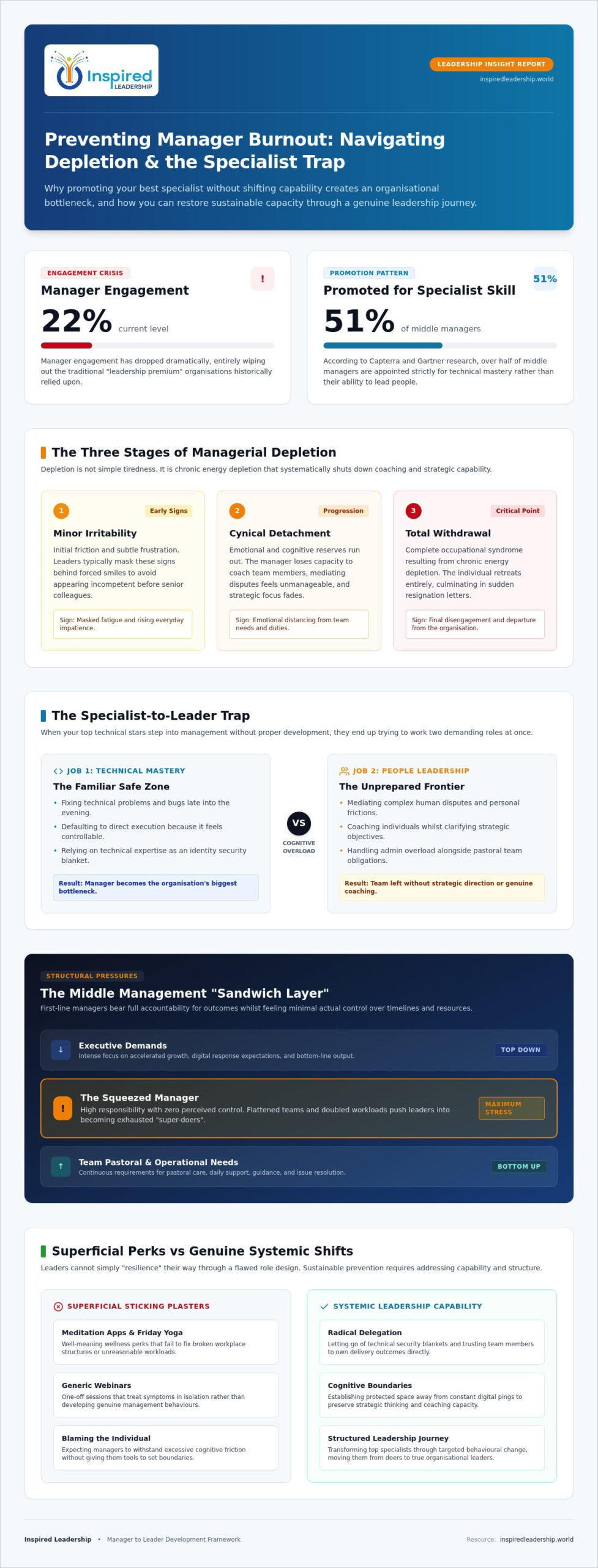
It starts subtly with minor irritability, slips into a cynical detachment, and ends in total withdrawal. Your managers will often mask these signs with a forced smile because they don’t want to look incompetent in front of the board. They’ll keep masking it right up until the day they hand in their resignation letter. If the pressure of leadership has begun to impact your personal well-being or lifestyle habits, you might check out Sober Coach for confidential, one-on-one recovery support.
When the demands of a high-pressure role start to erode your personal life, De Relatiespecialist provides specialised relationship therapy to help parents reconnect and manage the impact of professional stress.
Let’s be honest, a subscription to a meditation app or a free Friday yoga session won’t fix a fundamentally broken workplace structure. When teams are flattened and responsibilities double, your leaders need systemic support and proper development rather than generic wellness perks.
Investing in a structured manager to leader journey solves this by building the actual capability required to manage modern workloads. Preventing manager burnout requires shifting from superficial sticking plasters to genuine, long-term behavioural change.
The Specialist-to-Leader Trap: Why Your Best People Are Burning Out
You probably promoted your top technical star because they were brilliant at their job, not because they actually wanted to spend their Tuesdays mediating office disputes. Now, they are stuck in the Specialist-to-Leader Trap, trying to maintain technical mastery whilst simultaneously learning how to manage complex human emotions. It is a recipe for disaster that turns your best assets into your biggest organisational bottlenecks.
Research from Capterra and Gartner shows that 51 per cent of middle managers were promoted strictly because of their specialist performance. When stress hits, these leaders default to technical “doing” because it feels safe and familiar, making the task of preventing manager burnout even more complex. This chronic, unmanaged workplace stress aligns perfectly with the World Health Organization definition of burnout as an occupational syndrome resulting from energy depletion.
The Friction of Identity Shift
Moving from “expert” to “leader” is a psychological battleground where your best people often lose their sense of professional identity. Imagine your lead engineer still trying to fix bugs at 9 pm whilst their team is desperate for strategic direction. They feel depleted because they are essentially trying to work two full-time jobs at once, leading to a massive cognitive overload.
How Middle Management Becomes the “Sandwich Layer”
First-line managers are often squeezed in the “sandwich layer” between executive demands for growth and a team’s need for pastoral care. They end up with all the responsibility for output but feel they have none of the actual control over resources or timelines. If you want to start addressing these systemic pressures, you must look at the organisational structure rather than blaming the individual.
Preventing manager burnout requires acknowledging that your best people cannot simply “resilience” their way out of a poorly designed role. Without a clear development journey, they will continue to act as super-doers until they eventually break or quit. It’s time to help them trade their technical tools for genuine leadership capability.
Practical Strategies for Preventing Manager Burnout and Restoring Capacity
You can’t just wish for more hours or hope your inbox magically empties itself. Radical delegation is your first line of defence in preventing manager burnout. It requires you to let go of technical “security blankets” and trust your team to own the results you hired them to deliver.
Protecting cognitive space is just as vital as managing your time. Establishing leadership boundaries ensures you have the mental energy for strategic thinking rather than spending your day firefighting. Gallup research on manager burnout highlights that leaders face higher chronic stress than individual contributors, making these boundaries essential.
Implementing peer coaching networks reduces the isolation often felt in the “sandwich layer.” Sharing the load with others who “get it” provides much-needed emotional support and practical advice. Using a leadership assessment can help you pinpoint exactly where your current organisational structure is leaking energy.
Organising for Ownership
You need a team that thinks and owns their outputs. If you are still the only person making decisions, you have accidentally built a bottleneck. Use this quick checklist to evaluate your current habits:
- Are you still reviewing every single line of technical output?
- Do your team members wait for you to assign every minor task?
- Are you the only person who can answer stakeholder questions?
The Power of the Manager-to-Leader Journey
A structured manager to leader journey is the ultimate preventative measure for any growing organisation. It provides the scaffolded support needed to move from a “doing” mindset to a genuine “leading” one. I recommend you download our brochure to see how this transition helps your leaders reclaim their capacity.
Transforming Depletion into Sustainable Leadership Capability
True leadership development is a results-driven alternative to those dry, one-off training workshops that everyone forgets by Monday morning. By building capability at scale, you create a layer of organisational resilience that can actually withstand market volatility. This systemic approach is the most effective way of preventing manager burnout because it addresses the root cause: a lack of practical leadership tools.
Your executives must play a visible role in validating this transition, as their support signals that leadership growth is a non-negotiable priority. When the C-suite actively backs the process, managers feel safe enough to step away from their technical tasks and lean into their new roles. It transforms the culture from one of frantic doing to one of disciplined, sustainable leading.
Moving from Insight to Action
Knowing “how to lead” is technically useless if you don’t have the discipline to execute those skills when things get messy. Real transformation happens when insight meets consistent action, turning theory into tangible results for your team. You can see how this plays out in the real world by reading our leadership coaching testimonials from those who have already made the switch.
Your Next Steps as an Organisational Architect
You are the architect of your company’s culture, and right now, you have the power to stop the cycle of depletion. It’s time to stop patching up holes and start building a leadership pipeline that actually lasts. I invite you to contact inspired leadership for a bespoke consultation to see how we can help.
Let’s be blunt: a burnt-out manager is a phenomenally expensive mistake that your budget really doesn’t need. Replacing a leader costs far more than developing one, so stop treating your people like disposable batteries. Invest in their journey now, or prepare to pay the price when they eventually walk out the door.
Reclaiming Your Leadership Vitality
You’ve spent years building your technical expertise, but leading a team requires a completely different set of tools and a massive shift in identity. The evidence shows that preventing manager burnout isn’t about more yoga or meditation apps; it’s about escaping the specialist trap and reclaiming your cognitive space through radical delegation.
With 20 years of corporate experience specialising in medium-sized enterprise growth, I’ve seen that the most successful organisations treat leadership as a results-driven, pragmatic journey rather than a one-off training event. It’s time to stop acting like a frantic super-doer and start building a resilient team that actually owns its own outputs.
You have the power to transform your organisational culture from a state of depletion to one of sustainable, long-term growth. Your leaders are waiting for a partner who understands the corporate reality and offers a battle-tested alternative. You can choose to stay stuck in the cycle of exhaustion, or you can choose to lead with clarity and confidence.
Frequently Asked Questions
What are the first signs that a manager is feeling depleted?
The first signs of depletion are usually subtle shifts in temperament, such as uncharacteristic irritability or a sudden lack of patience with direct reports. You might see them “masking” their stress behind a forced smile whilst avoiding any strategic discussions that require deep cognitive focus. When a manager starts hiding in technical tasks to avoid people-related friction, their emotional reserves are likely running on empty.
How does manager burnout affect the wider organisation?
Manager burnout acts as a toxic contagion that quickly erodes team morale and destroys your organisational productivity. Depleted leaders are 3.5 times more likely to leave their roles, which triggers a cycle of high turnover and massive recruitment costs. Beyond the balance sheet, you will notice a sharp decline in decision-making quality as burned-out managers lose the capacity to coach or inspire their teams.
Can a leadership journey really prevent burnout in a high-pressure environment?
A structured leadership journey is a highly effective method for preventing manager burnout because it builds the practical capability required to handle high-pressure environments. Instead of offering temporary “self-care” sticking plasters, these journeys teach managers how to set boundaries and delegate with confidence. It transforms them from exhausted super-doers into resilient leaders who have the mental space to think strategically whilst supporting their teams.
What is the difference between a leadership program and a leadership journey?
A traditional program is often a one-off event that offers insight but fails to deliver lasting behavioural change or tangible results. Inspired Leadership specifically avoids these superficial workshops, focusing instead on transformational journeys that move leaders from theory into sustained action. A journey provides the scaffolded support and discipline needed to ensure that new leadership habits actually stick and improve your organisational performance.
How can senior executives support first-line managers in avoiding depletion?
Senior executives can support their managers by publicly validating their leadership development and protecting their time to actually lead. You must ensure that management isn’t treated as a “side-hustle” to be completed after a full day of technical work. By backing a structured leadership journey, you provide the systemic support that first-line managers need to stop feeling like the “sandwich layer” and start feeling like leaders.