

Why do we take our most gifted technical minds and effectively punish them with a promotion they aren’t prepared for? If you’ve ever implemented a high potential technical talent program only to see your best engineers struggle, you know the frustration of a stagnant leadership pipeline. It’s a recurring cycle that leaves your organisation’s future feeling fragile and your best people looking for the exit.
You know that these specialists are the backbone of your business, yet the transition to leadership often feels like a forced choice between “doing” and “leading.” I’m going to show you how to facilitate a radical identity shift that turns your experts into strategic enablers without stripping away their technical edge. We’ll move past the “fluff” and focus on how to maintain that specialist brilliance whilst expanding their influence.
We’ll explore how to build a sustainable leadership journey where your team members actually own their results and value human skills as much as clean code. Let’s stop pretending that a weekend workshop on “people skills” is enough to fix a systemic issue. It’s time to embrace a disciplined, human-centred approach that respects the specialist whilst driving real business impact.
Key Takeaways
- Stop treating leadership development like a dodgy software update and learn how to facilitate a genuine human evolution for your experts.
- Discover how a high potential technical talent program focuses on systemic thinking and human skills to give your business a serious competitive advantage.
- Master the shift from “command and control” to a coaching mindset so your experts lead teams effectively whilst keeping their technical edge.
- Find out how to identify true potential using more than just technical KPIs to align your people’s growth with your long-term strategy.
Why Traditional Technical Talent Programs Often Fail Your Business
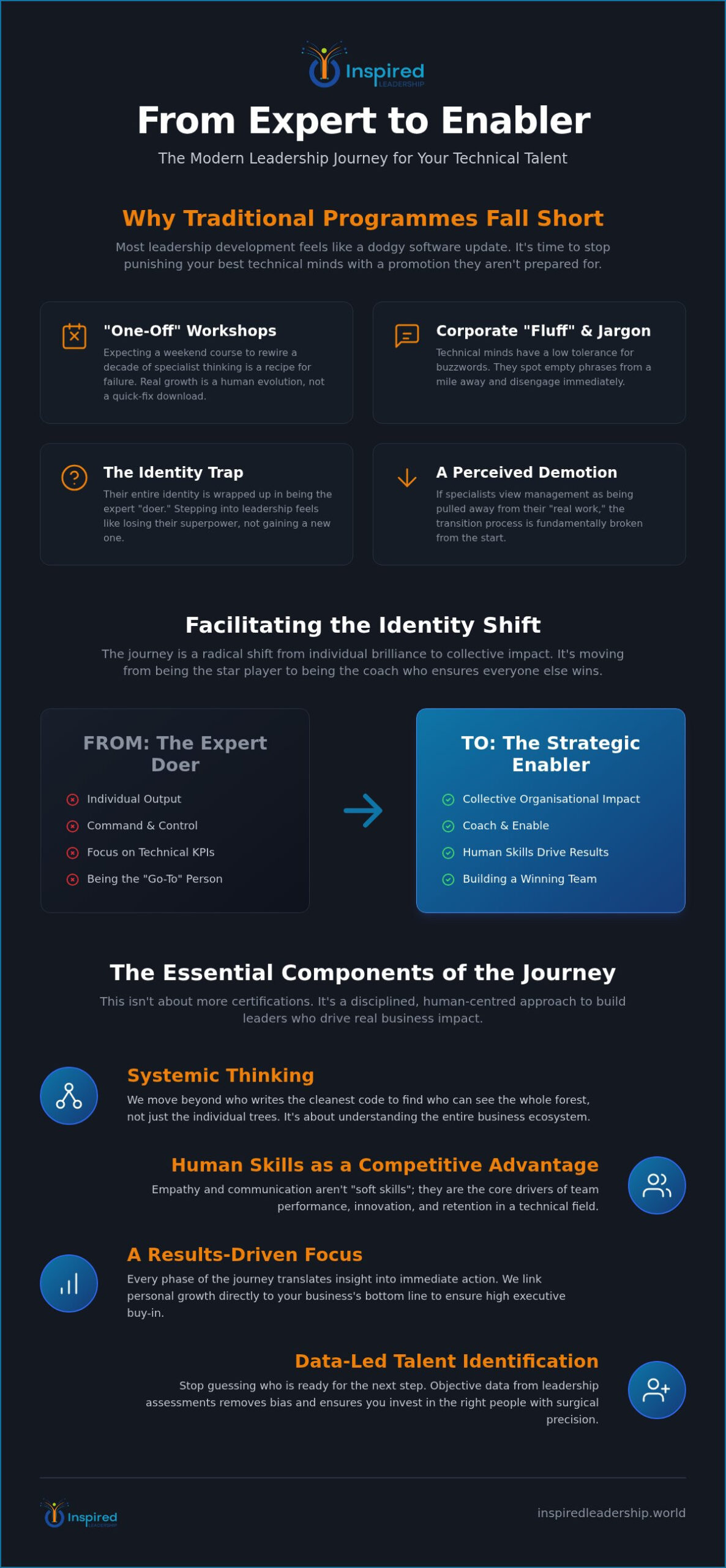
Most organisations treat leadership development like a routine software patch. They expect a one-off workshop to magically rewire a brain that has spent a decade valuing logic, syntax, and individual output. Real growth is a human evolution, not a quick-fix download.
If your specialists view management as a “demotion” from their real work, your transition process is likely broken. You’ve probably noticed that many technical experts feel they are being pulled away from what they love. A high potential technical talent program should be a structured journey that shifts the focus from individual brilliance to collective organisational impact.
Please, stop wasting your budget on generic workshops that your engineers will only mock in the canteen later. They can spot “fluff” from a mile away. A truly effective high potential technical talent program must respect their intelligence and offer practical, battle-tested solutions.
If you want to see where your team currently stands, you might start with a leadership assessment to identify those hidden gaps. This helps you move beyond guessing and into data-driven development.
The Specialist Identity Trap
Your best “doers” often struggle to let go of the keyboard because their entire identity is wrapped up in being the expert. Stepping into leadership feels like losing their superpower. You need to help them navigate the psychological friction of moving from “command and control” to “coach and enable.”
The Problem with Corporate Jargon
Technical minds have a very low tolerance for corporate buzzwords that lack substance. If you start talking about “synergy” or “alignment” without context, they will likely tune out before you’ve finished your sentence. A successful journey uses a no-nonsense, pragmatic approach that prioritises results over empty vocabulary.
Essential Components of a High Potential Technical Talent Journey
A successful high potential technical talent program isn’t about stacking more certifications on an already crowded CV. We need to move beyond identifying who writes the cleanest code and start looking for who can think systemically. It’s about finding the people who see the whole forest, not just the individual trees they’re currently pruning.
Human skills like empathy and communication are your real competitive advantages in a technical field. Whilst another Python certification is nice, it won’t help a lead engineer navigate the identity crisis of no longer being the “smartest person in the room.” We prioritise these human factors because they drive the hard results that actually matter to your organisation.
A results-driven high potential technical talent program ensures that every phase of the journey translates insight into immediate action. We link personal growth directly to your business’s bottom line to ensure executive buy-in remains high. If the development doesn’t solve a real-world business friction point, it’s just an expensive hobby for your HR department.
Building Leadership Capability at Scale
Medium-sized enterprises don’t need the bloated, generic processes used by global conglomerates. You need a lean, impactful approach that respects your specialists’ time and your budget. After completing the initial transition, many of our clients move their teams onto a Manager to Leader Journey to further refine their strategic influence.
The Role of Leadership Assessment
Stop guessing which expert is ready for the next step based on a gut feeling or tenure. Objective data is the only way to identify future leaders with surgical precision. Starting with a structured Leadership Assessment removes bias and ensures you are investing in the right people. If you want to stop the guesswork and start building a real pipeline, you can book a call to discuss your talent strategy.
Overcoming the Expert to Leader Friction Point
The transition from specialist to leader is often where a high potential technical talent program succeeds or fails. It requires a fundamental shift from a “command and control” style to one that focuses on “coach and enable.” You are moving from being the star player to being the coach who ensures everyone else wins.
You need to help your specialists understand that their value no longer comes from their own keyboard. This can be a scary prospect, particularly the fear of losing technical relevance in an industry that evolves every ten minutes. We teach leaders how to maintain their edge whilst prioritising the collective output of their team over their individual contributions.
Owning the result doesn’t mean doing the work yourself. It means creating a framework where you can “own the output” without micromanaging the process into the ground. It is a delicate balance of maintaining quality control whilst giving your team the space to actually do their jobs.
Developing an Ownership Mindset
A true technical leader owns their team’s behaviour and results, not just the technical specifications. This means stepping up when things go wrong instead of hiding behind a Jira ticket. Practical delegation involves setting clear standards and systemic checks so you can let go of the “doing” without losing sleep over the quality.
Human Factors in Technical Teams
We need to stop using the term “soft skills” because they are actually the hardest skills your leaders will ever master. Debugging a complex server is simple compared to navigating the nuances of human emotion and team dynamics. For those ready for deep behavioural change, the Human Factor Journey provides the tools to manage these complexities with confidence.
Implementing a Results-Driven Journey for Your Organisation
Moving from theory to practice requires a structured, systemic approach that respects the complexity of your business. Implementing a high potential technical talent program isn’t a “set and forget” task that you can delegate to a generic training provider. It requires a deliberate strategy that starts with identifying your future leaders using criteria that go far beyond their technical KPIs.
To ensure your investment delivers a genuine return, follow these four critical steps:
- Identify potential: Look for individuals who demonstrate systemic thinking and a natural curiosity about the “human factor” behind the code.
- Strategic alignment: Ensure the development path is directly linked to your medium-term business strategy so the skills learned are immediately relevant.
- Expert partnership: Work with a guide who understands the “Specialist Trap” and provides a battle-tested alternative to traditional, fluffy training.
- Measure impact: Focus on long-term behavioural changes and employee retention rates rather than superficial feedback forms or “smile sheets.”
In niche technical fields like quantitative finance, identifying this level of talent requires deep market insight. Consulting with specialists like QNT Partners can provide the advisory needed to ensure your leadership pipeline is populated with individuals who possess both the technical mastery and the potential for strategic impact.
One-size-fits-all journeys from massive global consultancies often fall flat because they lack the agility your business needs. You require a personal, direct partnership with someone who understands your specific organisational culture and the unique pressures your specialists face daily. A bespoke approach ensures that every conversation is grounded in your reality, not a generic corporate template.
Taking the Next Step
Take a moment to look at your current talent pipeline and identify exactly where the “leaks” are occurring. If you are tired of seeing your best technical minds struggle in leadership roles, it is time to offer them a more human-centred path to success. You can build a leadership culture that values expertise whilst demanding strategic impact.
Secure Your Organisation’s Technical Future
You now understand why generic leadership training usually ends up being mocked in the canteen. By focusing on systemic thinking and the human factor, you can finally bridge the gap between deep technical expertise and impactful strategic influence. It isn’t about changing who your people are, but about expanding what they are capable of achieving for the collective team.
Our high potential technical talent program offers a results-driven alternative that respects the specialist’s identity whilst driving measurable organisational growth. With 20 years of corporate expertise, we specialise in helping medium-sized enterprises turn raw potential into lasting leadership impact. We don’t do “fluff” because we know your engineers won’t stand for it.
It is time to stop guessing and start building a sustainable pipeline of leaders who truly own their results. You can transform your brilliant experts into strategic enablers without losing the technical edge that makes them so valuable to your business.
You already have the talent; now let’s give them the journey they actually deserve to lead your business forward.
Frequently Asked Questions
What is the difference between a leadership program and a leadership journey?
A program is usually a static event that ends when the workshop finishes, whilst a journey is a continuous evolution. We don’t believe in box-ticking exercises that lack long-term impact. A journey focuses on deep behavioural change and systemic thinking, treating your development as a process of growth rather than a one-off software update that everyone forgets by Monday.
How do you identify high potential in technical employees who don’t want to manage people?
You should look for systemic influence instead of just a desire for a fancy manager title. High potential often shows up in those who naturally guide technical strategy or mentor their peers without being asked. Our high potential technical talent program identifies these “enablers” who can drive massive organisational output through their technical leadership whilst keeping their hands on the tools.
Can you really teach “human skills” to a technical specialist?
Absolutely, because human skills are essentially just another complex system to be mastered. Technical minds often thrive when you explain the mechanics of empathy and communication using logic rather than “fluffy” corporate jargon. Once they understand the underlying “code” of human interaction, they can apply their analytical strengths to debug team dynamics and lead with genuine confidence.
How long does a high potential technical talent journey typically take to show results?
You’ll notice mindset shifts almost immediately, but measurable behavioural changes usually take between three and six months to fully bed in. A high potential technical talent program is a marathon, not a sprint; real results emerge when your specialists start owning their team’s output and delegating tasks effectively. This timeline ensures the transformation is sustainable and doesn’t just fizzle out.
Why do technical experts often struggle with the transition to leadership?
They struggle because their identity is usually wrapped up in being the “expert” who solves the hard problems. Stepping into leadership can feel like losing their superpowers and becoming technically irrelevant. Without a structured journey to help them move from “doing” to “enabling,” they often fall into the trap of micromanagement; they must learn that their value now comes from team success.