
The very expertise that secured your promotion is now the biggest obstacle standing in your way. You’ve likely spent years perfecting your craft, only to find that the specialist to leader transition feels like falling into a technical-shaped hole. It’s frustrating to feel like a bit of a fraud whilst your team looks to you for a vision you’re still defining.
You probably want to jump in and fix every technical glitch yourself because it’s easier than managing personalities. We understand this shift is jarring, but you don’t have to lose your professional soul to lead effectively. This article will show you how to navigate the shift from technical expert to people leader without losing your sanity or your hard-earned respect.
We’ll explore a framework to help you stop “doing” and start “enabling,” which is vital since job skill sets are projected to double by 2027. You’ll learn to measure value through team success rather than tangible outputs. It’s time to trade your toolkit for a compass and lead with the confidence you actually deserve.
Key Takeaways
- Understand why being the smartest person in the room is your new biggest liability and how to gracefully step back from the tools.
- Discover a clear framework to navigate the specialist to leader transition so you can stop fixing every technical fire and start leading the people who do.
- Learn why “soft skills” are actually the most difficult to master and how to prioritise human behaviour over rigid systems.
- Find out why one-off training workshops are a total waste of money and why a structured leadership journey is the only way to make your new role sustainable.
The expert’s paradox: Why your technical brilliance might hinder your leadership
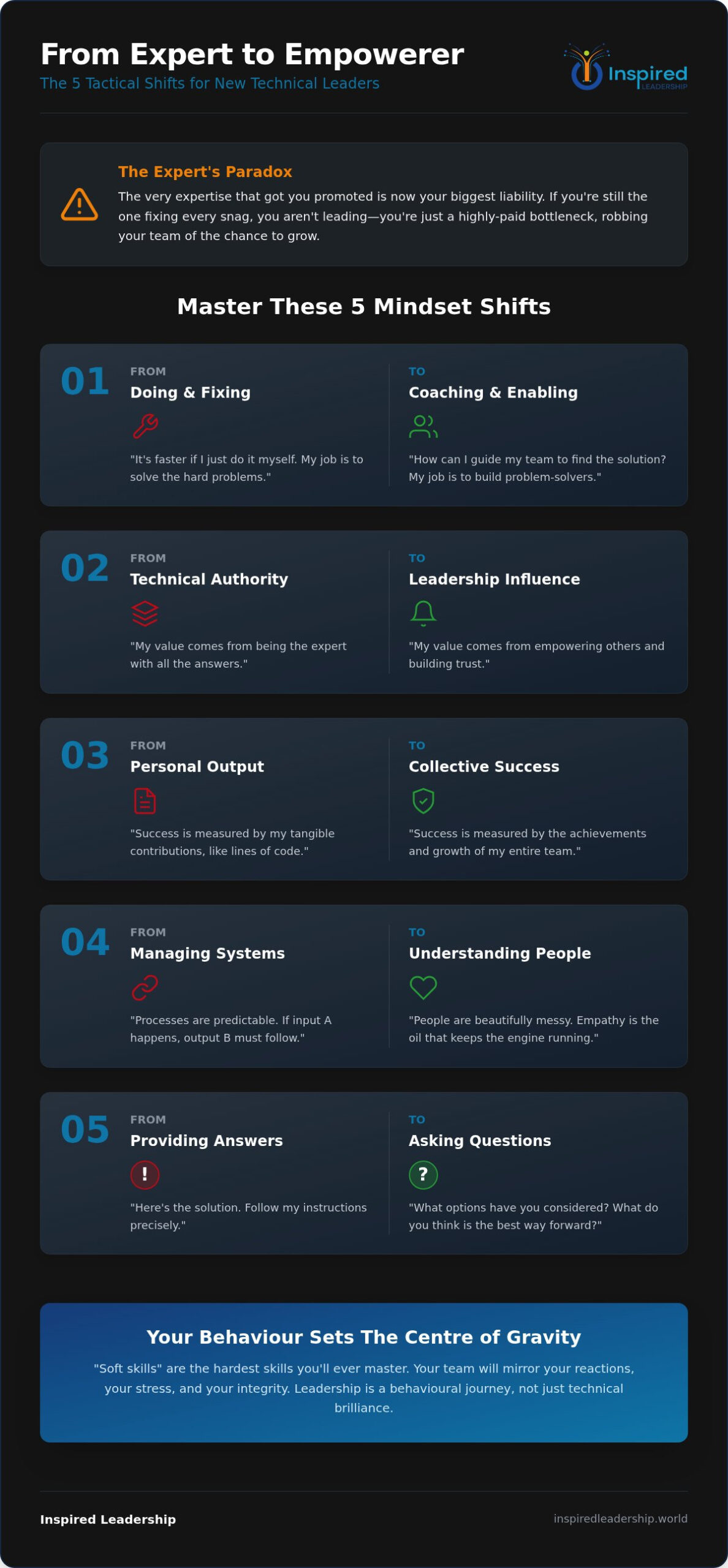
The specialist to leader transition isn’t just a shiny new title on your LinkedIn profile; it’s a complete psychological overhaul. You’ve spent decades becoming the “go-to” person for answers, but now, that very expertise is your biggest liability. If you’re still the one fixing every technical snag, you aren’t leading; you’re just a highly-paid bottleneck.
The behaviours that made you a top specialist, specifically fixing, doing, and knowing, are exactly what you must now delegate. It feels counterintuitive to step back when you know you could solve a problem in five minutes. However, staying in the “doing” phase keeps you stuck in the Expert’s Trap, where your team never learns to function without you.
Why being the best ‘fixer’ makes you a vulnerable leader
It’s incredibly tempting to dive into the trenches when a technical fire breaks out. You know exactly how to solve it, and frankly, you’ll do it faster than anyone else. Every time you grab the tools, you rob your team of the chance to grow and solve problems independently.
This creates a dangerous dependency where your team stops thinking because they know you’ll eventually intervene. Real influence comes from guiding others to find the solution, rather than being the human search engine for your department. Technical authority is about what you know, but leadership influence is about how you empower others to know it too.
The identity crisis of the newly minted manager
Many experts feel like a fraud during this shift because their old metrics of success, like lines of code or designs finalised, have vanished. You might worry that by stepping away from the “doing,” you’re losing your professional edge. It helps to ground yourself in core leadership development principles to understand that your value has simply evolved.
Your transition is an evolution of value from your personal output to the collective success of your team. This shift is the foundation of our manager to leader journey. Embracing this new identity allows you to master the specialist to leader transition whilst maintaining professional respect.
The human factor of moving from specialist to leader
Moving from code to people is like switching from a predictable operating system to one that updates randomly and speaks in riddles. You’ve likely spent years mastering systems where input A leads to output B, but humans simply don’t work like logic gates. During the specialist to leader transition, your focus must shift from the processes themselves to the complex individuals who operate them.
We often call them “soft skills,” but for a technical mind, they are the hardest skills you’ll ever master. Leadership is a behavioural journey that demands constant self-awareness because your team will mirror your reactions, your stress, and your integrity. Your behaviour sets the centre of gravity for the entire team’s culture; if you’re frazzled and reactive, they will be too.
Translating technical insight into leadership action
Your technical expertise doesn’t disappear; it just needs a new job description. Instead of providing the answers, use your deep knowledge to ask the kind of piercing questions that help your team find their own way. This is a core part of The Human Factor Journey, where we help experts pivot their focus.
By making these tactical shifts for new leaders, you move from being the smartest person in the room to being the most supportive. It’s about enabling others to shine whilst you provide the safety net. If you’re feeling stuck in the technical weeds, feel free to reach out for a chat about your next steps.
Managing the ‘messy’ side of people leadership
Accepting that people are beautifully messy and unpredictable is the first step toward genuine success in your specialist to leader transition. Empathy and compassion aren’t just “nice to have” traits; they are the oil that keeps a high-performing team from grinding to a halt. This focus on growth and finding meaning in leadership is central to the work of David James Rhodes, who explores the concept of ‘human becoming’. When you prioritise the person over the process, you build a level of trust that no technical manual can ever replicate.
Alright, let’s get practical before you accidentally automate your team out of a job or drive yourself into a technical breakdown. The specialist to leader transition requires you to put down the screwdriver and pick up the blueprint. You’re no longer the star player; you’re the coach who makes sure the star players don’t trip over their own laces.
To survive this shift, you need a framework that moves you from “doing” to “empowering.” Here are the five tactical shifts to keep your sanity intact:
- Stop fixing, start asking: Use your expertise to guide, not to dictate.
- Measure outcomes, not hours: Focus on what was achieved, not how many tickets were closed.
- Delegate for growth: Give tasks away to build your team’s skills, not just to clear your desk.
- Zoom out: Spend more time on strategy and less on syntax.
- Embrace the “mess”: Accept that people need more maintenance than servers do.
From ‘How do I fix this?’ to ‘How do they learn this?’
If you keep fixing every error yourself, you aren’t being helpful; you’re being a hover-manager. Delegation isn’t a task-dumping exercise for the bits of the job you hate. It’s a development tool that turns your team into experts in their own right, which is exactly what we tackle in our manager to leader journey.
Mastering the shift from output to outcome
Your success is no longer about your personal output, so stop checking your individual stats like a teenager on TikTok. In 2026, performance management is about collective impact and alignment with organisational purpose. You’ll know you’ve mastered the specialist to leader transition when your team’s collective results outweigh anything you could have produced alone.
Building a leadership pipeline that actually delivers results
Stop treating leadership like a software update you can install in a single afternoon. One-off workshops are the corporate equivalent of a New Year’s resolution that dies by January 3rd; they offer a temporary spark but lack the structure to sustain real change. A successful specialist to leader transition requires a methodical journey that translates raw technical talent into strategic influence over months.
Our High-Potential Technical Talent Journey is the gold standard for medium enterprises looking to build this internal muscle. It moves beyond the superficial checklists found in typical training to focus on measurable transformation and genuine behavioural change. By investing in a long-term development path, you ensure your experts don’t just survive their new roles but actually thrive in them.
Why medium enterprises need a bespoke leadership approach
Medium-sized organisations often fall into the “corporate suit” trap by adopting rigid, soul-crushing management styles that kill the very innovation that got them there. You need a results-driven approach that fosters an ownership mindset whilst maintaining the agility of a growing business. This bespoke method ensures your leaders remain human and accessible even as the organisation reaches new heights.
Your next steps on the leadership journey
To navigate these complexities, many organisations explore Fractional CTO options to secure high-level strategic guidance and execution support without the commitment of a full-time hire.
The first step is admitting that you don’t have all the answers, which is quite a leap for a former specialist. We recommend taking our Leadership Assessment to identify exactly where you are on your path. It provides a clear, data-backed starting point for your personal evolution from expert to enabler.
Once you have your results, you can see which path fits your specific needs. We encourage you to download the brochure for our High-Potential Technical Talent Journey to see how we bridge the gap between technical brilliance and leadership mastery. Please get in touch to start your own specialist to leader transition and build a pipeline that delivers genuine results.
Mastering your evolution from expert to enabler
Your specialist to leader transition is less about gaining a new title and more about shedding an old skin. You’ve discovered that your technical brilliance is now a tool for empowering others rather than a solo performance. By focusing on the human factor and mastering those tactical shifts, you can finally escape the Expert’s Trap for good.
We provide a results-driven alternative to those dusty, one-off workshops, backed by 20 years of battle-tested corporate experience. Our specialised journeys for technical talent are designed to ensure your professional identity evolves whilst maintaining the high standards you’ve always set for yourself.
You already have the hard-earned technical respect of your peers; now it’s time to build the leadership influence that makes your entire team unstoppable. It’s a significant step into a new way of working, but we know you’re more than ready to lead the way.
Frequently Asked Questions
How do I know if I am ready to move from specialist to leader?
You’re ready when you find more satisfaction in solving team bottlenecks than in fixing individual technical bugs. It’s about a shift in interest from “how do I do this?” to “how do I help them do this better?”. If you’re starting to see the bigger organisational picture and want to influence it, you’re likely on the right track for a specialist to leader transition.
Can I still be involved in technical work once I become a manager?
Yes, but your involvement must change from “the doer” to “the reviewer” or “the mentor.” You can’t spend 40 hours a week in the weeds whilst also leading a team effectively. If you keep your hands on the tools too often, you’ll become a bottleneck and stall your team’s growth whilst neglecting your architectural guidance duties.
What are the most common mistakes experts make when they start leading teams?
The biggest blunder is trying to be the “super-specialist” who saves the day every time a technical deadline looms. This disempowers your team and leads to a cycle of dependency that is incredibly hard to break. Other mistakes include avoiding difficult conversations or assuming that everyone thinks with the same technical logic you do because humans aren’t predictable code.
How long does a typical specialist to leader journey take to see results?
You’ll start noticing shifts in your mindset within weeks, but a full behavioural transformation usually takes several months of consistent practice. We don’t do one-off workshops because they simply don’t stick; real change requires a structured journey of application and reflection. By the six-month mark, most leaders feel a significant increase in confidence and team alignment during their specialist to leader transition.
What happens if I realise that people leadership isn’t for me?
It’s perfectly okay to decide that the management track isn’t your cup of tea. Recognising this early prevents burnout and allows you to pivot back to a high-level individual contributor role or a “Principal” specialist position. There is immense value in being a master of your craft without the burden of people management, and our leadership assessments can help you find that clarity.