
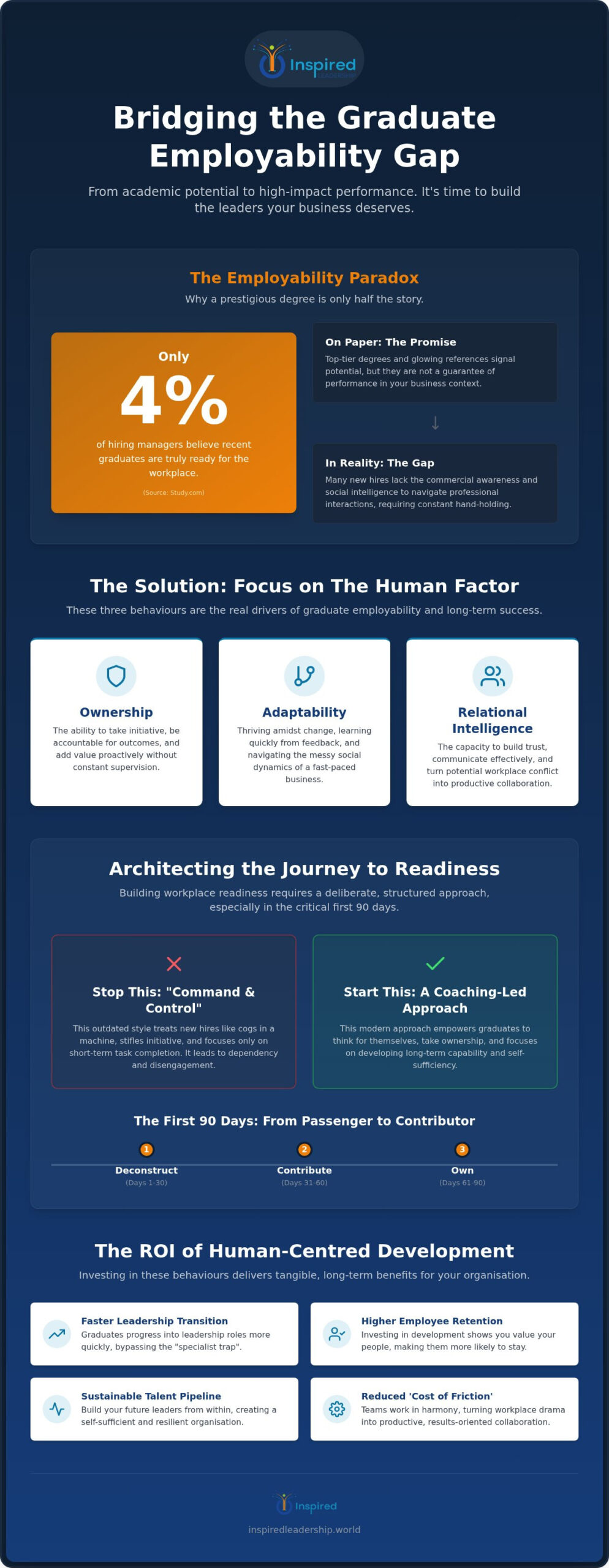
Did you know that only 4% of hiring managers believe most recent graduates are actually ready for the workplace? It’s a staggering figure from Study.com that highlights the massive gap in graduate employability facing businesses today. You’ve likely felt the sting of hiring a “star” candidate only to find they need constant hand-holding to navigate basic professional interactions.
It’s exhausting when your new hires have the technical skills but lack the human-centred leadership needed to actually get things done. I’m here to show you how to stop wasting resources on revolving-door talent and start building a self-sufficient cohort. You’ll discover how to transform raw potential into high-impact leadership through a strategic, human-centred approach to workplace readiness.
We’ll explore a clear framework for transitioning your graduates into first-line managers whilst drastically improving the ROI on your recruitment efforts. To help you find the right talent to begin this process, check out BlueBridge Group Placement Corp. I’ll show you how to move beyond basic training to focus on the human factor that drives real results. It’s time to turn your entry-level hires into the future architects of your organisation’s success.
Key Takeaways
- Learn why a prestigious degree is only half the battle and how to define readiness through social intelligence and organisational alignment.
- Identify the three “human factor” behaviours, including ownership and adaptability, that are the real drivers of graduate employability in your team.
- Discover how a coaching-led approach during the first 90 days of a graduate’s journey can eliminate the need for constant hand-holding.
- Build a sustainable talent pipeline that helps early-career hires bypass the “specialist trap” and transition smoothly into leadership roles.
The Employability Paradox: Why Degree Rankings are Only Half the Story
You’ve seen the CVs. Triple-first from a top university, glowing references, and enough extracurriculars to make anyone feel lazy. Yet, when they walk through your door, they’re often like a deer in headlights.
True graduate employability isn’t just a certificate; it’s the intersection of technical competence, social intelligence, and organisational alignment. When understanding employability, we must look at how an individual translates their knowledge into your specific business context. A top-tier degree is a signal of potential, but it’s rarely a guarantee of performance.
The Gap Between Academic Success and Corporate Reality
In a medium-sized organisation, you don’t have the luxury of a two-year “finding yourself” period; you need graduates who can add value and take ownership almost immediately. Whilst global giants rely on rigid, slow-moving schemes, your agility is actually your secret weapon for success. It allows you to integrate fresh talent into the heart of your operations much faster than the corporate behemoths.
Traditional recruitment often fails to boost graduate employability because it prioritises credentials over the “human” qualities that actually drive long-term impact. It’s time to stop hunting for ready-made leaders who don’t exist in the wild. Instead, you must focus on the human factor and start building the leaders your business deserves.
The Human Factor: Identifying the Behaviours That Drive Performance
You can’t code empathy or automate curiosity. These “human skills” have become the new strategic competitive advantage for any SME looking to boost graduate employability in a crowded market.
Traditional recruitment rubrics often obsess over grades but ignore the behaviours that actually move the needle. To truly improve the impact of your new hires, you must look for three specific markers: ownership, adaptability, and relational intelligence. These traits determine whether a hire will sink or swim when the initial “honeymoon phase” of the role ends.
The Human Factor Journey helps you bridge this specific gap by moving beyond the CV and focusing on real-world impact. It’s about giving your graduates the tools to handle the complexities of human interaction with confidence.
Moving Beyond the ‘Soft Skills’ Misnomer
Let’s stop calling them “soft skills” once and for all. They are actually the hardest skills to master and are the most valuable assets a new hire can bring to your organisation.
The ROI of Behavioural Development
Investing in these behaviours isn’t just a “nice-to-have” exercise for your HR department. Research shows that graduates with high relational intelligence stay longer and progress into leadership roles much faster than their technically-inclined peers.
Behavioural alignment reduces the “cost of friction” by ensuring your team works in harmony rather than constant conflict. It turns potential workplace drama into productive, results-oriented collaboration.
If you are ready to see how these behaviours can transform your specific team, you can start a conversation with us today to explore what’s possible.
Architecting the Journey: How to Build Workplace Readiness
So, you’ve hired your graduate. Now what? Building graduate employability isn’t a passive process that happens by osmosis; it requires you to be a pragmatic architect of their development.
Ditch the “command and control” style that treats new hires like robots. Instead, adopt a coaching-led approach that focuses on long-term sustainability rather than just ticking off this week’s task list.
The First 90 Days: From Passenger to Contributor
The first three months are the make-or-break period for workplace readiness. Start by defining what “good” looks like in terms of behaviour, such as showing up with solutions rather than just problems.
Implement a structured feedback loop that prioritises the “how” over the “what”. If they hit their targets but leave a trail of social destruction in their wake, they aren’t truly employable in a team setting.
Creating a Culture of Ownership
You want a contributor, not a passenger. Boosting graduate employability means encouraging “thought leadership” early on by asking for their perspective on internal processes.
This fosters a sense of belonging and sparks innovation. A well-structured approach to early career development ensures your graduates move from passive observers to proactive contributors who own their results from day one. Use this checklist to assess progress beyond technical KPIs:
- Do they take ownership of mistakes without prompting?
- Are they actively seeking out relational intelligence?
- Can they adapt when a project scope changes suddenly?
Book a call to architect your graduate journey
From Graduate to Leader: Securing Your Talent Pipeline
Improving graduate employability isn’t just about making sure your new hires don’t set the office on fire in their first week. The real prize is architecting a pipeline that transforms raw potential into your next generation of first-line managers. By focusing on long-term development, you’re securing the intellectual capital of your business.
You must avoid the ‘Specialist-to-Leader’ trap, which involves promoting your best technical graduate into a leadership role they simply aren’t prepared for. This classic blunder often results in a ‘double loss’ where you lose a brilliant specialist and gain a frustrated, ineffective manager. It’s a lose-lose situation that you can easily avoid with the right foresight.
A structured Emerging Leader Journey for high-potential graduates ensures they develop the social and strategic muscles required before they take on formal authority. It’s about building resilience now so your organisation doesn’t buckle under pressure later. You’re not just filling a role; you’re future-proofing your leadership team.
Identifying High-Potential Technical Talent Early
The Strategic Advantage of Internal Promotion
Promoting from within your graduate pool is a massive win because these individuals already live and breathe your company culture. They’ve grown with you, meaning they’ll hit the ground running as leaders far faster than an external hire who is still figuring out where the good coffee is kept. It builds a sense of loyalty that money simply can’t buy.
If you have graduates ready to take that leap from individual contributor to authority figure, direct them toward our Manager to Leader Journey. Investing in graduate employability through leadership development today is quite simply the smartest way to secure the future of your business.
Transforming Potential into Performance
You’ve seen how degree rankings are just the starting line. True graduate employability is built through the human factor, focusing on ownership and relational intelligence rather than just technical tick-boxes. It’s about moving from a “wait and see” mindset to becoming a proactive contributor who truly understands the business.
By architecting a deliberate 90-day journey, you stop the exhausting cycle of constant hand-holding and start building a resilient talent pipeline. With over 20 years of experience, we’ve seen how this transition secures the long-term success of medium-sized enterprises. You don’t have to navigate this cultural shift on your own.
Your graduates have the raw talent, and now you have the pragmatic framework to polish it into high-impact leadership. It’s time to stop hunting for mythical ready-made leaders in the wild and start building them from within. You’ve got this, and your future managers will definitely thank you for the investment.
Frequently Asked Questions
What is the difference between graduate skills and graduate employability?
How can SMEs compete with large corporations for employable graduates?
You can’t outspend global giants on salaries, but you can definitely out-manoeuvre them on impact and agility. SMEs offer graduates the chance to own significant projects and see their influence on the business almost immediately, whilst big corporates often treat early talent like cogs in a machine. By positioning your organisation as a place for genuine leadership growth, you’ll attract the high-potential talent you need.
Is it worth investing in leadership training for graduates who might leave?
Investing in a leadership journey is always worth the effort because the cost of an unskilled, disengaged employee is far higher than the cost of development. Even if a graduate eventually moves on, the high-impact work they produce whilst they’re with you will far outweigh the initial investment. Plus, a reputation for building leaders makes you a magnet for more top-tier talent, which naturally improves your long-term recruitment ROI.
What are the most important human skills for graduates in 2026?
The most critical human skills for 2026 are ownership, adaptability, and relational intelligence. As AI handles more technical tasks, the ability to navigate difficult conversations and pivot during a crisis becomes your graduate’s primary value, unless you enjoy awkward silences in boardrooms. When graduates use LYNKP to build a digital career identity, they can more effectively demonstrate these behaviours and handle the human factor that actually drives performance.
How do we measure the success of a graduate development journey?
You should measure success by looking at speed to contribution and the rate of progression into first-line management roles. A successful graduate employability strategy reduces the resource burden of “hand-holding” and increases the ROI on your recruitment efforts. For a deeper look at how to structure this process end-to-end, explore our graduate recruitment and development strategic guide. Look for tangible markers, like how quickly a graduate takes ownership of their mistakes and leads projects without constant oversight.