

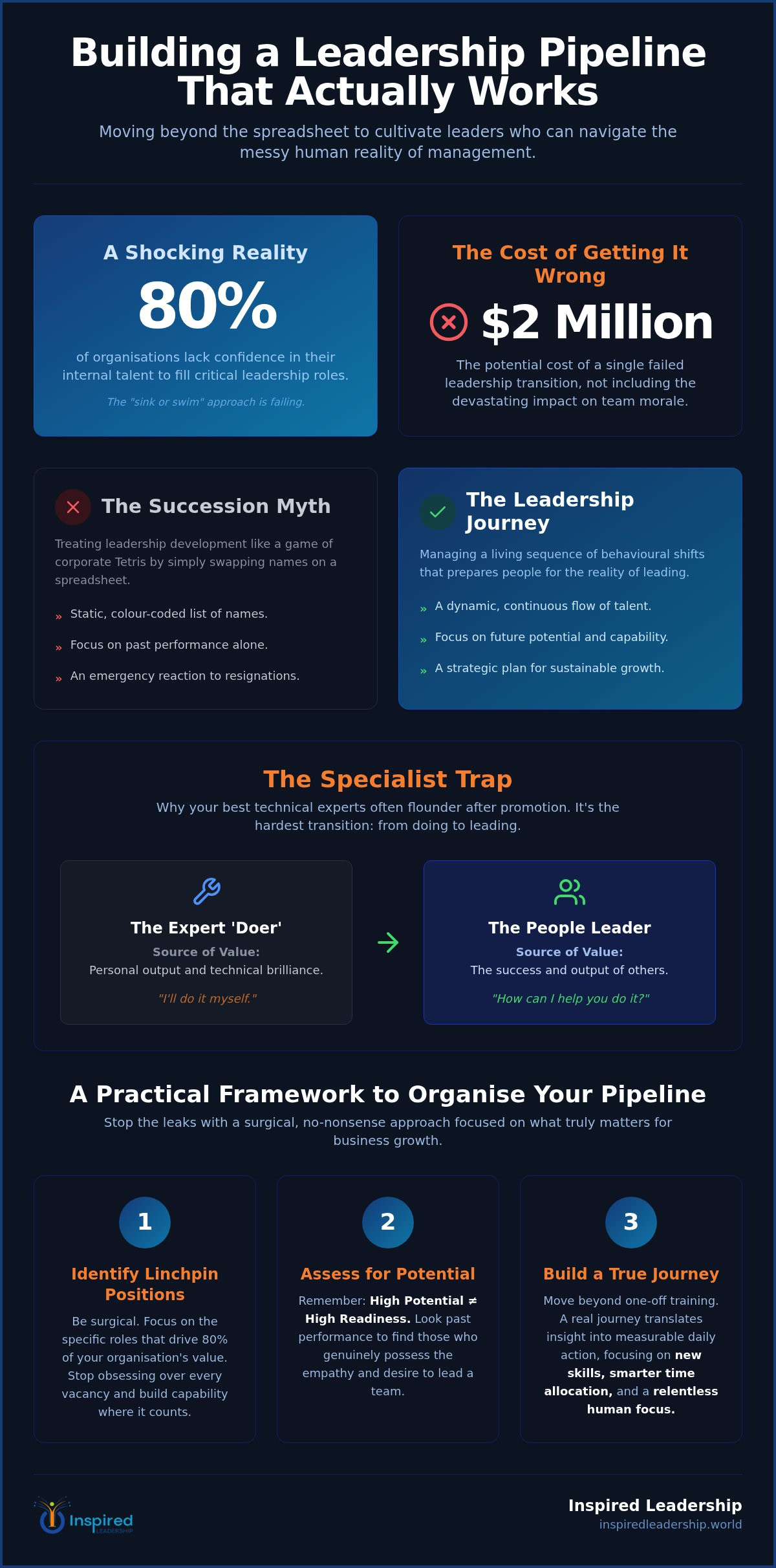
Your top performer just handed in their notice three months after a promotion, and frankly, it’s because you treated a name on a spreadsheet as a strategy. Building a leadership pipeline is not about identifying who looks good in a suit; it’s about managing the messy human transitions that traditional training ignores. When 80% of organisations lack confidence in their internal talent, the “sink or swim” approach is just a very expensive way to drown.
You likely feel the frustration of watching high-potential talent struggle with people management whilst growth stalls due to leadership gaps. We’ll move past static succession lists to discover how to transform your approach into a dynamic leadership journey that sticks. You’ll learn how to stop the “specialist trap” and cultivate managers who truly own their results.
We’ll explore why your strategy is leaking and identify the friction points that cause high performers to quit. This guide focuses on reducing hiring costs and building a sustainable bench of ready-now leaders. It’s time to stop crossing your fingers and start building a pipeline that actually delivers.
Key Takeaways
- Stop confusing a static list of names with a real talent strategy. You will learn to treat your pipeline as a living sequence of behavioural shifts that prepares people for the actual reality of leading.
- Discover why your best technical experts often flounder after a promotion and how building a leadership pipeline helps them bridge the gap between “doing” and “leading.”
- Learn a no-nonsense framework to identify your organisation’s linchpin positions and map out the specific journeys required to fill them without the corporate fluff.
- Move beyond traditional training that never sticks by focusing on results-driven journeys that translate leadership insight into measurable daily action.
The Succession Myth: Why a List of Names is Not a Pipeline
Most leaders think a Succession planning strategy is just a colour-coded spreadsheet tucked away in a dusty HR folder. It isn’t. Building a leadership pipeline is actually about managing a living, breathing sequence of behavioural shifts. If you’re just swapping names into boxes, you aren’t strategising; you’re just playing a corporate version of Tetris.
Moving Beyond the Spreadsheet Mentality
This shift requires you to look for potential rather than just past performance. A leadership assessment can help you see past the spreadsheet to find the people who can actually lead. You want to build a system that is ready for future needs, not one that is constantly playing catch-up with the present.
The Cost of Getting it Wrong
Promoting someone just because they are “next in line” is a recipe for a very expensive disaster. Research shows that a failed leadership transition can cost an organisation up to $2 million. Beyond the eye-watering financial loss, the ripple effect on team morale is devastating when a manager fails to lead effectively.
It’s much kinder to develop someone properly through a dedicated leadership journey than to set them up for a public fall. You need to build capability at scale rather than just plugging holes in the hull as they appear. Real growth happens when building a leadership pipeline becomes a continuous flow, not an emergency reaction to a sudden resignation letter.
The Specialist Trap: Why Your Best Experts Often Fail as Managers
You’ve seen it happen: your star coder or top-billing salesperson gets a shiny new office and suddenly, the team’s productivity tanks. It’s the classic specialist trap. You take your best “doer” and turn them into a mediocre “supervisor” because you mistook technical brilliance for the ability to manage people.
These accidental managers often suffer from a persistent itch to fix every technical problem themselves. They struggle to let go of the tools that made them famous, effectively becoming a bottleneck for their own team. This is where the “Human Factor” becomes the missing link in Leadership Development initiatives.
From Doing to Leading: The First Passage
Transitioning from doing to leading is arguably the hardest passage when building a leadership pipeline. It requires a total shift in how you spend your time and, more importantly, where you find your professional dopamine hits. You have to stop finding value in your own output and start finding it in the success of others.
A successful transition involves mastering three dimensions: new skills, smarter time allocation, and a relentless human focus. Our Manager to Leader Journey provides the structured support experts need to stop being the specialist and start being the catalyst. It’s about moving from “I’ll do it” to “How can I help you do it?”
Why High Potential Does Not Equal High Readiness
High potential is just raw material; it isn’t the same as being ready to lead. Some experts are purely chasing a pay rise, whilst others genuinely possess the empathy required to manage a team. By identifying those who actually want to lead, you are building a leadership pipeline that actually lasts.
If you’re struggling to spot the difference in your team, get in touch to discuss a more disciplined approach to talent identification. It’s much better to have a difficult conversation now than a failed transition later.
A Practical Framework to Organise Your Leadership Pipeline
Step one involves identifying those linchpins, followed by mapping out the specific journeys required for each leadership level. You then make development transparent so everyone knows how to move forward without the guesswork. Finally, you must measure progress through tangible behavioural change rather than just checking off attendance records. Building a leadership pipeline is a continuous process that requires moving from “knowing” to “doing” at every stage.
You can create a healthy bottom-up flow by focusing on your graduates and technical talent long before they reach a leadership crisis. The Emerging Leader Journey is a brilliant starting point for those just stepping into the professional world. It ensures you aren’t just filling slots but building a sustainable foundation that supports the entire organisation as it grows and evolves.
Ensuring Diversity in Your Pipeline
A stale leadership culture is a silent growth killer, so you must actively accelerate diverse talent to keep your perspective fresh. Specific paths like the Ignite Her Leadership Journey help women navigate the unique challenges of stepping into senior roles. This isn’t just about optics; it’s about making sure your pipeline doesn’t miss out on the best ideas because of outdated biases or systemic friction.
Translating Insight into Action: Making the Pipeline Stick
Most traditional training is a waste of time because it lives in the head and never reaches the hands. You don’t need another lecture; you need a way to bridge the gap between knowing what a leader does and actually behaving like one. Building a leadership pipeline requires a focus on results-driven journeys that fundamentally change daily behaviour.
We focus on cultivating an ownership mindset across your entire organisation so people stop waiting for permission and start taking responsibility. It’s about moving away from passive “learning” and into active “owning.” Stop making lists and start building leaders who think for themselves and own their outcomes.
The Role of Leadership Assessment
You cannot fix what you haven’t measured, which is why a Leadership Assessment is so vital. It helps you identify the specific gaps in your current pipeline before you waste money on the wrong development. Self-awareness is the first step in any transformational journey, giving your team the clarity they need to grow.
Your Next Steps to a Robust Pipeline
Ready to stop the leaks? Your next step is to download the brochure for the journey that fits your team’s specific needs, whether that’s for first-line managers or technical talent. We would love to have a direct conversation about your specific organisational friction points and how to resolve them.
Building a leadership pipeline is a deliberate act of architectural change, not a happy accident. Let’s move past the spreadsheets and start creating a legacy of leaders who actually deliver results. Contact us today to begin the transformation.
From Static Lists to Sustainable Success
You’ve likely spent enough time staring at colour-coded spreadsheets that don’t actually solve your talent gaps or stop your best people from leaving. Building a leadership pipeline is a deliberate, human-centred act that moves beyond simply filling vacant slots to cultivating genuine, sustainable capability. It requires moving your high performers through a structured journey that prioritises actual behavioural change over mere attendance records.
With 20 years of corporate expertise, we’ve seen exactly where the leaks happen and how to plug them with results-driven, pragmatic solutions. You can stop the “specialist trap” from draining your productivity by investing in managers who actually know how to lead and inspire their teams. It’s time to stop crossing your fingers and start building a bench of ready-now leaders who truly own their results.
You already have the talent right under your nose; you just need the right framework to let it flourish. Let’s turn your succession plan into a living, breathing reality that drives your organisation forward whilst reducing those eye-watering hiring costs. You’ve got this, and we’re here to help you make it happen.
Frequently Asked Questions
What is a leadership pipeline and why does it matter for my business?
A leadership pipeline is a strategic system for identifying and developing future leaders at every level of your organisation. It matters because it ensures long-term business continuity and reduces the massive costs associated with external executive hiring significantly. This proactive approach transforms your talent strategy into a sustainable engine that keeps your business moving forward steadily.
How do I identify high-potential employees for my leadership pipeline?
Look for individuals who demonstrate learning agility and emotional intelligence rather than just high technical output. High potential is about a “catalyst” mindset and a genuine desire to help others succeed. Using a formal leadership assessment helps you move beyond guesswork to find the quiet stars who are actually ready for a developmental journey.
Why do so many new managers fail during their first year?
Most new managers fail because they are promoted for technical brilliance but lack the support to handle the “Human Factor.” They often fall into the specialist trap, attempting to fix every problem themselves instead of empowering their team. This failure is typically a systemic issue within the organisation’s support structure, not a personal shortcoming of the individual.
What is the difference between succession planning and a leadership pipeline?
Succession planning is typically a static list of names for senior roles, whilst building a leadership pipeline is a continuous, organisation-wide development process. Think of the pipeline as the active flow of talent through various stages of professional growth. It is a living journey that prepares people for behavioural shifts long before they actually step into a new role.
How can I build a leadership pipeline in a medium-sized company with a small budget?
Building a leadership pipeline in a medium-sized company is entirely possible if you focus your limited resources on linchpin roles. You don’t need a massive HR department to implement a results-driven journey for your first-line managers or graduates. Prioritising tangible behavioural change over expensive, one-off workshops creates a sustainable system that eventually pays for itself; to ensure your organisational infrastructure is equally robust, visit BRS Advisory Services for expert HRMS design and compliance support.