

Being the smartest person in the room is your biggest liability when you’re trying to lead. You’ve spent years mastering the stack, yet you find yourself itching to grab the keyboard because it’s “just faster” than explaining the logic. This urge to micromanage is a common trap that stifles your technical leadership skills and leaves you feeling like a bit of a fraud in management meetings.
It’s exhausting to feel like you’re losing your edge whilst failing to bridge the gap with non-technical stakeholders. You want to lead a high-performing team that actually owns its output, but you’re too busy acting as the permanent safety net. Leadership isn’t a promotion; it’s a fundamental identity rewire from expert doer to strategic architect.
In this guide, you’ll learn how to make the essential shift from technical specialist to systemic leader. We’ll explore how to master the human skills that drive organisational results and ensure you’re seen as a vital partner to the executive team. It’s time to stop doing and start leading your own professional journey.
Key Takeaways
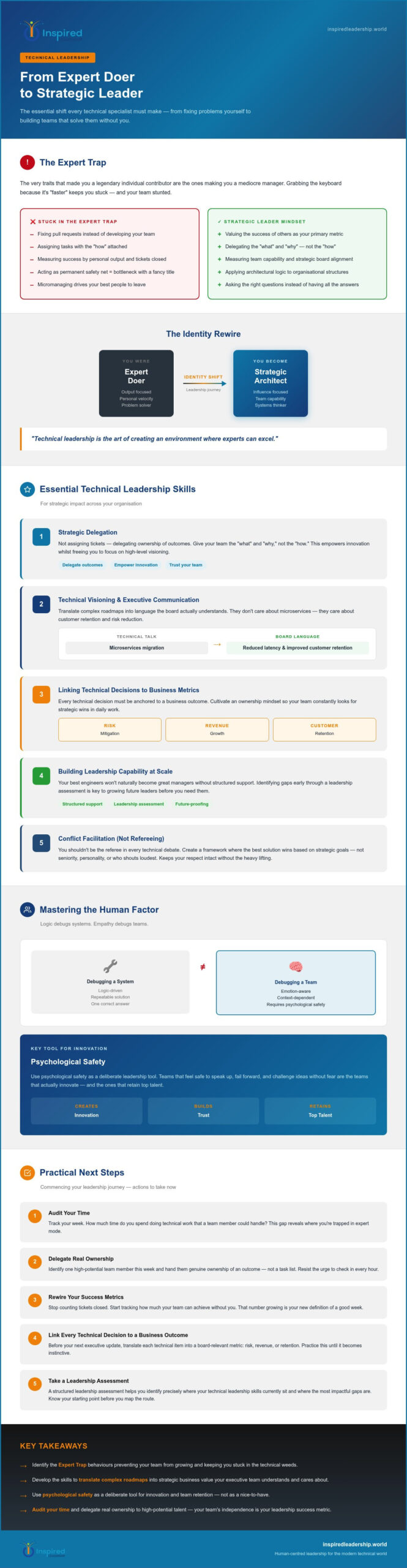
- Identify the “Expert Trap” behaviours that prevent your team from growing and keep you stuck in the technical weeds.
- Develop the technical leadership skills required to translate complex roadmaps into strategic business value that your executive team understands.
- Learn how to use psychological safety as a tool for innovation whilst navigating your team through the Human Factor Journey.
- Take immediate action by auditing your time and delegating real ownership to the high-potential talent in your department.
The Expert Trap: Why Your Best Technical Skills Are Now Your Biggest Liability
You’ve spent years becoming the go-to person for every edge case and architectural nightmare. That’s exactly why you’re currently struggling to lead. The “Expert Trap” is that seductive pull to solve the problem yourself because you can do it in twenty minutes whilst your junior dev would take four hours.
The very traits that made you a legendary individual contributor are the ones making you a mediocre manager. If your team is unorganised because you’re busy fixing their pull requests, you aren’t leading. You’re just a bottleneck with a fancier title and a higher risk of burnout.
Moving from “output” to “influence” is a massive identity shift that feels incredibly weird at first. You need to start valuing the success of others as much as you once valued your own clean code. Refining your technical leadership skills through this evolution is a necessary part of your leadership journey.
The Myth of the Hands-On Leader
There’s a persistent myth that you must be the smartest person in the room to command respect. In reality, if you’re always the smartest, you’ve failed to hire well or you’re micromanaging the life out of your high-potential talent. Constant intervention doesn’t show expertise; it shows a lack of trust that eventually drives your best people to leave.
Your job isn’t to have all the answers anymore. It’s to ask the right questions that lead your team to find those answers themselves. This is a core component of the emerging leader journey, where you learn to let go of the keyboard and trust your people.
Rewiring Your Definition of Success
Stop counting tickets closed and start measuring team capability and strategic alignment with the board. Success is no longer about your personal velocity; it’s about how much the team can achieve without you hovering over them. Developing technical leadership skills means moving from assigning tasks to delegating ownership and outcomes.
Technical leadership is the art of creating an environment where experts can excel.
Essential Technical Leadership Skills for Strategic Impact
Mastering technical leadership skills requires you to stop thinking about code and start thinking about systems. You need to apply your architectural logic to organisational structures, ensuring the right people are in the right places to succeed. This shift allows you to move from being a tactical fixer to a strategic partner who builds sustainable growth.
Strategic delegation is your first hurdle. It’s not about assigning a list of tickets; it’s about delegating the ownership of the final outcome. When you give your team the “what” and the “why” instead of the “how,” you empower them to innovate whilst you focus on high-level visioning.
Technical visioning involves translating your complex roadmap into a language the board actually understands. They don’t care about the intricacies of a microservices migration; they care about how it reduces latency and improves customer retention. If you struggle to find that common ground, you can get in touch with us to discuss how to sharpen your executive communication.
Translating Technical Insight into Business Action
Medium-sized organisations often struggle because they lack a structured approach to developing their future leaders. You can’t just hope that your best engineers will naturally become great managers without the right support. Taking a leadership assessment is a brilliant first step to identifying where your technical leadership skills currently sit.
Conflict resolution amongst experts is another vital skill. You shouldn’t be the referee in a technical debate; honestly, you have better things to do than babysit two seniors arguing over tabs versus spaces. Facilitating a framework where the best solution wins based on strategic goals keeps your professional respect intact without you doing the heavy lifting.
Mastering the Human Factor in Technical Environments
Logic is a beautiful thing when you’re debugging a system, but it’s often useless when you’re debugging a team. Humans are messy, emotional, and prone to “buggy” behaviour that can’t be fixed with a simple patch. The Human Factor Journey serves as the essential bridge between the cold logic of engineering and the nuanced reality of human emotion.
Innovation requires a culture of psychological safety where your team feels safe to fail without being crucified in the next stand-up. If your devs are terrified of making a mistake, they’ll stick to the safest, most boring path possible. Developing your technical leadership skills means building a space where “breaking things” is seen as a data point, not a disaster.
Providing feedback shouldn’t require you to act like a corporate robot programmed in the late nineties. You can be direct and authentic whilst injecting a bit of sass and humour to keep things human. People respect honesty far more than they respect a manager who hides behind HR-approved platitudes.
Empathy as a Pragmatic Business Tool
Advocating for Your Team and Your Vision
Navigating the transition from being “one of the devs” to the person in charge is undeniably awkward. You now have to balance being a supportive mentor with being the person who secures resources from senior leadership. Refining these advocacy skills is a core part of the Manager to Leader Journey, helping you maintain team trust whilst winning board-level battles.
Commencing Your Leadership Journey: Practical Next Steps
Transformation doesn’t happen by accident; it requires a deliberate shift in how you spend your most valuable resource: time. Start by auditing your calendar this week to see exactly how much “doing” you’re still clinging to versus actual leading. If you’re spending more than 70% of your time in the weeds, you’re not refining your technical leadership skills; you’re just a very expensive individual contributor.
Once you’ve identified the gaps, pick one high-potential team member and delegate a significant piece of ownership to them. Don’t just give them a ticket; give them the responsibility for the outcome and the authority to make decisions. This is how you build a team that owns its output whilst you step into your role as a strategic partner.
Stop wasting time on generic workshops that offer nothing but “participation trophies” and zero behavioural change. You need a results-driven alternative that focuses on actual transformation. Download the brochure for our Emerging Leader Journey to see how we map a path that works for your specific technical context.
Moving from Insight to Action
Reading about leadership is a bit like reading about swimming; it’s completely useless until you actually get in the water. Your daily work is the “theatre” where you must practice these new behaviours until they become muscle memory. Finding a mentor or coach who has successfully navigated the technical-to-leader transition can save you years of trial and error.
Future-Proofing Your Technical Career
In the 2026 job market, your ability to lead people will be far more valuable than your ability to lead a tech stack. Technical experts are plentiful, but strategic leaders who can bridge the gap between code and the boardroom are rare. Investing in your technical leadership skills now ensures you remain the most valuable asset in the room.
You don’t have to navigate this transition alone or lose your professional respect in the process. We’re here to help you bridge the gap between technical expertise and strategic leadership. You’ve got the brilliance; now let’s build the leadership engine to match.
Frequently Asked Questions
What are the most important technical leadership skills to develop first?
The most vital skills to master first are strategic delegation, psychological safety, and technical visioning. You must stop solving code bugs and start solving team dynamics to move the needle. Focus on creating an environment where experts can excel rather than trying to be the smartest person in the room. This fundamental shift is a core focus of our High-Potential Technical Talent Journey.
How do I maintain my technical skills whilst moving into a leadership role?
You maintain technical relevance by shifting your focus from execution to architectural oversight and strategic review. You don’t need to write every line of code to understand the system’s integrity or keep your edge. Spend your time reviewing high-level designs and staying curious about industry trends whilst letting your team handle the implementation. This keeps your professional respect intact without you doing all the work.
Can a technical expert become a good leader without an MBA?
Yes, because effective leadership is rooted in understanding human behaviour rather than just memorising business theory. An MBA won’t teach you how to navigate a senior developer’s ego or build trust during a high-pressure sprint. Practical, results-driven alternatives like our leadership journeys focus on the actual theatre of your daily work. You need pragmatic, no-nonsense solutions that translate technical insight into organisational action.
How do I handle technical disagreements within my team as a leader?
You should facilitate a logical framework where the best strategic solution wins rather than acting as a technical referee. Guide your team to evaluate their options based on business value and long-term sustainability instead of personal preference. If they can’t agree, use the moment to coach them on their own technical leadership skills. This approach ensures the team owns the final decision and learns from the process.
What is the difference between technical management and technical leadership?
Management is primarily about process and output, whilst leadership is about people, vision, and influence. A manager ensures the tickets move through the board; a leader ensures the team feels empowered to own those outcomes and innovate. Whilst management keeps the lights on, developing your technical leadership skills is what actually drives transformational change and long-term strategic results for your organisation.