
What if your expensive leadership training is actually just a glorified paperweight? You’ve likely seen the glossy manuals gather dust whilst your managers continue to act like task-obsessed robots rather than actual leaders. Finding the right leadership frameworks for organisational growth isn’t about adding more checklists to an already overflowing plate.
You probably agree that the “command and control” style of the past is about as useful as a chocolate teapot in today’s market. It’s frustrating to watch brilliant technical experts struggle with the human side of the job, or to see middle management dodge accountability at every turn. You want a team that thinks for themselves and owns their results without you having to hover over their shoulders.
This 2026 guide promises to show you how to move beyond rigid corporate boxes and implement leadership journeys that deliver tangible, scalable results for your growing business. We’ll explore how to bridge the gap between internal psychology and external performance. By the end, you’ll have a clear roadmap for building a leadership team that doesn’t just manage tasks but actively drives your organisation forward.
Key Takeaways
- Understand why rigid corporate checklists act as a handbrake and how to implement leadership frameworks for organisational growth that actually breathe.
- Explore the four essential pillars of mindset, ownership, insight, and action that turn a standard training day into a transformative development journey.
- Gain a practical roadmap to help your technical wizards stop doing everyone else’s work and start leading with genuine authority.
- Learn to ditch the useless “Happy Sheets” and use Impact Sheets to prove your leadership spend is actually moving the needle.
Why Traditional Leadership Frameworks Often Stunt Organisational Growth
Most leadership manuals are basically expensive doorstops. They focus on rigid rules and ticking boxes, which is how you end up with a team of “yes-people” who can’t make a decision without a committee meeting. It’s enough to make any sane founder want to scream into a pillow. Beyond internal culture, many founder-led organisations also benefit from the strategic advisory and consulting services of Founded Partners to navigate the complexities of scaling.
Implementing effective leadership frameworks for organisational growth shouldn’t involve a dusty PDF that no one ever reads. It needs to be a living system that breathes with your business. If your framework doesn’t encourage people to actually think, it’s just a set of instructions for robots.
Growth isn’t about stuffing knowledge into people’s heads like you’re packing a suitcase. It’s about a fundamental shift in behaviour and ownership. You don’t need more training; you need people who take responsibility for outcomes.
The Trap of the Checklist Manager
Traditional leadership frameworks for organisational growth often fail because they create managers who follow rules rather than leaders who solve problems. They follow every procedure to the letter but fail when a real human problem walks through the door. This rigid thinking acts as a massive handbrake when you try to scale.
Scaling requires leaders who can navigate ambiguity, not just those who can follow a map. When your business grows but your leadership thinking stays small, you create a friction that burns out your best talent. It’s a recipe for stagnation no “productivity hack” can fix.
Moving Beyond Command and Control
The old “Command and Control” style is dead, or at least it should be. It ignores the “Human Factor”, which is the secret sauce that makes teams actually want to perform. You can’t bully people into being innovative or caring about your KPIs.
To truly liberate your team, you need a Beyond Command Journey that focuses on empowerment. This aligns with the Functional Leadership Model, which prioritises behaviours that contribute to organisational effectiveness. It’s about leading the people, not just managing the tasks.
The Core Pillars of a Scalable Leadership Journey
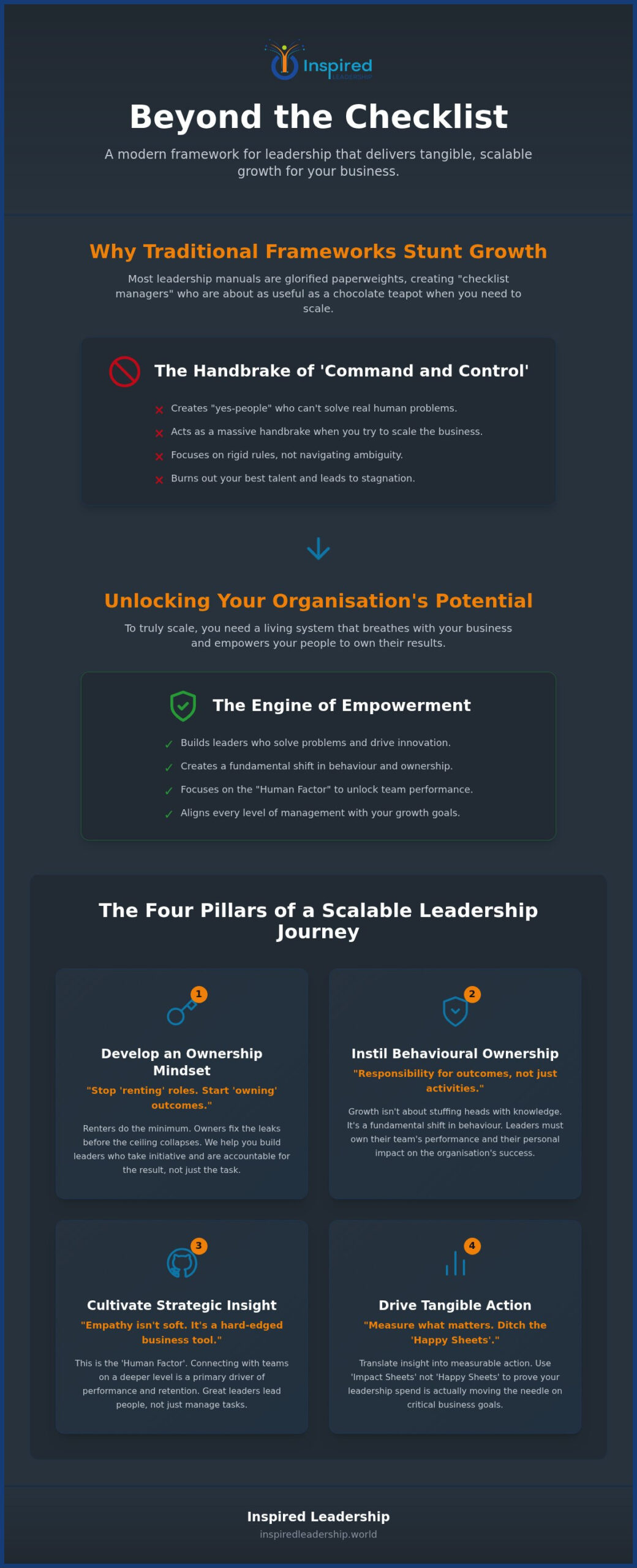
Scaling a business isn’t just about hiring more bodies; it’s about building a leadership engine that doesn’t stall under pressure. Effective leadership frameworks for organisational growth rely on four non-negotiable pillars: Mindset, Behavioural Ownership, Strategic Insight, and Tangible Action. Without these, your development spend is just a donation to the “corporate theatre” fund.
These pillars must be woven into the daily rhythm of your business to ensure they actually stick. When every level of management is aligned with your growth goals, you achieve true leadership at scale. This human-centred approach is a massive competitive advantage in the 2026 talent market where employees are looking for more than just a payslip.
Developing an Ownership Mindset Across the Organisation
For businesses looking to scale through a franchise model, maintaining this alignment across a network is a unique challenge. To see how culture acts as a vital asset in these environments, check out Imagine Franchise for expert insights on network growth.
Think of leadership like property. Some managers “rent” their roles, doing just enough to keep the landlord (you) happy whilst letting the proverbial garden go to seed. You need leaders who “own” the place, people who fix the leaks before the ceiling collapses and actually care about the long-term value of the house.
This mindset shift ensures that your leadership frameworks for organisational growth result in people who own their outputs rather than just their tasks. When a manager owns the outcome, they don’t wait for permission to solve a problem. They just get on with it, which is exactly the kind of initiative that drives scaling businesses forward.
The Human Factor in Strategic Growth
Empathy isn’t just a “nice-to-have” soft skill; it’s a hard-edged business tool. Global research, including studies from South Africa, consistently shows that empathy is a primary driver of employee performance and retention. The Human Factor Journey helps your leaders connect with their teams on a deeper level to unlock this potential.
If you’re tired of renting leadership and want to build a team of genuine owners, let’s chat about your strategy. We can help you move from checklists to real impact.
Empowering the Engine of Growth: First-Line Managers and Technical Experts
Your first-line managers are the actual gears that turn your business strategy into reality. If these gears are grinding, your whole operation slows to a crawl. Often, we take our brilliant technical experts and “promote” them into leadership roles without a single clue on how to handle people.
It’s a classic mistake: you lose your best engineer and gain a mediocre manager who still tries to do everyone’s job. To fix this, you need leadership frameworks for organisational growth that specifically address this transition. Step one is identifying who is actually ready to lead rather than just being the person who shouts the loudest during a server outage.
The Specialist-to-Leader Transition
Moving from “expert” to “leader” is a massive psychological shift that most corporate training completely ignores. It’s about letting go of the tools and picking up the human skills needed to manage former peers. For those in your team ready to make this leap, our Manager to Leader Journey provides the roadmap they’ve been missing.
You need a structured journey that rewards leadership behaviours over technical output. If you keep praising the manager for fixing the code themselves, they’ll never learn to empower their team. It’s time to implement a feedback loop that celebrates coaching, delegation, and strategic thinking instead of just “doing”.
Building Leadership Capability at the Front Line
Your front-line leaders are the most critical link in your growth chain because they touch every part of the employee experience. When they struggle, the whole organisation feels the friction. We encourage you to download the brochure for our First Line Manager journey to see how we build scalable capability that actually sticks.
Effective leadership frameworks for organisational growth don’t just happen by accident. They require a deliberate focus on the human complexities of managing people who used to be your lunch mates. This isn’t just about soft skills; it’s about making sure your business can actually scale without breaking your people.
Measuring Impact: Translating Leadership Insight into Action
Most companies measure leadership success by “Happy Sheets”, those feedback forms where everyone says the lunch was nice and the trainer was funny. Let’s be honest: “feeling better” isn’t a business metric; it’s just a mood. You need leadership frameworks for organisational growth that focus on actual performance outcomes rather than just participation numbers.
We advocate for “Impact Sheets” to track how a leadership journey actually moves the needle in your business. By setting results-driven KPIs before the journey even begins, you ensure every penny spent has a clear purpose. This results-oriented approach builds massive trust with the board because you aren’t just asking for a budget; you’re demonstrating a strategic return on investment.
From Participation to Performance
Tangible growth metrics are the only way to prove your development spend is actually working. Look for improvements in staff retention, faster project delivery, or a reduction in the time it takes to onboard new talent. You can use our Leadership Assessment to baseline your current capability and track the long-term behavioural change that drives these results.
The Inspired Leadership Difference
Generic courses are like off-the-rack suits; they might fit some people okay, but they never look quite right on anyone. A bespoke, results-driven journey beats a generic framework every single time because it addresses your specific organisational friction points. We focus on bridging the gap between internal psychological states and external performance outcomes to ensure your capability scales as fast as your ambitions.
If you’re ready to ditch the checklists and start seeing measurable ROI on your development spend, Contact Inspired Leadership to design your custom growth journey. It’s time to stop ticking boxes and start building a leadership team that truly owns its actions and drives your business forward.
Building a Scalable Future Through Human-Centred Leadership
We’ve moved past the era of rigid checklists and “command and control” management. You now have the tools to shift from task-based management to genuine behavioural ownership. By focusing on your first-line managers and technical experts, you ensure the engine of your business actually has the fuel to scale.
Choosing the right leadership frameworks for organisational growth is about prioritising human connection and measurable impact over generic participation. With over 20 years of corporate experience, we’ve seen exactly what works and what just gathers dust. You can read our Leadership Coaching Testimonials to see how other executives have transformed their teams.
Download the brochure for our transformational journeys today to see how a bespoke approach can change your business trajectory. You’ve got the vision; now it’s time to build the team that can actually deliver it. We’re ready when you are.
Frequently Asked Questions
What is the most effective leadership framework for a growing medium-sized company?
The most effective leadership frameworks for organisational growth prioritises behavioural ownership over rigid, dusty checklists. You need a living system that breathes with your business and allows your managers to actually think for themselves. This prevents the “task-robot” syndrome and ensures your people are prepared for the messy complexities of scaling.
How do you measure the ROI of a leadership development journey?
Ditch the “Happy Sheets” and focus on tangible performance metrics like staff retention and project delivery speed. By setting results-driven KPIs before your journey begins, you ensure every penny spent has a clear purpose. This results-oriented approach builds trust with the board and proves that leadership development is a strategic investment.
Why do technical experts often struggle when they are promoted to management roles?
Technical wizards often struggle because they try to solve human problems with engineering logic, which usually ends in a bit of a mess. They are used to being the “doer” and find it difficult to stop fixing things themselves and start empowering others. It’s a massive psychological shift that requires a structured journey to navigate successfully.
How can we scale our leadership capability without losing our company culture?
You scale without losing your soul by keeping leadership frameworks for organisational growth centred on the “Human Factor”. As you add layers of management, every leader must remain aligned with your core values and ownership mindset. This prevents your business from turning into a soulless corporate machine and keeps your unique culture alive.
What is the difference between a leadership course and a leadership journey?
A leadership course is usually a one-off event that provides information but rarely changes long-term behaviour. In contrast, a leadership journey is a transformational process that embeds new habits into your business’s daily rhythm. It’s the difference between reading a map and actually walking the path to becoming a better leader.