

What if being the smartest person in the room is actually the biggest bottleneck for your delivery? You’ve spent years becoming a technical wizard, but mastering technical lead leadership skills requires a radical shift in how you define your own productivity. It’s no longer about how fast you can push a fix, but how well you can empower others to find the solution themselves.
It’s normal to feel twitchy when you aren’t coding, especially when a team member takes hours to solve something you’d finish in minutes. You might even feel anxious about the “people stuff” that feels messier than a clean bit of logic. We’ve been in those trenches for twenty years and know the urge to just grab the keyboard yourself.
This article shows you how to escape the specialist trap and transition from an expert operator to a strategic orchestrator. You’ll discover how to build a high-performing team that owns its outcomes whilst you find a sustainable balance between technical oversight and people development. Let’s start the journey toward commanding executive respect without losing your technical edge.
Key Takeaways
- Recognise when your technical brilliance becomes a bottleneck and learn how to step back so your team can step up.
- Develop vital technical lead leadership skills by shifting your focus from solving immediate bugs to delegating for long term growth.
- Implement simple daily behaviours like “the pause” to resist the urge to take over the keyboard whilst your developers are learning.
- Understand how a structured leadership journey transforms you from a stressed specialist into a strategic influencer who commands executive respect.
The Specialist-to-Leader Friction Point: Why Your Expertise is Now Your Biggest Hurdle
You likely reached the top of your game by being the person who could untangle any legacy spaghetti code in record time. But the moment you stepped into leadership, that same technical brilliance became a potential liability. When you swoop in to fix every bug, you aren’t being a hero; you’re becoming a bottleneck.
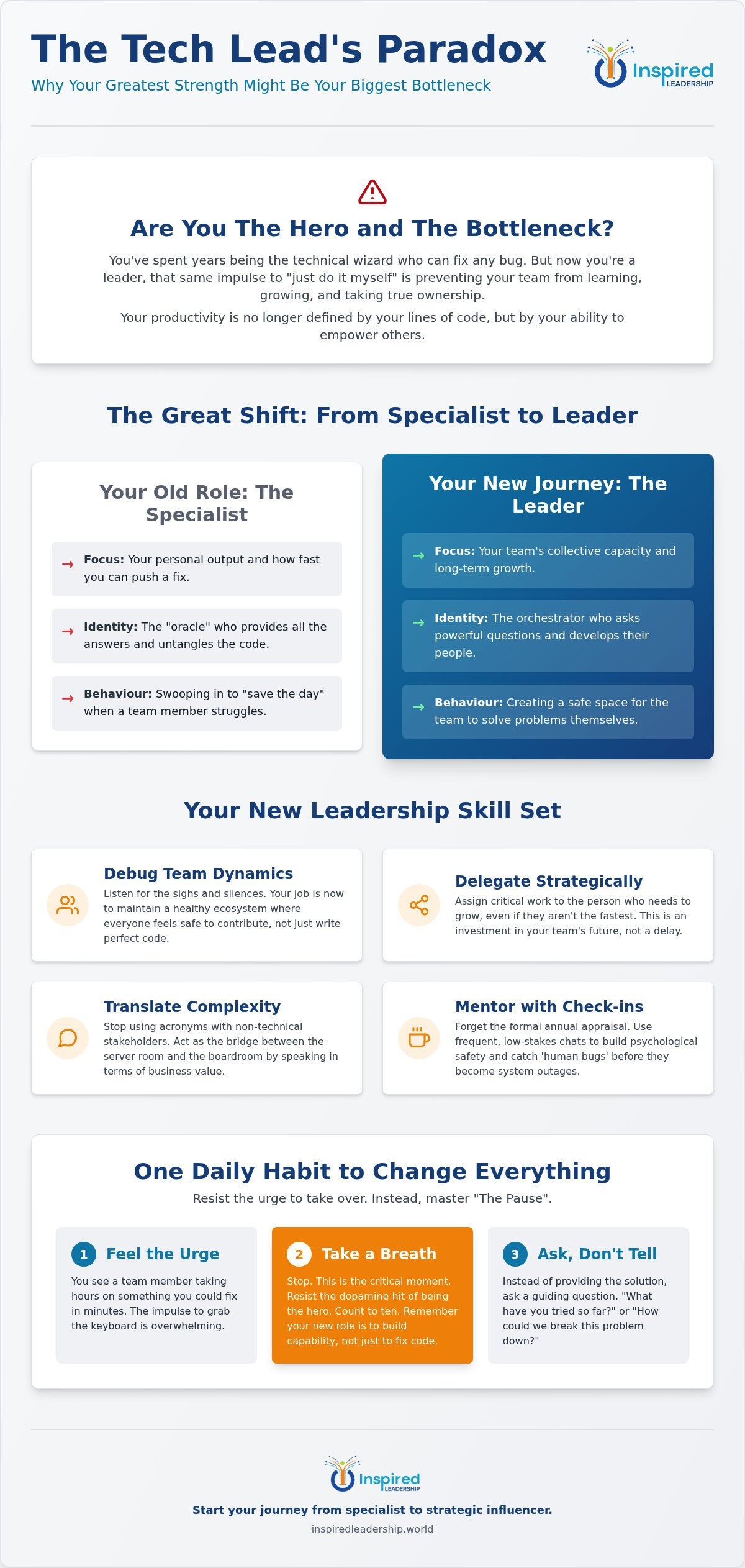
Developing technical lead leadership skills is about learning to sit on your hands whilst someone else struggles. It’s a bit like watching a junior dev try to use Vim for the first time without a cheat sheet. You want to take over the keyboard, but doing so robs them of the chance to actually learn.
Traditional Lead Programmer Responsibilities often blur the lines between high-level coding and people management. This creates a trap where you feel unproductive if you haven’t merged a pull request by lunch. We know that itch; it’s the dopamine hit of a green build versus the slow burn of human development.
It’s incredibly annoying when a task that takes you ten minutes takes a team member two hours. But if you keep being the “fixer”, you’ll eventually find yourself working 14-hour days whilst your team waits for your input on every minor detail. You have to let go of the tools to pick up the influence.
The Identity Crisis of the New Technical Lead
Your ego used to live in your IDE, but now it has to live in your team’s collective success. Shifting from an individual contributor to a leader means redefining what “done” looks like. It’s no longer about your personal output, but about how much you’ve increased the capacity of everyone else around you.
Why Your Team Stops Thinking When You Provide All the Answers
If you are the “oracle” for every architectural question, your team will eventually stop trying to find their own answers. They become passive observers waiting for your permission to be brilliant. Look for the signs: are they asking “how do I do this?” instead of “how should we approach this?”.
The Technical Lead Skill Set: Moving Beyond Code to Strategic Influence
Leadership isn’t just a fancy title; it’s a completely different operating system. You need to move from debugging code to debugging team dynamics. Mastering these technical lead leadership skills requires focus on the humans behind the keyboards, which they definitely didn’t teach you in your computer science degree.
During stand-ups, you must listen for the sighs or the heavy silences between the status updates. Managing a “brilliant jerk” who writes perfect code but destroys team morale is now your highest priority. It’s about maintaining a healthy ecosystem amongst your developers where everyone feels safe to contribute without being shut down by a technical ego.
Strategic delegation involves assigning critical work to the person who needs to grow, even if they aren’t the fastest. You must develop systems thinking to see how a single technical choice impacts the whole organisation. This allows you to mentor others whilst they learn to navigate complex architectures.
Translating Technical Complexity for Non-Technical Stakeholders
Stop using acronyms when you talk to the board because they simply don’t care about your tech stack. Research on Technical Leadership Development Strategies shows that the best leaders act as a bridge between the server room and the boardroom. This shift in technical lead leadership skills is what separates a senior coder from a genuine business influencer.
The Art of the “Check-in” Over the Performance Review
Forget the annual appraisal; it’s a formal relic that rarely drives actual performance. Use frequent, low-stakes check-ins to build psychological safety and catch human bugs before they lead to system outages. These conversations are where you truly mentor your team through their own professional development journey. If you’re finding it hard to switch gears from specialist to leader, reach out to us for a chat.
Transitioning Without Losing Your Soul: Practical Daily Leadership Behaviours
Changing your identity from a “doer” to a “leader” doesn’t happen overnight. It requires a deliberate shift in your daily routine to embed those critical technical lead leadership skills. It’s as tempting as eating a whole pack of biscuits, but jumping in to “save the day” ruins your team’s appetite for problem-solving.
- Step 1: Audit your calendar to identify where you are still acting as a specialist instead of a strategist.
- Step 2: Practice “the pause” before jumping in to fix a bug that a junior is struggling with; it’s painful, but that’s where their growth happens.
- Step 3: Ask powerful questions that lead the team to discover their own solutions rather than just handing them the answer.
- Step 4: Master the art of giving feedback that actually sticks by focusing on the impact of the behaviour whilst encouraging growth.
Building an Ownership Mindset in Your Squad
Stop being the person who owns every problem and start being the one who owns the collective outcomes. When you give your developers autonomy, they are far more likely to stay with your organisation long-term. High autonomy is a top driver of job satisfaction, so stepping back is actually a clever retention strategy.
Managing Your Own Energy Amidst the Meeting Chaos
Your calendar is now your most important technical tool, so treat it with the same respect you’d give a production database. Set firm boundaries to protect time for deep thought and strategic planning. If you are constantly context-switching between code reviews and stakeholder meetings, your brain will fry before Friday.
Your Leadership Evolution: Scaling Impact Through the Technical Talent Journey
You have likely realised by now that reading a few clever blog posts won’t magically fix your leadership style. To make technical lead leadership skills a permanent part of your toolkit, you need a structured approach that moves beyond theory. It is about rewiring your brain to value team ownership over personal keyboard time, which is easier said than done when a deadline is looming.
Our High-Potential Technical Talent Journey is specifically crafted to turn brilliant experts into influential leaders. We avoid dry, academic lectures because corporate life is far too messy and unpredictable for textbook solutions. You deserve a guide who has spent 20 years navigating office politics and high-pressure delivery cycles whilst keeping their sanity intact.
Partnering with someone who understands the “human bugs” in your organisation allows you to scale your impact without burning out. This isn’t just about managing a sprint; it’s about becoming the strategic voice that executives actually listen to. Let’s take the next step in your professional development journey together.
From Manager to Leader: The Long-Term Vision
This transition is a continuous journey rather than a one-off event you tick off a checklist. Inspired Leadership helps you translate those occasional “aha!” moments into measurable organisational action that delivers real results. We focus on the human factor because people are significantly more complex than even the most convoluted microservices architecture you’ve ever built.
Take Action: Download the Journey Brochure
If you are ready to stop being the team bottleneck and start being a visionary orchestrator, explore our Manager to Leader Journey. It is time to stop guessing and start leading with a battle-tested framework that commands respect. We encourage you to download the brochure today and share it with your executive team to demonstrate your commitment to growth.
Take Command of Your Leadership Evolution
Escaping the specialist trap isn’t about ditching your love for tech. It’s about realising that your biggest impact now comes from building people, not just building systems. By mastering technical lead leadership skills, you move from the person who fixes every bug to the leader who creates a culture of genuine ownership.
We’ve spent 20 years in the corporate trenches, so we know that this transition is often messy. Our human-centred approach provides transformational journeys specifically designed for medium-sized enterprises. We help you translate those awkward management moments into pragmatic, sustainable growth that commands respect from the boardroom.
You’ve already got the technical brilliance; now it’s time to stop hoarding all the fun problems and let your team shine. We’re ready to help you navigate this journey from expert to orchestrator with confidence and a healthy dose of pragmatic flair.
Frequently Asked Questions
What are the most important leadership skills for a technical lead?
The most critical technical lead leadership skills are strategic delegation and active listening. You need to move beyond syntax to understand the human dynamics at play during a sprint. It’s about learning to hear what your developers aren’t saying and knowing when to sit on your hands so others can solve the problem. This shift in focus is what transforms a senior coder into a genuine leader.
How can I lead a technical team if I am no longer the best coder?
You lead by becoming an orchestrator who understands the big picture rather than the finest detail of every pull request. Your value now lies in your ability to remove blockers and translate technical complexity for stakeholders. It is actually better if you aren’t the best coder; it forces you to trust your team. This allows you to focus on high-level architecture and strategic influence instead of getting lost in the weeds.
What is the difference between a technical lead and a people manager?
A technical lead typically focuses on technical vision and mentoring developers through architectural challenges. A people manager often handles the administrative side like holiday requests and formal performance reviews. Whilst a tech lead needs technical lead leadership skills to guide the squad, they usually stay closer to the code than a pure manager. Both roles require empathy, but the tech lead is the one shaping the technical soul of the product.
How do I handle conflict between two highly opinionated developers?
You handle technical disagreements by refocusing the conversation on business value and user impact rather than personal preference. Don’t play the judge; instead, ask questions that force both sides to justify their logic against the project goals. If things get heated, use a “check-in” to lower the temperature and ensure everyone feels heard. Your job is to facilitate a consensus that serves the organisation, not to pick a favourite developer.
How much time should a technical lead spend coding versus leading?
Most successful leads aim for a 30% coding and 70% leading split, though this varies by team size and maturity. If you spend 100% of your time in the IDE, you are neglecting your team; if you spend 0%, you might lose your technical edge. The goal is to stay dangerous enough to provide oversight without becoming the person on the critical path. Find a sustainable balance that allows you to mentor whilst protecting your time for deep strategic thought.