
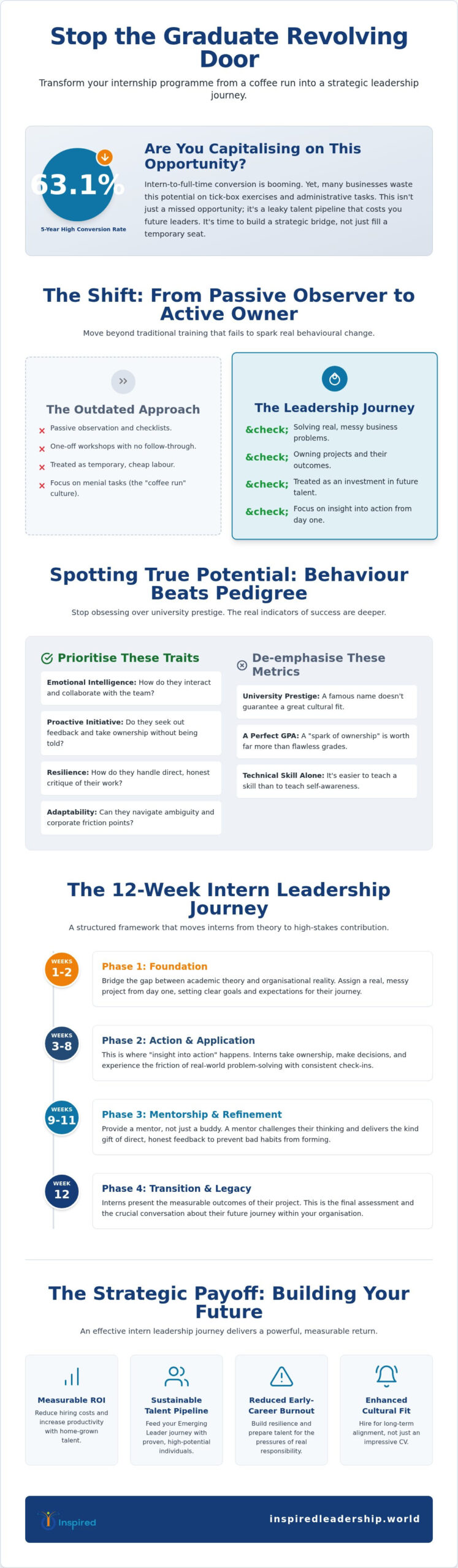
Did you know that intern-to-full-time conversion rates recently hit a five-year high of 63.1%? That is a massive chunk of your future workforce sitting right under your nose, yet many businesses still treat these placements as little more than a source of cheap labour and coffee runs. If you want to stop the graduate revolving door, you must view this time as a strategic intern leadership development journey rather than a three-month administrative trial.
It is exhausting to watch bright, ambitious talent drift away because they felt disengaged or stuck in a tick-box exercise that lacked real substance. You shouldn’t have to settle for a talent pipeline that leaks, and your interns shouldn’t feel like they’re just filling a seat. I’ll show you how to transform a simple work placement into a structured leadership journey that secures your organisation’s future.
We will explore how to identify management potential early and ensure your development efforts deliver a measurable ROI. It is time to stop guessing and start building a legacy of leadership that begins on day one.
Key Takeaways
- Move beyond the “coffee run” culture by treating your intern leadership development journey as a strategic bridge between academic theory and real organisational ownership.
- Prioritise behavioural potential and emotional intelligence over university prestige to ensure you are hiring for long-term cultural fit and leadership capability.
- Implement a structured 12-week framework that focuses on “insight into action” by giving your interns real, messy problems to solve from the very beginning.
- Build a sustainable talent pipeline that provides a measurable ROI and feeds directly into your senior leadership and executive journeys.
Redefining the Intern Leadership Development Journey for 2026
In 2026, the global leadership development market is projected to hit USD 98.7 billion. Despite this massive investment, many firms still treat interns like glorified filing clerks or professional tea makers. Your intern leadership development journey should be a strategic bridge that moves talent from academic theory into genuine organisational ownership.
Let’s be honest about the “coffee run” culture. It is a spectacular waste of your recruitment budget and their untapped potential. Medium-sized enterprises have a unique advantage because they can be more agile and personal than faceless corporate giants.
You have the space to give interns real, messy problems to solve. Leadership starts on day one, not when someone finally lands a manager title. If you wait until they are “ready” to lead, you’ve already lost the best ones to your competitors.
The Shift from Passive Observer to Active Owner
There is a world of difference between watching the work and actually owning the outcome. We expect interns to think for themselves whilst they are with us rather than just following a checklist. This shift turns a passive placement into an Emerging Leader Journey that creates immediate, measurable value.
Why Traditional Training Fails Your Interns
One-off workshops are often just a tick-box exercise that fails to spark any real behavioural change. If you want results, you need a structured, results-driven journey that lasts longer than a single afternoon. Real growth happens through consistent application and insight into action, not through a few slides and a lukewarm buffet.
The Psychology of Potential: Why Behaviour Beats Technical Skill
Stop obsessing over university crests and fancy degrees. Whilst technical skills are easy to teach, self-awareness and emotional intelligence represent the real “Human Factor” that determines long-term success. You’ve likely met the straight-A student who is brilliant on paper but struggles to hold a conversation or work in a team.
Compare that to the scrappy B-student who takes initiative and actively seeks out your feedback. That spark of ownership is worth ten times more than a perfect GPA. It is the fuel for a successful intern leadership development journey that actually builds your future management layer.
Observing how an intern handles a critique of their work is the ultimate litmus test for their potential. High-impact initiatives, such as the public service leadership program, demonstrate that identifying leadership capacity is the priority from the very start. If you want to refine how you spot this potential early, let’s chat about your strategy.
The Specialist-to-Leader Seed
Even at this early stage, you need to see if they can move from simply “doing” tasks to “leading” their own small projects. Using a leadership assessment can help you identify these traits before you invest months of resources into the wrong candidate. It helps you find the individuals who think about the outcome, not just the checklist.
Building Resilience Amongst Early Career Talent
The modern workplace is messy and often unpredictable. A structured journey helps your talent navigate corporate friction points without burning out or feeling overwhelmed. By prioritising adaptability, you ensure your interns are ready to handle the pressure of real responsibility.
Designing a 12-Week Journey That Actually Delivers Results
Building a successful intern leadership development journey requires more than providing a desk and a laptop. You need a structured framework that moves beyond observation and into high-stakes contribution. When designing an internship program, you must prioritise “insight into action” by handing over real, messy problems that need solving.
Don’t confuse a buddy with a mentor. A buddy is there to show them where the good coffee is and how to navigate the internal filing system. A mentor is the person who challenges their thinking and holds them to a higher standard of leadership. Direct, honest feedback is the kindest gift you can give an intern because it prevents them from forming bad habits early in their career.
If they are doing something wrong, tell them immediately and clearly. They are here to learn, and sugar-coating their mistakes only slows down their growth. High-potential talent actually craves this level of directness because it shows you are invested in their future.
Month One: Immersion and Ownership
The first four weeks are about understanding your organisational “why” and setting clear expectations for output. We ask our interns to identify at least one “friction point” in their first 30 days. This encourages them to stop being passive observers and start thinking like owners who can improve the business from the inside out.
Month Three: The Capstone Project
The final month culminates in a Capstone Project where the intern demonstrates their leadership capability directly to the board or senior team. It is a high-stakes moment that proves whether they have the potential to transition into your emerging leader journey. This ensures your talent pipeline is built on proven results rather than just hopeful intentions.
Building a Sustainable Pipeline with the Emerging Leader Journey
Think about the sheer ROI of this approach. Retaining someone who already understands your “ownership” mindset saves you thousands in recruitment and onboarding costs. They arrive on day one of their permanent role already knowing how you operate and what you value, which is far more efficient than hunting for strangers in a volatile market.
The energy from a fresh, ambitious intern can revitalise even your most cynical senior managers. When they see early-career talent taking real ownership of messy problems, it creates a ripple effect that values growth at every level. This isn’t just about the intern; it’s about shifting the entire organisation’s posture towards continuous development and high-level competence.
Your Next Steps for a Results-Driven Journey
It’s time to stop “training” your people and start transforming them into the leaders your business deserves. You can learn more about how we structure a results-driven intern leadership development journey by downloading the brochure for our Emerging Leader Journey.
The best time to start building this pipeline was six months ago, but the second-best time is right now. Don’t wait for your competitors to snap up the best talent because you were too busy ticking boxes. Your competitors are already looking for their next star, and they’d love nothing more than for you to do the hard work of finding them only to let them walk away.
Secure Your Future Talent Today
Your interns are the heartbeat of your future leadership team, provided you treat them with the strategic respect they deserve. By shifting from passive training to a results-driven intern leadership development journey, you transform a simple work placement into a powerful organisational asset. We have spent 20 years in the corporate trenches learning that behaviour always beats technical skill, and your medium-sized enterprise is the perfect environment to prove it.
It is time to move beyond the tick-box exercises and start building bespoke solutions that actually result in behavioural change. Focus on ownership, demand real results, and watch your talent pipeline flourish whilst your competitors are still trying to figure out where the best graduates went. You have the tools and the framework to stop “training” and start leading from the very first day.
The path to a sustainable talent pipeline isn’t paved with coffee runs; it’s built through intentional growth and measurable transformation.
I am genuinely excited to see you turn those bright-eyed interns into the powerhouse leaders of tomorrow. You have the insight, now it is time to put it into action.
Frequently Asked Questions
What is an intern leadership development journey?
An intern leadership development journey is a strategic bridge between academic theory and organisational ownership that treats interns as future leaders from day one. Unlike a standard work placement where they might just be glorified tea makers, it focuses on building behavioural capability. This ensures your talent pipeline starts with individuals who already understand your specific culture, values, and long-term business goals.
How do you measure the ROI of an intern journey?
You measure success through intern-to-full-time conversion rates and the reduction in recruitment costs for entry-level management roles. Since these conversion rates hit a five-year high of 63.1% recently, the financial benefit of retaining proven talent is significant. You also see immediate value through “capstone projects” that solve real business friction points, providing a tangible return on your investment before the journey ends.
Can interns really lead projects in a medium-sized enterprise?
Yes, and they absolutely should, because medium-sized enterprises offer the agility and personal touch that corporate giants often lack. By giving an intern a specific, messy problem to solve, you test their initiative and ownership mindset immediately. It is less about the scale of the project and more about their ability to move from simply “doing” to “leading” a desired outcome for your team.
What is the difference between an internship and a leadership journey?
An internship is often a passive observation period, whilst an intern leadership development journey is an active, results-driven transformation. Standard internships typically focus on technical tasks and administrative support, but a journey prioritises behavioural growth and leadership potential. It is the fundamental difference between hiring a temporary pair of hands and intentionally cultivating a future executive for your organisation’s long-term success.
How do you structure feedback for early-career talent without being patronising?
You treat them as adults by focusing on the direct impact of their work and providing clear, actionable insights. Be direct and honest about their performance because high-potential talent actually craves transparency over sugar-coated praise. Avoid talking down to them; instead, explain the “why” behind your feedback to help them build the resilience needed for a successful career in your business.