
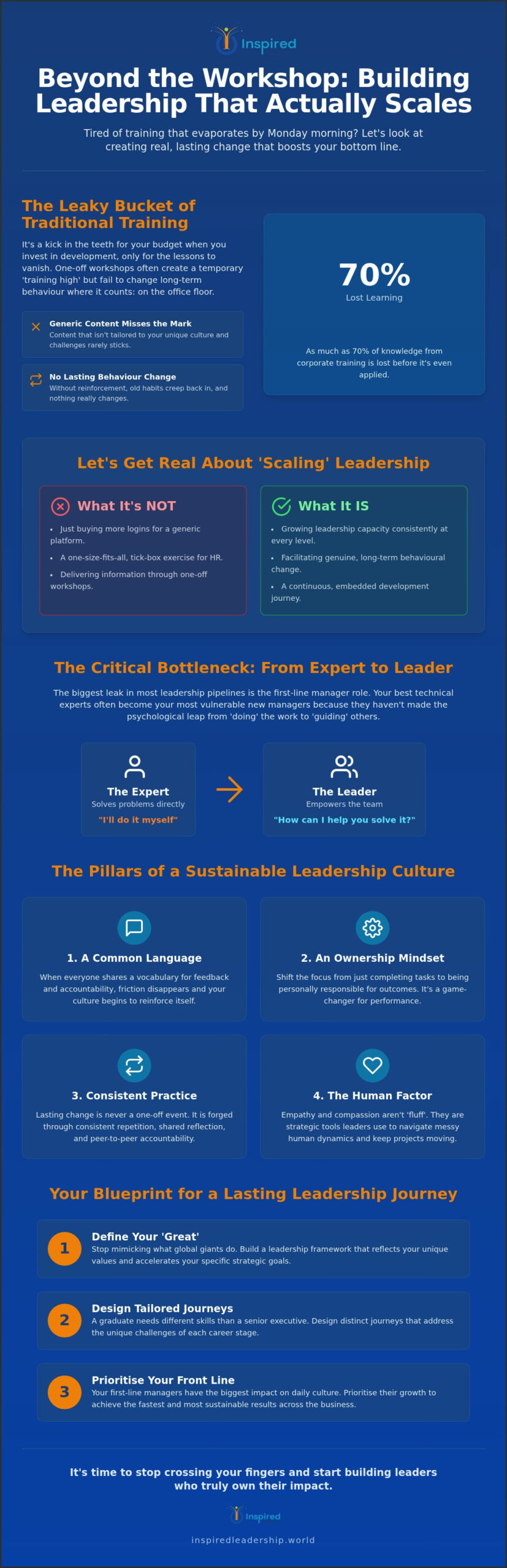
Did you know that as much as 70% of the learning from traditional training workshops is lost before it even hits the office floor? It’s a bit of a kick in the teeth for your budget, especially when you’re trying to implement scalable leadership development that actually sticks. You likely feel the sting when your brilliant technical experts stumble after a promotion, or when that leadership pipeline looks more like a leaky tap.
It’s frustrating to spend money on development that doesn’t actually change how people behave on a Tuesday morning. Drawing on 20 years of corporate experience, I’ve seen that you deserve a system that grows as you do, without losing that essential human spark. We’re moving past the era of generic slide decks to focus on what really moves the needle.
In this guide, you’ll discover how to move beyond static training and build a journey that creates lasting behavioural change across your entire business. We’ll explore how to empower your first-line managers and finally secure a measurable ROI on your development spend. It’s time to stop crossing your fingers and start building a culture that actually owns its actions.
Key Takeaways
- Learn why true scalable leadership development is about consistent behaviour change across all levels, rather than just buying more logins for a generic platform.
- Discover how to build a common leadership language that stops your technical experts from failing when they move into management roles.
- Find out how to design specific leadership journeys that address the unique challenges of every career stage, from graduates to your executive talent.
- Identify the practical steps to ditch the corporate “fluff” and create a results-driven culture where leaders actually own their actions.
Why Your Current Leadership Training Isn’t Scaling (and What to Do)
The Pitfalls of Check-the-Box Training
One-off workshops often create a temporary “training high” that evaporates by the time your team opens their emails on Monday morning. Generic content lacks the specific context of your organisational culture and the actual hurdles your people face. You need a system that translates theory into daily practice.
To see results, you need to ditch the idea of a “course” and embrace a structured leadership journey that embeds new habits over time. This approach ensures that Leadership development becomes a continuous process rather than a calendar event. It’s about creating a ripple effect that touches every part of your business.
Identifying the Systemic Friction Points
Most leadership pipelines leak at the first-line manager level where technical experts often struggle with a “doing” mindset. You might find your best engineers or specialists are actually your most vulnerable new managers because they haven’t made the psychological leap to leading others. They often try to solve problems themselves instead of empowering their teams.
Addressing this gap requires aligning executive strategy with front-line execution through our manager to leader journey. You cannot scale leadership if your people are still stuck in the weeds. Scaling isn’t just about automation; it’s about managing the emotional transition from being the expert to being the guide.
The Pillars of Sustainable Leadership Capability at Scale
Scaling isn’t just about software; it’s about creating a common language that everyone from the CEO to the newest graduate understands. When your team shares a vocabulary for feedback and accountability, you strip away the friction that usually slows things down. This alignment is the bedrock of scalable leadership development because it allows your culture to police itself. For firms looking to unify their technical and human systems, Trinity One offers an AI-native operating system that integrates machine operations and people management.
You need to foster an ownership mindset where every leader feels personally responsible for their outputs rather than just their tasks. Behaviour change isn’t a one-off event but happens through consistent repetition, reflection, and peer-to-peer accountability. It’s about making leadership part of the daily rhythm, not a special event you attend once a year.
Insight is essentially useless if it doesn’t lead to a change in how your team interacts on a daily basis. You can start by using a leadership assessment to identify the specific behaviours that actually need to scale. To turn these insights into action, you should focus on:
- Creating frameworks that encourage managers to coach their own teams.
- Multiplying impact through shared reflection sessions.
- Establishing peer-to-peer accountability loops.
The Human Factor in Organisational Growth
Don’t fall into the trap of thinking empathy and compassion are just “soft skills” for the HR department. These are strategic tools that help your leaders navigate the messy human dynamics that cause projects to stall. Scaling leadership means giving your people the confidence to have difficult conversations with grace and clarity.
When your leaders can handle conflict without it turning into a drama, your organisation moves faster. If you’re ready to build this kind of resilience, you might want to chat with us about your goals. It’s time to put people at the centre of your strategy.
How to Design a Scalable Leadership Development Journey
Designing scalable leadership development isn’t about mimicking what a global tech giant does. You need to define what “great” looks like for your specific business. Don’t let a generic template dictate your culture; instead, build something that reflects your unique values and strategic goals.
Organise your development into distinct journeys tailored to specific career stages. Your first-line managers are your most important building block. They influence the daily culture more than the executive suite ever will, so prioritise their growth to see immediate results across the board.
Every journey needs a blend of theory, practice, and measurable feedback loops. If your leaders don’t get to test new skills in a safe environment, they’ll simply revert to old habits. It’s about creating a consistent cycle of action and reflection that makes new behaviours permanent.
The Specialist-to-Leader Transition
Your technical experts are often your biggest flight risk when they move into management. They need a specific manager to leader journey to survive the promotion without burning out. It’s time to teach them how to stop “doing” the work and start enabling others to do it better through delegation and strategic thinking.
Accelerating Diverse Talent Pipelines
Scalability is severely limited if you are only developing one type of leader. Use targeted journeys like a women leadership accelerator to unlock the hidden potential already sitting in your office. You can even build graduate journeys that instil the right behaviours and ownership mindsets from the very first day of their career.
Partnering for Impact: Why Medium Enterprises Choose Inspired Leadership
You’ve likely sat through enough “motivational” workshops to know that hype doesn’t pay the bills or fix a broken culture. At Inspired Leadership, we understand that you’re tired of corporate jargon and “fluff” that fails to deliver on its promises. We offer a results-driven alternative that focuses entirely on the unique needs of growing companies.
Our approach is pragmatic, direct, and rooted in two decades of real-world corporate experience. We don’t just teach theory; we provide the tools to build an organisation that thinks for itself and takes full responsibility for its results. This is scalable leadership development designed for leaders who value depth and practicality over superficial training sessions.
The Beyond Command Journey
Moving from a “command and control” style to one that inspires genuine ownership is a significant psychological shift for any senior team. Our Beyond Command journey helps your executives make this transition with confidence and clarity. This is a vital component of scalable leadership development, as it sets the tone for the entire organisation.
If you want to see how this looks in practice, read our leadership coaching testimonials to see the tangible results we’ve delivered. We focus on measurable behavioural change that survives long after the initial sessions are over. Your senior leaders will learn to lead by empowering others rather than micromanaging the details.
Taking the Next Step in Your Growth
Stop settling for training that doesn’t stick and start building a legacy of leadership today. You can contact us today to discuss how we can act as the strategic catalyst for your organisation. We also encourage you to download our journey brochure to see exactly how we can help you scale your leadership capability.
Build a Culture That Thinks for Itself
You’ve seen how traditional training fails when it ignores the messy human side of growth. True scalable leadership development happens when you stop ticking boxes and start building a common language that everyone from your graduates to your executives can actually use. It’s about turning your technical experts into confident leaders who empower their teams instead of micromanaging the life out of them.
We’ve spent 20 years in the corporate trenches, so we know exactly how to cut through the fluff with a human-centred, no-nonsense approach designed specifically for medium-sized firms. You don’t need another boring slide deck; you need a journey that turns insight into action and creates a pipeline of talent that actually owns its results.
It’s time to stop crossing your fingers and start building a leadership legacy that actually sticks. You already have the talent within your walls, and we have the battle-tested roadmap to help you unleash it. Let’s get to work and build something brilliant together.
Frequently Asked Questions
What is the difference between leadership training and a leadership journey?
Training is a one-off event, whilst a leadership journey is a sustained process of behavioural change. Think of training as a speed date and a journey as a committed relationship.
A journey includes reflection, peer support, and real-world application. This approach ensures you don’t just learn theory but actually change how you lead your team on a daily basis.
How do you measure the ROI of a scalable leadership development journey?
You measure ROI by looking at tangible shifts in team performance, employee retention, and the speed of decision-making. Gartner research indicates that fewer than 20% of HR leaders feel they can effectively measure impact, so we focus on observable behaviours.
When you implement scalable leadership development, you see a reduction in “firefighting”. You’ll also notice managers who take full ownership of their results.
Can technical experts really be trained to become effective managers at scale?
Absolutely, but only if you stop treating them like walking encyclopaedias and start treating them like humans. Most technical experts fail because they try to “do” the work instead of “leading” the people.
By focusing on delegation and empathy rather than just management theory, you can help your specialists make that tricky psychological leap. It’s about giving them the confidence to step away from the tools.
Why is scalability so important for medium-sized enterprises?
Scalability is vital because medium-sized firms often hit a ceiling when their leadership pipeline is too thin to support growth. If your culture depends on one or two “hero” leaders, you’ll eventually crumble under the pressure.
Building scalable leadership development ensures that your first-line managers are equipped to grow with the business. It prevents the bottleneck that happens when technical talent is promoted without the right support.
How long does it typically take to see behavioural change in an organisation?
You’ll usually notice small shifts in how people communicate within the first few weeks. However, deep-rooted behavioural change typically takes six to twelve months of consistent practice and reflection.
This isn’t a quick fix or a magic wand. It’s a deliberate process that requires your leaders to show up, try new things, and occasionally get it wrong before they finally get it right.