

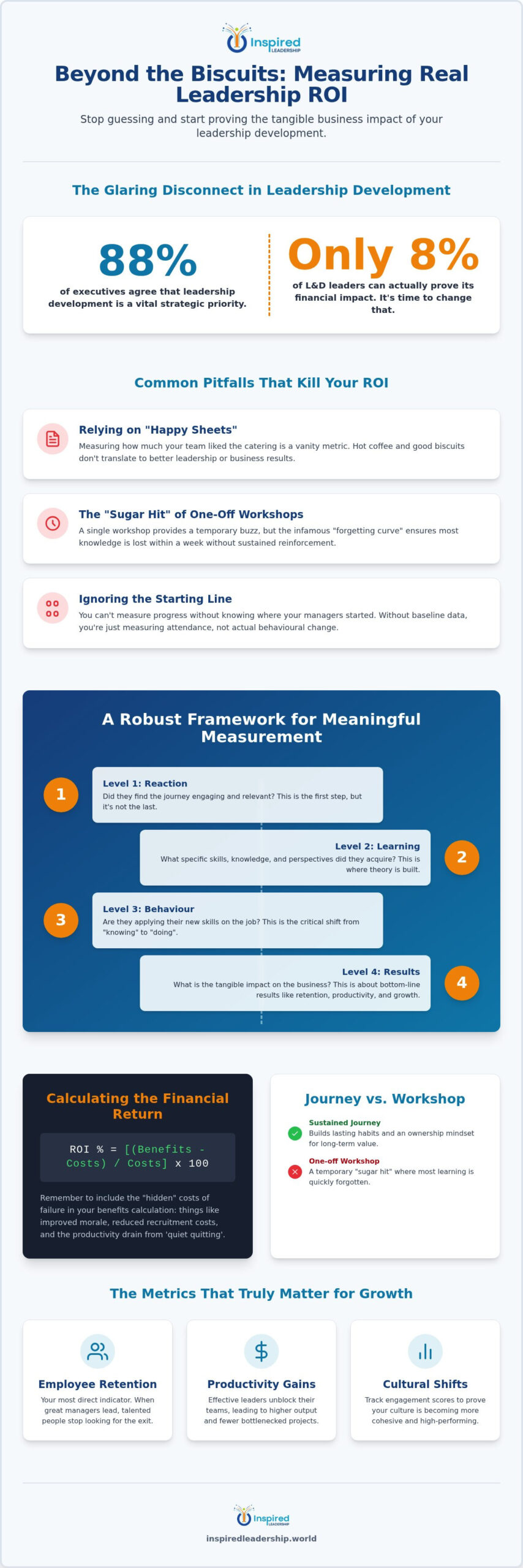
Did you know that whilst 88% of executives agree leadership development is vital, only 8% of L&D leaders can actually prove its financial impact? It’s a bit of a nightmare when the board starts asking for hard numbers and all you have is a stack of feedback forms saying everyone liked the biscuits. Measuring leadership development ROI shouldn’t feel like trying to nail jelly to a wall.
I know you’re likely feeling the heat from above to justify every penny spent on your people. You want to see your first-line managers actually leading instead of just “coping” whilst turnover rates climb. This article will show you how to move beyond those basic feedback forms and calculate the tangible business impact of your leadership development investments.
We’ll explore a clear framework for measuring success that translates behavioural shifts into bottom-line results. You’ll discover how to improve manager performance and slash recruitment costs by keeping your best talent right where they belong. It’s time to turn your leadership journey into a proven strategic asset.
Key Takeaways
- Stop relying on “happy sheets” that only measure how much your team liked the biscuits and start looking for actual behavioural shifts in your managers.
- Use a robust four-level framework to track everything from initial engagement to the tangible skills your leaders actually bring back to the office.
- Learn how to identify the metrics that really matter for your growth, making measuring leadership development ROI a straightforward process rather than a guessing game.
- Discover why a sustained leadership journey creates far more value than a one-off training event by building a lasting ownership mindset.
Why Most Organisations Fail at Measuring Leadership Development ROI
Most companies treat Leadership development like a tick-box exercise rather than a strategic investment. You’ve likely seen the “Happy Sheet” trap where success is measured by how much the participants enjoyed the catering. Whilst it’s lovely that the coffee was hot, relying on these vanity metrics makes measuring leadership development ROI almost impossible.
Focusing on attendance logs rather than behavioural change amongst your leaders is a common mistake. You cannot measure progress if you don’t have baseline data to show where your managers actually started their journey. If your managers are showing up but still acting like stressed-out dictators once they get back to their desks, the investment is wasted.
The Flaw of One-off Training Workshops
One-off workshops are the sugar hit of corporate life. They provide a temporary “high” and a few days of excitement, but they offer zero long-term ROI because the “forgetting curve” eats your training budget for breakfast. Without a sustained journey that reinforces new habits, most of that shiny new knowledge is gone within a week of the session ending.
The Human Factor in Data Collection
You need to actually talk to your people instead of just glancing at their completion certificates or HR records. Getting honest feedback requires psychological safety, where leaders feel safe to admit what they don’t know without fear of judgment. Spoiler alert: if you don’t define what success looks like before the journey starts, you’ve already lost the battle for meaningful data.
The Four Levels of Impact: A Robust Framework for Measurement
You can’t just guess if your investment is working. To get serious about measuring leadership development ROI, we often look to The Kirkpatrick Model. This framework breaks down impact into four distinct levels that move from surface-level feelings to hard business data.
Level 1 is Reaction, which asks if your leaders actually engaged with the journey. Level 2 measures Learning, focusing on the specific skills they’ve acquired whilst away from their desks. Levels 3 and 4 move into the “doing” phase, tracking behavioural changes in the office and the eventual impact on your bottom line.
Moving from Insight to Action
Most training dies at Level 2 because it’s all theory and no trousers. Our Manager to Leader Journey is specifically built to push your people into Level 3 by focusing on practical application. We don’t just want them to “know” more; we want them to “do” better whilst building sustainable habits.
Calculating the Financial Return
Research shows that only 8% of L&D leaders can currently demonstrate the business impact of their training in financial terms. To join that elite group, you’ll need to calculate (Benefits minus Costs) divided by Costs, multiplied by 100. Don’t forget to include the “hidden” costs of failure, like low morale and the productivity drain of quiet quitting, when measuring leadership development ROI.
If you’re ready to see how this framework fits your specific team, let’s have a chat about your goals.
Identifying the Right Metrics for Your Organisation’s Growth
Medium-sized firms can’t afford to wait years for a “longitudinal study” to tell them if their training worked. You need data that reflects the reality of scaling a business in 2026. Measuring leadership development ROI in an SME requires a focus on immediate, observable shifts in how your teams function every day.
Employee retention is your most direct indicator that your managers have stopped being “bosses” and started being leaders. When people feel supported, they stop looking at the exit and start focusing on their work. Stop playing whack-a-mole with your recruitment strategy and start measuring how many people actually want to stay.
Productivity gains are equally vital, as teams led by journey participants often show higher output and fewer bottlenecked projects. You can use Leadership Assessments to track these cultural shifts and engagement scores. This data proves that your culture is evolving from a collection of individuals into a cohesive, high-performing unit.
Metrics for Technical Talent
Technical experts often face a bit of a shock when their old technical KPIs no longer matter. You need to track the reduction in “specialist-to-leader” friction points, such as how quickly they stop micromanaging and start delegating. It’s about measuring their ability to enable others rather than just being the person who fixes everything themselves.
The Ripple Effect: Intangible ROI
Don’t ignore the “ripple effect” of your investment on your brand reputation. Becoming an “employer of choice” amongst graduates saves you a fortune in recruitment fees whilst measuring leadership development ROI through better talent attraction. Plus, having a shared leadership language across your entire organisation makes every meeting and project run just that little bit smoother. To assist your team in mastering these delivery standards, you can learn more about Yellowhouse and their accredited certifications in project and programme management frameworks such as PRINCE2 and MSP.
Let’s be honest: the “sheep dip” approach to training is often a waste of everyone’s time. Shoving your managers into a room for a single day and hoping for a miracle rarely works because it ignores how humans actually learn and retain new habits. A sustained journey creates a narrative of growth that sticks through constant reinforcement and real-world practice.
When you are serious about measuring leadership development ROI, you quickly realise that spaced learning provides a much higher return than a quick theory hit. This method builds an ownership mindset that persists long after the formal sessions have finished. Your managers stop waiting for permission and start taking initiative because they have the tools to lead effectively.
The Strategic Catalyst Approach
We don’t just sell content; we partner with you as a strategic catalyst to ensure every journey aligns with your specific business goals. This isn’t about ticking boxes; it’s about genuine, measurable transformation that you can see in your daily operations. You can explore the impact for yourself by reading our leadership coaching testimonials from those who’ve already seen the results.
Ready to Measure Success?
If you are tired of vague promises and want to see the specific outcomes we target for our clients, it’s time to take action. Download our brochure to see how we structure our journeys to deliver a clear financial and cultural return for your organisation. Measuring leadership development ROI shouldn’t be a chore; it should be a celebration of your team’s ongoing growth.
Scaling this capability transforms the whole organisation rather than just one or two individuals. You create a shared language and a consistent standard of excellence that permeates every department. Stop buying courses that gather dust and start investing in journeys that actually move the needle.
Turning Strategic Insight into Tangible Performance
Measuring leadership development ROI doesn’t have to be a dark art that leaves you guessing. By moving beyond simple satisfaction scores and focusing on behavioural shifts, you can prove the real value of your leadership journeys. It’s about connecting the dots between individual growth and the bottom line of your organisation.
With over 20 years of corporate expertise, I’ve seen how a human-centred approach to change creates far more impact than any tick-box course. We specialise in helping medium-sized firms scale their capability whilst keeping their best talent from walking out the door. You deserve a measurement strategy that is as robust as your business goals.
Take the first step towards a more accountable and effective leadership culture today. Your managers are ready to become the leaders your business needs to thrive in 2026. Let’s make sure every penny of your investment counts.
Frequently Asked Questions
How do you calculate the ROI of leadership development in a medium-sized company?
You calculate it by comparing the total cost of the journey against the financial gains from improved performance and reduced turnover. Start by tracking specific metrics like the cost of replacing a manager, which can be eye-wateringly high for an SME. Use the formula (Benefits minus Costs) divided by Costs to get your percentage. This makes measuring leadership development ROI a data-driven reality rather than just a gut feeling.
Can you really measure “soft skills” like empathy and communication?
Yes, you can measure these by tracking observable behavioural changes rather than just “vibes”. Use 360-degree feedback and team engagement surveys to see if your managers are actually listening better or resolving conflicts more effectively. When a manager’s team reports feeling 20% more supported, that is a hard metric you can take to the board. It’s about turning internal states into external performance markers.
How long does it take to see a return on a leadership journey investment?
You will likely see initial shifts in morale and team communication within the first three months of a journey. However, the full financial return usually matures between six and twelve months as behavioural changes bed in. This is when you’ll notice lower recruitment costs and higher productivity across the board. It is a marathon, not a sprint, but the results are far more sustainable than a quick-fix course.
What are the most important KPIs for a first-line manager development journey?
Focus on team retention rates and promotion readiness to get the most accurate picture of success. You should also track productivity markers and the results of regular leadership assessments to see how culture is shifting. If your first-line managers are suddenly keeping their best people and hitting targets without the usual drama, you know your investment is working. These KPIs prove that your managers have truly stepped up.
Why do most leadership training programs fail to deliver a positive ROI?
Most fail because they are “sheep dip” events that lack any follow-up or practical application back at the desk. They focus on vanity metrics like how much the participants liked the trainer instead of measuring leadership development ROI through actual behavioural change. Without a structured journey that reinforces new habits over time, most people simply revert to their old ways within a week. It’s a total waste of your budget.