
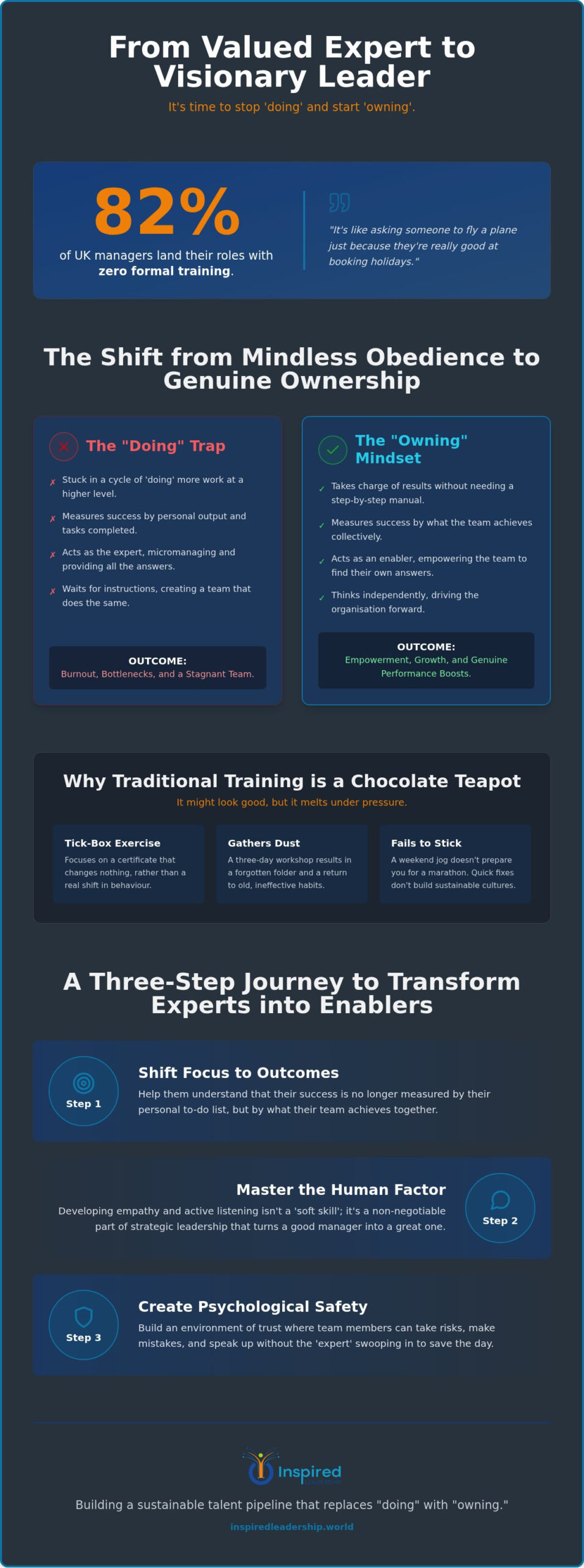
Did you know that a staggering 82% of managers in the UK land in their positions without a lick of formal training? It’s a bit like asking someone to fly a plane just because they’re really good at booking holidays. This systemic friction is exactly why your search for a strategic leadership development program usually starts when your best technical experts begin to struggle under the weight of people management.
After 20 years in the corporate trenches, I know how exhausting it feels to watch high-potential staff wait for instructions rather than taking the lead. You want a team that thinks independently and owns their outcomes, yet traditional training often feels like a box-ticking exercise that never quite sticks. It’s time to stop settling for mere obedience and start demanding genuine ownership from your future leaders.
In this article, you’ll discover how a structured leadership journey transforms experts into visionary owners who stop ‘doing’ and start leading. We’re going to look at creating a sustainable talent pipeline that delivers measurable performance boosts whilst keeping your sanity intact. Let’s explore how to build a culture that actually moves the needle and empowers your people to think for themselves.
Key Takeaways
- Learn how to help your technical experts stop being the “smartest person in the room” and start becoming the enablers your team actually needs.
- Discover why a results-driven strategic leadership development program must focus on behavioural shifts rather than just ticking off another list of boring modules.
- Understand the specific psychological barriers that prevent first-line managers from leading strategically and how a structured journey can break these habits for good.
- Find out how to create a sustainable talent pipeline that replaces “doing” with “owning,” ensuring your leaders drive the organisation forward independently.
Why Traditional Strategic Leadership Development Journeys Often Miss the Mark
Most leadership training is about as effective as a chocolate teapot. You sit in a room for three days, eat some decent biscuits, and return to the office with a folder that gathers dust. A true strategic leadership development program isn’t just a collection of modules; it’s a transformational shift in how your people actually behave and think.
We often see managers burning out because they mistakenly believe leadership is just “doing” more work at a higher level. They stay stuck in a cycle of mindless obedience, waiting for the next instruction whilst their team stands idly by. Real strategic leadership replaces this exhaustion with “owning,” which is the ability to take charge of results without needing a step-by-step manual.
The Difference Between a Course and a Journey
Take Dave, a brilliant engineer who attended a “Leadership 101” course and learned some fancy theory. By Tuesday, he was back to micromanaging his team’s spreadsheets because he didn’t know how to stop being the expert. A journey, like our manager to leader journey, focuses on the “ownership” mindset rather than a tick-box certificate that changes nothing.
Why Medium-Sized Enterprises Face Unique Leadership Friction
Medium-sized businesses often hit a painful ceiling where they are too big to be nimble, but too small to have a massive corporate HR machine. You need leaders who can translate executive visions into frontline reality without needing their hands held at every turn. This requires a specific type of development that bridges the gap between internal psychological states and external performance outcomes. For sales-led teams, an execution platform like CloseStrong can help bridge this gap by ensuring company strategy is implemented on every deal.
Sustainable change requires a structured, systemic approach that a standard strategic leadership development program often lacks. Relying on a three-day workshop to fix a stagnant culture is like expecting a weekend jog to prepare you for a marathon. This is why we focus on long-term evolution rather than quick fixes that fail to stick.
Navigating the Specialist-to-Leader Trap in Your Organisation
Promoting your most brilliant specialist to a management role often feels like a logical reward, but it can quickly turn into a disaster for both the individual and the team. This happens because their entire identity is wrapped up in being the “expert” who has all the answers. Shifting from a technical doer to a strategic enabler requires a massive psychological pivot that most people simply aren’t prepared for.
Whilst academic resources like the Harvard Strategic Leadership Program provide excellent high-level theory, technical specialists need something more grounded and pragmatic. A results-oriented strategic leadership development program must address these identity shifts directly to be effective. If you’re seeing your best experts drowning in admin whilst their teams wait for permission to breathe, it’s time for a different approach.
Three Steps to Transition Technical Experts Successfully
- Shift focus to outcomes: Help them understand that their success is now measured by what the team achieves, not how many lines of code they personally wrote.
- Master the human factor: Developing empathy and active listening is non-negotiable for anyone entering a strategic leadership development program.
- Create safety: Leaders must build an environment of psychological safety where team members feel comfortable taking risks without the “expert” swooping in to save the day.
The Role of the Emerging Leader Journey
We’ve designed the emerging leader journey specifically to help your high-potential talent make this leap without losing their technical soul. It provides a practical roadmap that turns specialists into visionary owners who empower their teams to excel. You can download the brochure on that page to see exactly how we structure this transformation.
If you’re ready to stop the specialist-to-leader churn, feel free to reach out for a chat about your team.
Essential Components of a Results-Driven Leadership Journey
You can’t build a leader by simply handing them a list of abstract competencies and hoping for the best. A results-driven strategic leadership development program must be a structured journey that connects macro-organisational strategy with micro-level individual growth. It’s about moving from the big-picture vision down to the daily habits that actually move the needle for your team.
We call this “The Human Factor” because businesses are ultimately just groups of people trying to achieve something together. Without a deep focus on empathy, trust, and psychological safety, your leadership initiatives will remain surface-level fluff. To explore how to operationalise these connections for better performance, visit Culture Of Belonging Global INC. and discover how they help organisations thrive. By starting with a rigorous leadership assessment, you can pinpoint exactly where the friction lies before you spend a single penny on training.
Coaching is the glue that makes these new behaviours stick when things get messy back at the office. It provides a safe space for leaders to troubleshoot real-world challenges whilst they transition from doing to owning. Without this ongoing support, most people revert to their old, comfortable habits within a fortnight.
Leaders shouldn’t just be passive students; they need to become “Strategic Catalysts” who architect genuine change within their teams. This means development shouldn’t be an elitist executive perk reserved for the C-suite whilst the rest of the company struggles. To further explore strategic growth, you can discover Scott Lumley and his approach to business consulting. Every level of your organisation deserves a path that translates executive insight into practical, frontline action.
Measuring the ROI of Your Leadership Investment
This strategic approach is equally vital when navigating the digital landscape; for instance, Indie Collaborates demonstrates how performance-led leadership in the creator economy can help brands scale through vetted influencer and UGC campaigns.
For businesses looking for a creative marketing agency that provides strategic leadership and hands-on execution, Indigo Collective Group is an excellent example of how to translate vision into measurable growth.
For technical leaders evaluating how to best allocate resources, Founders Workshop provides a comprehensive guide on the pros and cons of outsourcing software development projects to ensure long-term scalability.
In addition to these strategic resources, establishing a strong foundation for personal and professional management is vital; LifeOS™ by Venturis 13 offers a category-defining AI Business and Life Infrastructure designed to support leaders and ventures in their growth.
To ensure your systems support your people strategy during large-scale changes, you can visit HRIS Audit for expert advisory and client-side leadership on enterprise HR technology transformation.
For global organisations looking to validate their management standards alongside leadership growth, International Associates Limited provides independent auditing and certification services to ensure operational excellence.
Building on this commitment to excellence, you can also explore ISO 27001 Information Security Management with Formatour Incorporated to ensure your strategic transformation includes a high level of organisational resilience and security.
For those looking for strategic insights into team development and leadership growth, you should check out Alfredo Bala (The Motivation Guy).
If you aren’t measuring it, you’re just guessing, and guesswork is for pub quizzes, not your payroll. Look for these tangible signs that your investment is actually working:
- Reduced staff turnover and higher retention of your top technical talent.
- Faster decision-making at the team level without constant escalation.
- Higher engagement scores that reflect a culture of ownership.
Before you dive in, use a leadership assessment to benchmark where your team stands today.
How Inspired Leadership Transforms Organisational Culture
If you’re tired of motivational hype and superficial training that disappears faster than office biscuits, we’re the pragmatic partner you’ve been looking for. We deliver a strategic leadership development program that prioritises human potential and measurable results over corporate jargon. Our 20 years of experience have taught us that real change only happens when leaders stop waiting for permission and start owning their actions.
The manager to leader journey creates a ripple effect of ownership throughout your entire company. When your first-line managers shift their mindset, it empowers their teams to work independently and solve problems without constant escalation. This shift is the foundation of a culture that actually thinks for itself.
We also place a heavy emphasis on diversity through our Women Talent Accelerator, which is a strategic necessity for modern organisational excellence. Diverse leadership isn’t just a box-ticking exercise; it’s a proven way to increase ROI and foster innovation. I’d encourage you to download the brochures on our journey pages to see the practical roadmaps we offer for your team.
Building Leadership Capability at Scale
Our Beyond Command journey is built on the philosophy that leadership capability should exist at every level. In South Africa, we’ve seen this human-centred approach transform medium enterprises by bridging cultural gaps and improving team performance. It proves that when you treat people like leaders, they start acting like them.
Your Next Step: From Insight to Action
It’s time to stop settling for one-off training workshops that don’t stick and start a transformational journey. Investing in a strategic leadership development program is the only way to ensure your high-potential talent doesn’t stagnate. You know which of your experts are ready to make the leap, so let’s give them the tools to succeed.
Your people are waiting for the chance to become visionary leaders who truly own their results. Stop overthinking it and let’s get them started on the right path today. For those who want to complement this development with high-level guidance, Robin Lohmann provides strategic advisory and management consultation to help leaders navigate these transitions effectively.
<h2 id=
Building a successful leadership culture also requires a strong organisational foundation. This often involves establishing a powerful mission statement to guide your team; you can find out more about how professional branding can transform your organisational identity and align your leaders with your core values.
You’ve seen how traditional training fails because it ignores the messy reality of being human at work. Shifting from a technical expert to a visionary leader requires more than a certificate; it demands a fundamental change in how you own your results. Our human-centred methodology prioritises people over rigid processes, ensuring that every step of the journey delivers tangible results for your organisation.
With 20 years of battle-tested corporate expertise, we know that medium enterprises need a results-driven strategic leadership development program that actually sticks. By focusing on the “Human Factor” and providing bespoke paths for technical talent and women, you can build a sustainable talent pipeline that thinks for itself. Stop settling for managers who follow orders and start building leaders who architect genuine change.
It’s time to lead an organisation that is ready for whatever the future throws at it. You’ve got the insight; now take action and transform your culture for good. Let’s get your people moving today.
Frequently Asked Questions
What is the difference between a leadership program and a leadership journey?
A leadership program is typically a static set of modules, whilst a journey is a transformational shift in behaviour over time. Think of a program as a map and a journey as the actual hike where we focus on sustained evolution. It’s about moving from “doing” to “owning” through constant application and reflection in the real world rather than a three-day workshop.
How do I know if my managers need a strategic leadership development journey?
You’ll see the signs when your managers wait for instructions instead of taking the lead or when fire-fighting becomes the norm. A strategic leadership development program helps these individuals stop micromanaging and start architecting results by shifting their focus to ownership. If your team can’t function without your constant input, they definitely need to start this journey to build independent capability.
Can technical experts really become effective strategic leaders?
Technical experts can become brilliant leaders once they stop being the “smartest person in the room” and start being the enabler. This requires a massive psychological shift from technical output to team outcome through “human factor” skills like empathy. It’s not about losing their technical soul; it’s about learning to lead other experts to achieve a much greater organisational impact.
What is the expected ROI of a strategic leadership development journey?
A strategic leadership development program delivers ROI through faster decision-making and significantly higher retention rates. Gallup research from 2026 shows that organisations strategically investing in development report 11% greater profitability. You’ll also notice a reduction in the costly “obedience” trap as your leaders begin to think independently and drive the business forward without constant supervision.
How does Inspired Leadership support medium-sized enterprises specifically?
We act as a pragmatic partner for businesses that are too big to be nimble but too small for massive corporate HR departments. Our 20 years of experience allow us to offer no-nonsense solutions that translate executive insight into practical frontline action. We prioritise results over theory to ensure your leadership capability scales effectively, whether you are based in South Africa or operating globally.