
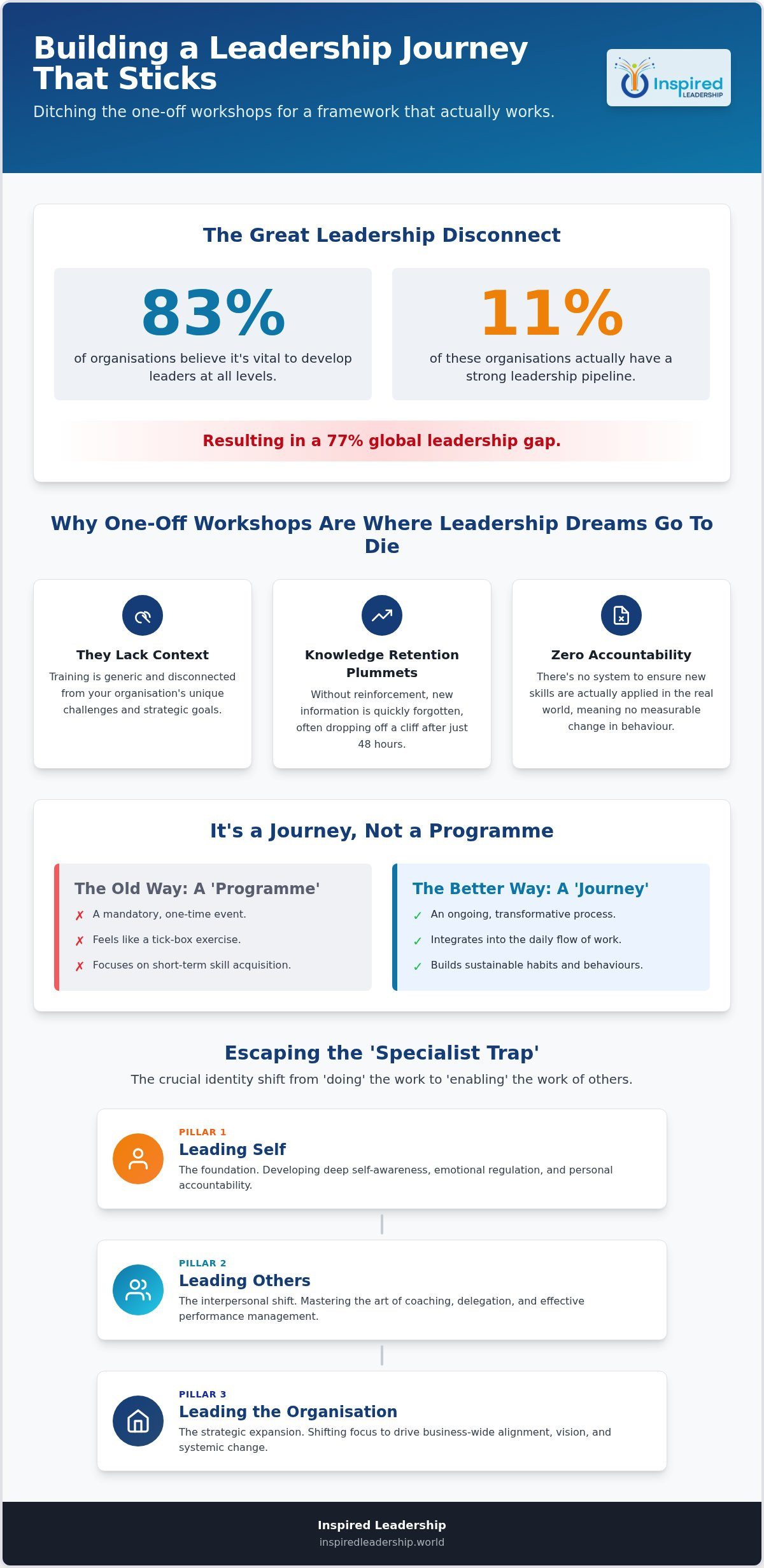
Did you know that whilst 83% of organisations believe it’s vital to develop leaders at all levels, only 11% actually have a strong pipeline? It’s a bit of a mess, isn’t it? You’ve likely seen your top technical wizard promoted to manager, only to watch them struggle because you lack a systemic leadership journey framework.
I’ve spent 20 years in the corporate world watching one-off training events fail as your hard-earned investment vanishes into thin air. You deserve a system that doesn’t just teach theory but actually builds a culture of accountability and strategic grit.
In this guide, we’ll ditch the jargon and look at how to transform your technical experts into high-performing leaders. We’ll explore a clear roadmap for every level of your organisation, ensuring your middle management finally starts taking the lead instead of just taking notes.
Key Takeaways
- Learn why one-off workshops are where leadership dreams go to die and how a systemic leadership journey framework keeps them alive.
- Identify the ‘Specialist Trap’ that causes your brilliant technical wizards to stumble when they first step into a management role.
- Explore the three core pillars of development that move your people from leading themselves to leading the entire organisation with confidence.
- Discover how to align your leadership development with 2026 strategic goals so you can finally see a measurable ROI on your people investment.
- Understand the direct link between improved leadership behaviour and tangible business wins like better staff retention and productivity.
What is a Leadership Journey Framework (and Why Most Fail)?
Most companies treat leadership training like a quick trip to the dentist; it’s painful, forgotten quickly, and usually only happens when there’s a problem. A leadership journey framework is different. It’s a structured path that aligns individual growth with your specific organisational goals, ensuring that development isn’t just a tick-box exercise but a strategic driver of success.
One-off workshops are where leadership dreams go to die. You can’t expect a person to change their entire professional DNA after six hours in a windowless hotel conference room. Real change requires a systemic approach that moves beyond simple skill acquisition and actually addresses the underlying behaviours that drive performance. With 77% of organisations globally reporting a leadership gap, it’s clear that the old ways of “spray and pray” training simply aren’t cutting it. These isolated events fail because:
- They lack context for your specific business challenges.
- Knowledge retention drops off a cliff after 48 hours.
- There is zero accountability for actually applying the new skills in the real world.
Looking at the history of Leadership development, it’s clear that the most successful initiatives are those that treat growth as a process, not an event. We need to stop looking for silver bullets and start building sustainable systems.
A leadership journey framework is the bridge between your current talent and your future organisational capability.
The Shift from ‘Programme’ to ‘Journey’
The word ‘programme’ feels like a mandatory software update; you click a button, wait for the bar to fill, and then it’s done. A ‘journey’ implies ongoing transformation that actually sticks. It’s a bit like buying a gym membership and expecting six-pack abs by just looking at the treadmill. You don’t need another classroom lecture; you need a path that integrates learning into the actual flow of your daily work so that new habits can take root whilst you’re actually leading.
Avoiding the Jargon Trap
Most frameworks are buried under so much academic fluff that your managers will just roll their eyes and get back to their emails. Whether you’re in London, Johannesburg, or New York, your people need pragmatic, human-centred language that actually makes sense in a busy boardroom. We’ve spent 20 years stripping away the nonsense to focus on what actually works for real people. If you aren’t sure where to start your own transition, taking a leadership assessment can help you identify exactly where the gaps are hiding in your team.
The Strategic Architecture: Mapping the Specialist-to-Leader Transition
Have you ever noticed how your most brilliant software engineers or accountants often become your most stressed managers? This is the “Specialist Trap.” It’s a bit like asking a world-class violinist to suddenly conduct the entire orchestra without giving them a baton or a score.
To fix this, you need a leadership journey framework that addresses the psychological shift from being the one who “does” the work to being the one who “enables” it. This architecture provides a vital safety net for that identity crisis. It helps your people realise they aren’t losing their expertise; they’re simply gaining a new, more complex set of tools to drive performance.
This architecture rests on three core pillars. First, Leading Self requires deep self-awareness and emotional regulation. Second, Leading Others focuses on the art of coaching and performance management. Finally, Leading the Organisation shifts the focus toward strategic alignment. Research suggests that a robust framework for leadership development must include these layered stages to be effective.
The Manager to Leader Journey
Your first-line managers are the engine room of your business, yet they’re often the least supported. Moving from a “command and control” style to a coaching mindset is a massive identity shift that can feel quite daunting. If you want your managers to actually lead rather than just micromanage, you can download the brochure for the manager to leader journey to see how we structure this transition.
Developing Technical Talent
Technical experts don’t just need “soft skills” training. They need a leadership journey framework that respects their intellect whilst expanding their perspective. It’s about bridging the gap between logic-driven tasks and the messy, human side of leadership. If you’re struggling to help your specialists make this leap, it might be time to chat with us about your team’s specific needs.
Designing Your Organisation’s Journey for Scalable Performance
As we head toward 2026, your strategic objectives likely involve more than just survival; you want to scale. To do that, you need a leadership journey framework that isn’t just a manual on a shelf, but a living part of your culture. It’s about building a system where leadership is a shared responsibility rather than just a fancy title on a business card.
Medium enterprises face a unique challenge in this regard. You’re large enough to require a formal structure to avoid chaos, yet small enough that your human culture remains your greatest asset. By translating high-level insights into daily actions, you ensure that every manager knows exactly how their behaviour drives the bottom line.
Scaling Capability Across the Board
A truly effective framework needs to work for your fresh-faced graduates just as well as it does for your seasoned senior executives. By fostering peer-to-peer learning, you create an environment where leadership wisdom flows in all directions instead of just trickling down from the top. If you’re looking for a blueprint to develop your high-potential talent, the emerging leader journey offers a structured path for those just starting their ascent.
Empowering Diverse Leadership
Your framework must also act as an accelerator for women and underrepresented talent to ensure your pipeline reflects the global market. Diversity isn’t just a box-ticking exercise; it’s a strategic necessity for innovation and resilience in a complex world. I strongly suggest you explore the Ignite Her leadership journey to see how we specifically support women in reaching their full potential.
Beyond the Classroom: Driving Results through Systemic Change
Measuring the ROI of your leadership journey framework shouldn’t leave you feeling like you’re sitting a surprise maths exam. You can see the results in the way your team handles a sudden crisis or in the noticeable drop in your recruitment costs. When leaders actually lead, your best people tend to stick around.
A Gartner study found that employees with high-purpose alignment are 4.1 times more likely to stay with their employer. That isn’t just a “nice to have” statistic; it’s a massive saving on your bottom line and a boost to your organisational stability. Better leadership behaviour directly fuels productivity because your people spend less time second-guessing their bosses and more time doing their best work.
Moving “Beyond Command” means creating an organisation that finally thinks for itself. You want a self-sustaining leadership culture where ownership and initiative are the default settings, not rare occurrences. This is how you turn a struggling business into a high-performance machine that scales without your constant, exhausted intervention.
Translating Insight into Organisational Action
We’ve all been to those talks where everyone nods along whilst the speaker is on stage, but nothing actually changes on Monday morning. Your framework must insist on practical application through accountability loops that ensure new behaviours actually stick in the real world. If you’re ready to lead with real impact at the executive level, you should look into our Beyond Command journey.
Your Next Steps as a Strategic Catalyst
Pitching a long-term journey to your board requires you to speak the language of sustainable growth and risk mitigation. Start small by implementing a pilot for your technical talent, then use those early wins to prove the case for a wider organisational rollout. Just remember, you can’t fix a systemic organisational problem with a one-day workshop and a plate of soggy sandwiches.
Ready to Build a High-Performance Leadership Culture?
You’ve seen why the old ways of training are failing your people. It’s time to stop crossing your fingers and start building a leadership journey framework that actually turns your technical stars into the managers you need.
We’ve spent over 20 years helping medium enterprises ditch academic theory in favour of tangible results. Your team deserves a roadmap that respects their expertise whilst pushing them to lead with real impact.
You have the talent sitting right there in your office. You just need the right system to unlock it and get your organisation ready for 2026.
Frequently Asked Questions
What is the difference between a leadership journey and a training course?
A leadership journey is a continuous, systemic process of transformation whilst a training course is usually just a one-off event that people forget by Tuesday morning. Our leadership journey framework integrates learning into your daily work so new habits actually stick. It’s the difference between reading a cookbook and actually learning how to run a kitchen under pressure.
How long does a typical leadership journey framework take to implement?
Most organisations see real behavioural change within six to twelve months, though you’ll start noticing “quick wins” much sooner. Transforming a culture isn’t an overnight job; it requires consistent application and feedback loops to ensure the change is permanent. If someone promises to fix your leadership gaps in a weekend, they’re likely selling you snake oil.
Can we customise the framework for our specific industry or technical needs?
You absolutely can, and honestly, you should. A generic leadership journey framework is about as useful as a chocolate teapot when you’re dealing with specific technical challenges. We specialise in tailoring these journeys to fit the unique human dynamics and strategic goals of medium-sized enterprises across various sectors.
How do we measure the success of a leadership journey in a medium-sized company?
Success is measured through tangible business outputs like improved staff retention and higher productivity levels. You’ll also see it in the “unspoken” metrics, such as a decrease in micromanagement and an increase in proactive problem-solving from your middle managers. It’s about seeing your people take ownership without you having to nag them.
Why do technical experts often struggle with the management transition?
Technical experts often struggle because they’re caught in the “Specialist Trap,” where their identity is tied to being the smartest “doer” in the room. Management requires a shift toward enabling others, which can feel like losing your hard-earned edge. A structured journey helps them navigate this identity crisis without losing their technical soul.
Is a leadership journey framework suitable for remote or hybrid teams?
It’s actually vital for remote or hybrid teams because it provides the social glue and clear expectations that physical offices used to offer. A leadership journey framework creates a shared language and consistent standards of behaviour, regardless of where your team is sitting. It ensures that “out of sight” doesn’t mean “out of alignment” with your company goals.