

Promoting your top developer to a leadership role is often the quickest way to lose a brilliant coder and gain a miserable manager. It’s a bold move that frequently backfires because we mistakenly expect technical genius to translate into people mastery by osmosis. If you are searching for a technical lead to manager program, you’ve likely realised that coding logic and human emotions don’t exactly share the same syntax.
You probably feel the weight of declining productivity whilst your new managers drown in a sea of people issues they weren’t equipped to navigate. It is frankly painful to watch high-performers struggle with the shift from doing the work to enabling others to do it. We understand this friction because we’ve spent 20 years watching organisations repeat the same expensive mistakes.
This article explores how to transform your technical experts into high-performing leaders without the usual collateral damage to your team culture. We will look at the specific mindset shifts required to move from specialist to leader through a structured journey. You’ll discover how to protect your output whilst building a leadership pipeline that actually sticks.
Key Takeaways
- Learn how to escape the “specialist trap” where your most brilliant coders become your most stressed managers because, let’s be honest, code is often easier to manage than people.
- Discover how to stop being the “solo hero” and start acting as a force-multiplier for your team, shifting your focus from system architecture to the nuanced world of human dynamics.
- Understand why a structured technical lead to manager program is the most effective way to ensure your high-potential talent thrives whilst navigating their new leadership journey.
- Realise the power of peer support amongst other technical leaders who are navigating the same messy, human-centred challenges as you are.
- Get the roadmap you need to turn vague leadership concepts into measurable action and protect the productivity and happiness of your entire organisation.
The Specialist Trap: Why Technical Experts Often Struggle in Management
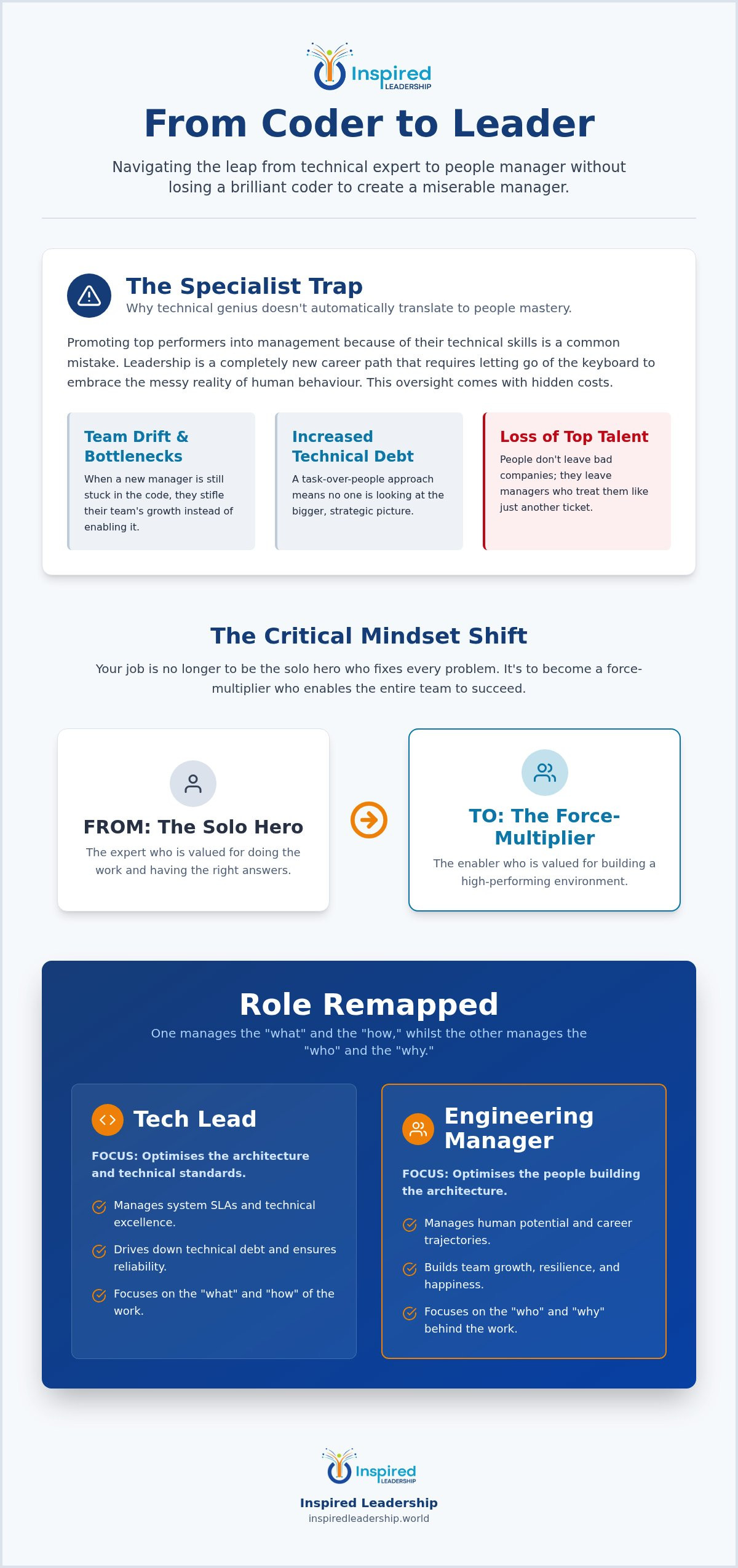
You were probably the person everyone turned to when the production server melted or a bug refused to die. It makes sense that you got promoted, but here is the snag; being a wizard with Python doesn’t mean you’re a wizard with people. This is the classic specialist trap where your best individual contributors are suddenly your most stressed managers.
Technical excellence is about logic and predictable outputs, but leadership is a different beast entirely. It requires a fundamental shift in your professional DNA. If you are looking for a technical lead to manager program, you’ve likely realised that leadership isn’t just a side-quest. It is a completely new career path that requires a different set of tools.
In fast-growing organisations, we see the “accidental manager” syndrome everywhere. People get pushed into leadership roles because they’ve been there the longest or write the cleanest code. However, Engineering Management is its own discipline that requires letting go of the keyboard to embrace the messy reality of human behaviour. You have to trade your favourite IDE for the far more complex task of motivating a diverse group of humans.
The Hidden Cost of the Accidental Manager
When a leader is stuck in the code, the team starts to drift. You might think you’re helping by fixing that ticket yourself, but you’re actually creating a bottleneck and stifling your team’s growth. This task-over-people approach often leads to massive technical debt because nobody is looking at the bigger strategic picture.
If your team is struggling with technical debt, you can discover The Code Factory for specialised code remediation and production readiness reviews to help clear the bottleneck.
Poor management is also the fastest way to lose your best talent. People don’t leave bad companies; they leave managers who treat them like just another Jira ticket. If your leadership style is purely transactional, you’ll soon find your team culture is as brittle as legacy code with no documentation. Investing in a proper leadership journey is the only way to protect your team from this avoidable attrition.
Shifting Focus: Moving from System Architecture to People Leadership
Systems have documentation and predictable outputs. People, however, have bad days, complex motivations, and a frustrating lack of a “reset” button. Transitioning through a technical lead to manager program requires you to accept that your new “codebase” is actually the collective output of your team.
Your job is now to be a force-multiplier. Instead of solving one problem yourself, you’re enabling ten other people to solve a hundred problems. It’s a massive shift from being the solo hero to being the architect of a high-performing environment.
You might feel a twinge of anxiety when you aren’t writing code. That “unproductive” feeling is a lie your ego tells you because it misses the dopamine hit of a successful build. In reality, From Engineer to Manager transitions succeed only when you stop fixing bugs and start coaching people to find their own solutions.
Re-coding Your Professional Identity
You used to be the smartest person in the room. Now, you need to be the most supportive. Soft skills aren’t just “fluffy” extras; they are high-performance technical tools for managing human complexity.
Shifting your identity from “the expert” to “the enabler” is the hardest part of this journey. If you’re struggling to make this mental leap, reaching out to discuss your specific challenges can help clarify the path ahead.
The Technical Lead vs Engineering Manager Framework
While a Tech Lead focuses on system SLAs and technical debt, an Engineering Manager focuses on human potential and career trajectories. You both care about the roadmap, but your execution looks different. Managing a system is about reliability, whilst managing people is about growth and resilience.
- Tech Lead: Optimises the architecture and technical standards.
- Engineering Manager: Optimises the people building that architecture.
One manages the “what” and the “how,” whilst the other manages the “who” and the “why.” Balancing these two perspectives is exactly what turns a standard promotion into a transformational leadership journey.
Essential Components of a Technical Lead to Manager Journey
One-off training workshops are where good intentions go to die. If you really want to move from specialist to leader, you need a structured journey that actually changes behaviour. Leadership isn’t a plugin you can just install overnight.
Whilst many organisations hunt for a “technical lead to manager program” as a quick fix, the reality is that leadership is a muscle you build over time. You need to get your hands dirty with real-world application rather than just memorising management theory. Action beats theory every single time.
We also recommend using a leadership assessment early on. It is the best way to identify the blind spots in your communication that are likely driving your team mad. You can’t fix what you can’t see.
Building Leadership Capability at Scale
Medium-sized enterprises often struggle to develop talent without a massive internal training department. Organising a developmental journey for your high-potential talent ensures that leadership standards remain consistent as you grow. It turns your talent pipeline into a sustainable engine for growth.
The Emerging Leader Journey provides the perfect foundation for this transition. It translates high-level insights into the kind of measurable action that keeps your stakeholders happy and your team engaged.
The Role of Feedback and Mentorship
You need a safe space to fail, and trust me, you will fail occasionally. Having a mentor who has been there helps you navigate those awkward first 1-on-1s without losing your mind. It’s about building resilience whilst you learn the ropes.
Access to Leadership Coaching during your first six months is an absolute game-changer. It provides the external perspective you need to stop micromanaging and start leading with confidence. A bit of expert guidance goes a long way when you’re feeling overwhelmed.
Realising the Potential: How to Organise Your Leadership Transition
The path from a technical expert to a transformational leader is rarely a straight line; it is often a zig-zag through trial, error, and awkward 1-on-1s. Finding the right technical lead to manager program is about more than just a certificate; it’s about a fundamental shift in how you see your role. You have the technical foundations, but now it is time to build the leadership architecture that supports your entire team.
Executives must stop viewing a technical lead to manager program as a luxury and start seeing it as a strategic investment in team retention. Whether you are leading a team in the heart of London or navigating the corporate landscape in South Africa, human-centred leadership remains a universal language. Translating insight into measurable action is what separates high-performing organisations from those stuck in perpetual firefighting mode.
Assess Your Current Leadership Readiness
Before you can lead others, you need a clinical understanding of your own starting point. We recommend taking a Leadership Assessment to identify exactly where your current strengths and friction points lie. This data-driven approach ensures your development journey is tailored to your specific needs rather than a generic checklist.
Your Next Steps Beyond the Code
It is time to decide if you want to remain a brilliant individual contributor or become a catalyst for others. If you are ready to stop micromanaging the syntax and start leading the strategy, explore our Manager to Leader Journey. This path is designed specifically for those who want to bridge the gap between technical depth and executive impact.
You can download the full journey brochure to see the structured path we’ve built over 20 years of corporate experience. Don’t leave your leadership evolution to chance; take the first step towards becoming the leader your team actually deserves.
Mastering the Human Syntax
You have spent years mastering the logic of machines, but the logic of people is where your true impact now lies. Transitioning from a specialist to a leader isn’t about giving up your technical soul; it’s about becoming a force-multiplier for everyone around you. It is a fundamental shift from being the smartest person in the room to being the most supportive.
We’ve spent 20 years helping medium-sized enterprises turn their best coders into their most inspiring leaders through a human-centred approach. Choosing a technical lead to manager program is the first step in moving from fixing bugs to building trust and ownership within your team. We focus on translating high-level leadership insights into measurable action that actually sticks in a corporate environment.
You don’t have to navigate this messy journey alone or settle for outdated training that doesn’t reflect your technical reality. It is time to step away from the keyboard and start architecting the future of your leadership. Taking ownership of your evolution is the best gift you can give your team and your career.
Your team is waiting for the leader you are capable of becoming. Let’s make that transition something you’re actually proud of.
Frequently Asked Questions
What is the primary difference between a tech lead and an engineering manager?
The primary difference is your focus; a tech lead manages the “how” of the technology whilst an engineering manager manages the “who” of the team. While the tech lead stays deep in the codebase and system architecture, the manager focuses on career development, conflict resolution, and team health. It is essentially a shift from being a technical gatekeeper to becoming a human-centred enabler.
Is a technical lead to manager program worth the investment for small teams?
Investing in a technical lead to manager program is actually more critical for small teams because every single person is a massive percentage of your culture. In a team of five, one frustrated manager can tank your entire productivity and cause a mass exodus of talent. A structured journey ensures your few leaders have the tools to build trust and ownership from day one.
How do I know if a technical expert is ready for a management role?
You know they are ready when they start caring more about the team’s success than their own individual commits. Look for signs of empathy, such as mentoring juniors or proactively resolving team conflicts without being asked. If they are already acting as a “force-multiplier” for their peers, they are likely ready to begin their leadership journey.
What are the most common mistakes new technical managers make?
Can someone be both a tech lead and an engineering manager simultaneously?
While you can technically hold both roles in a tiny startup, it is a fast track to burnout and mediocre results in both areas. Attempting to balance deep technical work with the emotional labour of people management usually means one of them gets neglected. It is far better to pick a primary focus so you can excel at either the architecture or the people.