

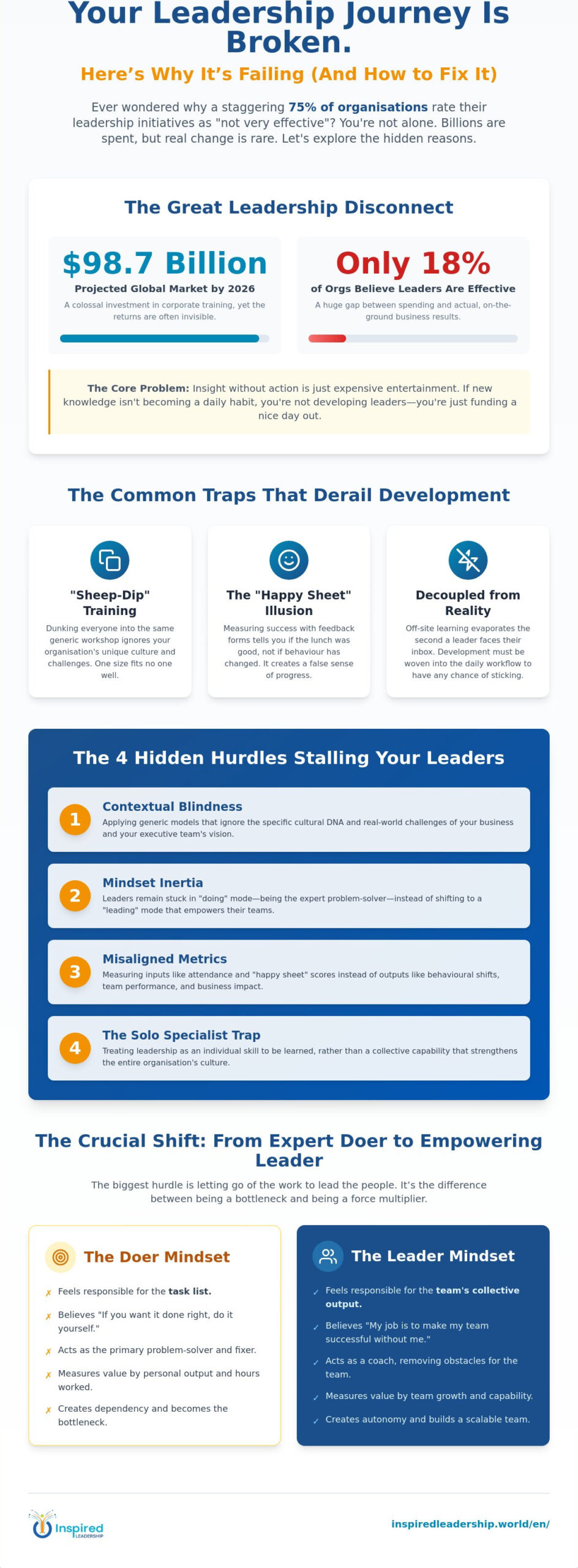
Did you know that 75% of organisations rate their leadership initiatives as “not very effective”? It is a staggering figure that explains why leadership development programs fail so consistently whilst billions are poured into them annually. You have likely felt that sting when your star technical expert crumbles after being promoted to management.
It is incredibly frustrating to watch your budget vanish into “sheep-dip” training that leaves leaders full of theory but empty of action. You want a pipeline of people who actually own their decisions, yet you are often left with the same old friction points and a lack of accountability. We have spent 20 years watching this cycle, and frankly, it is time to stop the rot.
In this article, you will discover the systemic hurdles that cause these initiatives to stagnate and learn how to build a journey that delivers genuine organisational transformation. We will explore how to move beyond the classroom to create a culture where your leaders do not just know what to do; they actually do it. By the end, you will have a clear roadmap to ensure your investment finally yields the ROI your business deserves.
Key Takeaways
- Understand why leadership development programs fail when they rely on generic “sheep-dip” training that ignores your unique organisational context.
- Identify the systemic friction points and hidden mindsets that stop your managers from taking full accountability for their results.
- Learn how to help your technical experts escape the “Specialist Trap” so they can stop doing and start leading.
- Discover how to design a transformational journey that turns theoretical insight into practical, everyday habits that actually stick.
The Great Leadership Disconnect: Why Billions Go Down the Drain
Global corporate training spend is eye-watering, with the market projected to reach $98.7 billion by 2026. Despite this massive investment, only 18% of organisations believe their leaders are truly effective at achieving business goals. It’s a staggering disconnect that leaves executives wondering where the money actually went.
One of the main reasons why leadership development programs fail is the “Sheep-Dip” trap. You’ve likely seen it: a company rounds up every manager and dunks them into the same generic workshop, hoping they’ll emerge transformed. It ignores the unique context of your business and the specific hurdles your people face.
Insight without action is simply expensive entertainment for your staff. If your leaders aren’t translating their new knowledge into daily habits, you’re just paying for them to have a nice day out. Real Leadership development must focus on the human factor of behavioural change to be sustainable.
The Illusion of Progress: Why Happy Sheets Lie
We often rely on “happy sheets” to measure success, but these reactionary metrics are deeply flawed. A high rating usually just means the lunch was decent and the facilitator was charismatic. It tells you nothing about whether your culture is actually shifting or if your managers are making better decisions.
Relying on these scores creates a false sense of security for HR departments and executives alike. You might feel like you’re making progress, but without tangible shifts in behaviour, you’re just ticking boxes. True success isn’t found in a feedback form; it’s found in the way your team handles a crisis three months later.
Decoupling Learning from the Reality of the Desk
Most training fails because it happens in a vacuum, far away from the chaos of a daily inbox. This off-site learning usually evaporates the second a manager returns to their desk and faces a mounting pile of “urgent” emails. You can’t expect someone to change their leadership style in a sterile hotel conference room.
Development needs to be a journey that happens whilst people are actually doing their jobs. When learning is decoupled from daily reality, it never stands a chance against the old habits that keep your organisation stagnant. We need to bridge the gap between “knowing” and “doing” in the thick of the action.
The Human Factor: Four Systemic Friction Points Stalling Your Growth
Identifying why leadership development programs fail isn’t just an academic exercise. It’s about figuring out why your brilliant people are hitting a brick wall. Most initiatives stall because they ignore the systemic friction points that exist right under your nose.
- Contextual Blindness: Ignoring the specific culture and challenges of your business.
- Mindset Inertia: Leaders who are stuck in “doing” mode rather than “leading” mode.
- Misaligned Metrics: Measuring attendance instead of actual behavioural shifts and team performance.
- The Solo Specialist: Treating leadership as an individual skill rather than a collective organisational strength.
Why Context is King in Medium-Sized Enterprises
What works for a global conglomerate with 50,000 employees will likely fall flat in your nimble, growing company. You don’t need a generic framework that was designed for a different world. You need a bespoke journey that aligns perfectly with the vision of your current executive team.
If the development isn’t grounded in your actual daily challenges, it’s just expensive noise. We’ve seen too many brilliant teams struggle because they were forced into a one-size-fits-all box. If you’re ready to move past the generic fluff, it might be time to chat about a more tailored approach for your team.
The Mindset Shift: From Doing to Leading
The biggest psychological hurdle is often the hardest to talk about: letting go of “the work” to actually lead the people. Your high performers often feel like they’re losing their identity when they stop being the primary “doer” in the room. It’s a bit like a star striker struggling to become a manager; they still want to run onto the pitch and kick the ball themselves.
An ownership mindset is the core of leadership maturity, where the leader takes full responsibility for the team’s collective output rather than just their own task list. Without this shift, your managers will always be the bottleneck in your business. They’ll keep “fixing” things themselves whilst their teams wait for permission to act.
The Specialist Trap: Why Generic Journeys Fail Technical Talent
Your best engineer is probably your most frustrated manager right now. This is a classic reason why leadership development programs fail; we take someone who loves “doing” and tell them to “manage” without shifting their internal compass. A generic leadership journey won’t stop them from wanting to grab the keyboard and fix the problem themselves.
Meet the “Hero Manager.” They are the one who swoops in at 2 AM to fix a server issue because they don’t trust the team to handle it. Whilst they feel like a martyr, their team feels redundant and uninspired. It might solve the immediate crisis, but it destroys the team’s ability to own their actions and grow.
To stop this cycle, you need a specific Manager to Leader Journey. This approach addresses the psychological shift from technical output to human influence. It helps your experts understand that their value now comes from the success of others, not their own individual brilliance.
Developing First-Line Managers at Scale
First-line managers are the most critical yet most neglected level of your organisation. They move the needle every day, yet they often receive the least support when transitioning from being a star contributor. Based on 20 years of corporate experience, we know that a structured Emerging Leader Journey is vital for ensuring new talent has the tools to lead before they burn out.
The Technical Talent Pivot
Technical experts need a different language of leadership to feel authentic. They often view “management” as a distraction from the “real work” they were hired to do. Helping them pivot from technical output to strategic influence is the only way to keep them effective without losing their specialist identity or their passion for the business.
Translating Insight into Action: Designing a Journey that Sticks
It is time to stop buying off-the-shelf courses and start designing transformational journeys with clear, measurable milestones. One of the main reasons why leadership development programs fail is that they lack a functional bridge between the classroom and the real world. Every piece of learning you invest in must be immediately applied to a genuine organisational problem to have any hope of sticking.
You want to build a culture where leadership is “owned” by every individual rather than just being a set of rules handed down from the board. This requires moving beyond surface-level skills to address the deep-seated behaviours that drive daily performance. Our Human Factor Journey is designed specifically to tackle the “why” behind the “how,” ensuring that change is both profound and permanent.
When you integrate development into the flow of work, it stops being a chore and starts being a catalyst for growth. You will see the difference when your managers stop asking for permission and start taking accountability for their outputs. It is about creating a sustainable ecosystem where leadership is a shared responsibility, not a solo sport.
The Power of the Results-Driven Alternative
Moving from “knowing” to “being” is a rigorous process that requires sustained coaching and objective assessment. It isn’t enough to understand the theory of leadership if you cannot execute it whilst under pressure in a high-stakes meeting. You can start by taking our Leadership Assessment to identify exactly where your team stands today and where the hidden friction points are hiding.
Your Next Steps: Beyond the Brochure
You should stop settling for superficial training that leaves your managers feeling inspired for a week before they revert to their old habits. Demand tangible outcomes that reflect in your bottom line and your staff retention rates. It is time to embrace a battle-tested alternative that prioritises human potential over corporate jargon.
If you are ready to build a leadership pipeline that thinks, acts, and owns its results, we are here to guide you. Explore our range of transformational journeys and download the brochures to see how we can help your organisation thrive. Your path to genuine leadership maturity starts with a single, decisive step toward a more human approach.
Stop the Stagnation and Start the Journey
You now have the roadmap to move beyond generic workshops that don’t stick. By identifying systemic friction points and helping your technical experts escape the “Specialist Trap,” you can build a pipeline of leaders who truly own their actions. Understanding why leadership development programs fail is the first step toward creating a culture of genuine accountability and growth.
We bring over 20 years of corporate experience to the table, specialising in transformational journeys for First Line Managers and Technical Talent. We don’t do “sheep-dip” training; we build sustainable behavioural change that reflects in your organisation’s bottom line. It’s time to stop wasting your budget on superficial fixes and start investing in a journey that actually delivers.
Are you ready to stop wasting budget and start building leaders?
Your team’s potential is waiting for the right catalyst. Let’s make it happen together.
Frequently Asked Questions
How do you measure the ROI of a leadership development journey?
You measure ROI by tracking tangible behavioural shifts and their direct impact on business performance metrics like staff retention or project delivery speed. Research suggests that effective development can return an estimated $7 for every $1 invested. Move beyond “happy sheets” and look at how team accountability and decision-making improve over time.
Can you really change the mindset of a long-term technical specialist?
Absolutely, but it requires a strategic pivot rather than a personality transplant. You help them realise that their value now comes from their influence and the success of others rather than just their individual technical output. It is about shifting their internal compass so they stop “doing” and start leading with confidence.
Why do managers revert to their old behaviours after a training course?
Managers revert to old habits because most training is treated as a one-off event that evaporates the moment they face a mountain of emails. This lack of integration into daily work is a major reason why leadership development programs fail so consistently. Without sustained support and real-world application, the path of least resistance will always win.
What is the difference between a leadership program and a leadership journey?
A program is typically a series of classroom events with a start and end date, whereas a journey is a sustained, transformational process. Journeys integrate learning into the daily flow of work and focus on long-term habit formation rather than just ticking a box. One is a transaction; the other is a genuine evolution of your organisational culture.
How long does it take to see real behavioural change in an organisation?
You will likely see initial shifts in awareness and action within the first few weeks of a structured journey. However, deep-seated cultural change and habit formation usually take six to twelve months of consistent application and coaching. Why leadership development programs fail is often due to organisations giving up before these new behaviours have truly taken root.