

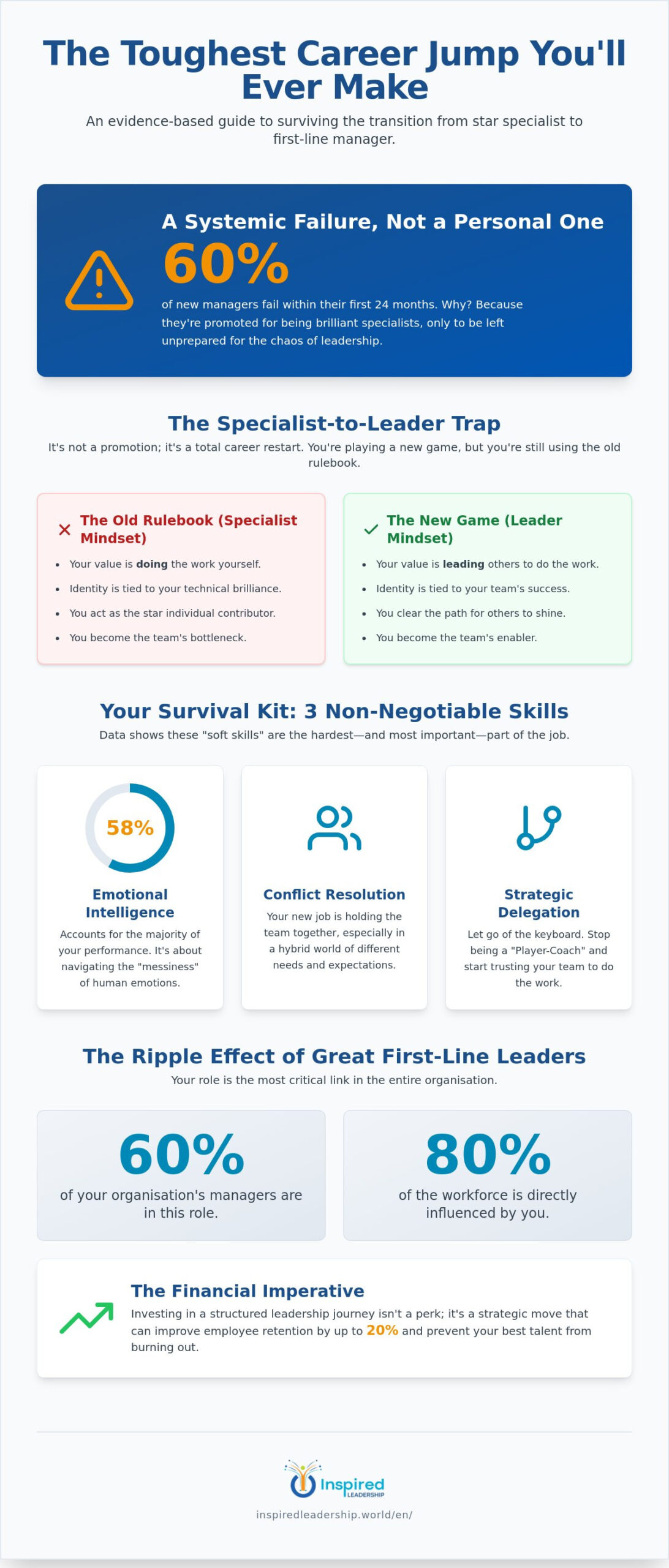
Did you know that 60% of new managers fail within their first 24 months because they weren’t properly prepared for the jump? This employee to first-line manager transition research overview reveals that most of us are promoted for being brilliant specialists, only to end up drowning in admin whilst our former work besties start treating us like the enemy. It’s a documented phenomenon that feels like a personal crisis, but the data suggests it’s actually a systemic failure.
You likely feel like a glorified admin assistant rather than a visionary leader, stuck in a specialist-to-leader trap that drains your energy. We promise to help you navigate this identity overhaul with evidence-based strategies that turn that friction into genuine influence. You’ll find validation that your current struggle isn’t a lack of talent, but a lack of a structured roadmap.
We’ll explore the managerial identity shift and look at the research behind why only 18% of people are naturally wired for this specific type of chaos. By the end of this journey, you’ll have a clear understanding of how to survive the shift from doing to leading. Let’s dive into the realities of the most difficult career jump you’ll ever make.
Key Takeaways
- Understand why your technical brilliance might actually be holding you back and how to bridge the “Identity Gap” that leaves new leaders feeling like imposters.
- Explore this employee to first-line manager transition research overview to discover why emotional intelligence and delegation are your new best friends for avoiding the 60% failure rate.
- Master the art of “Boundary Management” so you can lead your former work besties without things getting weird or losing their respect.
- Stop falling for the “Player-Coach” myth that’s currently tanking team productivity and learn how to focus on leading rather than just doing more work.
- Discover why a long-term leadership journey is the only way to actually change your brain and survive the most difficult career jump you will ever make.
The Specialist-to-Leader Trap: Why Your Best Experts Often Stumble
The “Specialist-to-Leader Trap” is a phenomenon where your technical brilliance actually masks a total lack of leadership capability. It happens when organisations promote their best “doer” into a line manager role, assuming that task-mastery automatically translates to people-mastery. This employee to first-line manager transition research overview suggests that this shift is less of a promotion and more of a total career restart.
In territories like the UK or South Africa, businesses frequently promote based on historical performance metrics that have zero correlation with leadership potential. This creates a research-backed “Identity Gap” where your ego remains tied to “doing” the work whilst your new role requires you to step back. If you feel like you’re drowning, you aren’t failing; you’re simply trying to play a brand new game with an old rulebook.
The Psychology of the Inflection Point
Research highlights that your self-perception must undergo a radical shift to avoid the 60% failure rate seen in new managers. Take the “star” coder who gets promoted but still spends their weekends fixing everyone else’s bugs because they can’t let go of the keyboard. This behaviour doesn’t just lead to burnout; it tells your team you don’t trust them, which is a recipe for team resentment.
Why Traditional Training Fails the Research Test
One-off workshops are often just expensive entertainment that provides a temporary “aha” moment without any lasting change. To truly hardwire new leadership behaviours, you need a sustained Manager to Leader Journey that translates insight into action. Data confirms that without a structured process, most new managers revert to their specialist roots as soon as the first deadline hits.
What the 2026 Data Reveals: Critical Competencies for New Managers
First-line leadership represents 60% of the manager population and directly influences the productivity of 80% of the workforce, making it the most critical link in any organisation. This employee to first-line manager transition research overview shows that your new role is less about technical oversight and more about becoming a “culture carrier” in a hybrid world. It’s about holding the team together when half of them are in the office and the other half are working in their pyjamas.
Research from 2026 identifies three non-negotiable skills for survival: emotional intelligence, conflict resolution, and strategic delegation. According to the Kellogg School of Management, one of the biggest challenges for first-time managers is the stubborn refusal to stop doing the technical work themselves. Emotional intelligence alone accounts for 58% of performance in these roles, proving that your “soft skills” are actually the hardest part of the job.
Let’s be honest, the “Player-Coach” model is a myth that usually ends in tears and team resentment. Your team doesn’t want a manager who competes with them for the best tasks; they want a leader who clears the path for them to shine. If you’re still trying to be the top individual contributor whilst managing five people, you’re not a coach, you’re a bottleneck.
The ROI of Evidence-Based Development
Investing in a structured Manager to Leader Journey isn’t just a nice-to-have; it’s a financial imperative that can improve employee retention by up to 20%. For medium-sized firms, these interventions are the difference between scaling successfully and burning through your best talent. When you move beyond “one-off” training, you start seeing measurable shifts in team productivity and morale.
The Human Factor in Technical Transitions
Technical experts often struggle with the “messiness” of human emotions because, unlike code or spreadsheets, people don’t always follow logic. Using a Leadership Assessment helps you identify these blind spots before they become full-blown career derailers. If you’re ready to stop guessing and start leading with precision, feel free to reach out for a chat about your specific challenges.
Navigating the Friendship Trap: Peer to Manager Research
It’s all fun and games until you have to give a performance review to the person you were doing shots with last Friday. This employee to first-line manager transition research overview highlights that “Boundary Management” is the single biggest hurdle for internal promotes. If you focus too much on being liked, you’ll find it impossible to be respected when tough decisions land on your desk.
Research suggests that the “Friendship Trap” often leads to a performance dip because new leaders are afraid to hold their mates accountable. You can be friendly without being a “bestie” at the cost of the team’s output. It’s about shifting your focus from individual popularity to collective success.
To reset your relationships without looking like a corporate robot, follow this simple 3-step framework:
- Acknowledge the awkwardness: Name the shift out loud to clear the air.
- Define the new boundaries: Be clear about what has changed and what stays the same.
- Invite feedback: Ask your team how you can support them in this new dynamic.
Setting the New Social Contract
Having the “reset conversation” requires authentic, human-centred language rather than rehearsed HR scripts. Being transparent about your new responsibilities builds more trust than pretending nothing has changed whilst you secretly panic behind your laptop. This honesty creates a psychological safety net for the entire team.
Managing Conflict Amongst Former Peers
Research on “Fairness Perception” shows that teams are hyper-sensitive to any hint of favouritism from a former peer. This is especially tricky if you are managing a “resentful runner-up” who also applied for your new role. Navigating this requires a deep understanding of The Human Factor to ensure everyone feels heard without undermining your authority.
If you’re struggling to draw the line between friend and boss, contact us today for a chat about how to reset your team dynamics and build a culture of respect.
Designing Your Leadership Journey: From Insight to Action
We’ve dissected the data and looked at the pitfalls, but now it’s time to focus on your actual future. This employee to first-line manager transition research overview has shown that simply knowing the facts isn’t enough to survive the jump. You need to move from the “what” of research to the “how” of your daily leadership habits.
One-off training is often just a fleeting moment of inspiration that disappears by Monday morning, whilst a journey is designed to actually hardwire new behaviours into your brain. It’s the difference between reading a map and actually walking the path. We want you to think about your legacy: do you want to be just another boss, or a strategic catalyst for your team’s success?
If you’re ready to move beyond the theory, contact Inspired Leadership to discuss how we can design a bespoke journey for your organisation. We specialise in turning experts into leaders who actually enjoy their jobs.
The Power of the Ownership Mindset
The most significant mental shift you’ll ever make is moving from “owning the task” to “owning the output” of your entire team. This means your success is no longer about your own keyboard strokes, but about the collective performance of the people you lead. This fundamental mindset shift is the hallmark of our Emerging Leader Journey, where we help you let go of the “doing” to embrace the “leading.”
Your Next Practical Steps
To sum up the research: you need a mentor, a proven framework, and the courage to be a bit quirky. Don’t try to fit into a boring corporate mould that doesn’t suit your personality. Authenticity builds trust far faster than a polished, robotic exterior ever could.
Final cheeky reminder: don’t let your technical brilliance be the reason your leadership fails. You’ve spent years becoming an expert in your field, so give yourself the grace and the tools to become an expert in people too. The transition is tough, but with the right support, it’s the most rewarding journey you’ll ever take.
Master Your Evolution from Expert to Architect of Change
This employee to first-line manager transition research overview confirms what you’ve likely felt in your gut: the jump is massive and the old specialist rulebook is useless. You’ve seen that the identity gap and the friendship trap are documented hurdles, not personal failures. It’s time to stop playing the old game and start mastering the new one.
We bring 20 years of real-world corporate expertise to help you move from technical brilliance to genuine leadership impact. Our human-centred approach prioritises people over processes, ensuring transformational results for medium-sized enterprises ready to scale. We don’t just teach theory; we facilitate the shift in self-perception required to lead with confidence.
Don’t stay stuck in the “Player-Coach” bottleneck whilst your team’s productivity stalls. You’ve outgrown the technical grind, so don’t let your specialist brilliance be the reason your leadership fails. You deserve a structured roadmap that turns these research insights into daily habits and sustainable success.
Download the First-Line Manager Journey Brochure and start your transformation today. You’ve already got the talent; now let’s find your rhythm as a leader. We can’t wait to see you thrive in your new role.
Frequently Asked Questions
What is the biggest mindset shift when moving from employee to first-line manager?
The most significant shift is moving from “owning the task” to “owning the outcome” of the entire team. You have to stop measuring your success by how much work you personally finish and start measuring it by how well your team performs. It’s a radical identity overhaul that requires letting go of the technical tools you’ve spent years mastering.
How long does it usually take to feel confident as a new manager according to research?
Research suggests it takes between six to twelve months for most new managers to move past the “imposter” phase and find their rhythm. This employee to first-line manager transition research overview highlights that without a structured journey, that timeline often stretches even longer. You aren’t supposed to feel like an expert on day one; you’re essentially starting a brand new career from scratch.
What can organisations do to reduce failure rates in first-line leadership roles?
Organisations can slash failure rates by replacing one-off workshops with sustained, structured leadership journeys that focus on behavioural change. Providing a mentor and a clear framework for the first 90 days is also essential for survival. When companies prioritise the “human factor” over simple admin training, retention rates for new leaders can improve by up to 20%.
Is it possible to manage former peers without losing their friendship?
Yes, it is possible to lead former peers, but it requires setting a new “social contract” through radical transparency and clear boundaries. You have to be honest about your new responsibilities whilst acknowledging the inherent awkwardness of the situation. Being respected for your fairness is far more sustainable than trying to be everyone’s favourite “bestie” at the cost of team performance.
Why do high performers often struggle during the transition to management?
High performers often struggle because their technical brilliance doesn’t naturally translate into the “messy” world of human emotions and conflict resolution. They fall into the “Specialist-to-Leader Trap”, where they try to solve every problem themselves rather than delegating. Since only 18% of people have a high natural talent for managing others, even the best “doers” need specific development to succeed.