
Why are we still pouring money into a global leadership market worth over $113 billion when so many of these programmes result in nothing but a fancy cheese platter and a few ignored posters? You have likely seen it before: a “big vision” is announced with a flourish, yet six months later, your technical experts are still micromanaging and your management layers feel as disconnected as a patchy NBN connection.
It is incredibly frustrating when a high-stakes organizational leadership transformation feels more like a box-ticking exercise than a genuine shift in performance. You deserve a culture of ownership and a talent pipeline that does not dry up the moment a senior executive decides to retire to the Sunshine Coast.
When internal development needs to be supplemented by external expertise, you can visit Calibre One to learn how they help build high-performing leadership teams through specialized executive search.
This article provides the pragmatic, no-nonsense steps to translate that executive vision into daily habits across your entire team. We will bypass the usual corporate fluff to focus on measurable improvements and building capability that actually lasts.
Key Takeaways
- Stop burning your budget on “one-and-done” workshops that result in nothing but fancy catering and dusty binders. Real change is a team sport that requires a systemic shift in collective behaviour.
- Learn why your first-line managers are the engine room of any organizational leadership transformation. If they aren’t on board, your executive vision is just a very expensive daydream.
- Help your technical wizards stop micromanaging and start leading by facilitating the psychological shift from “doing” to “coaching”. It is the only way to build a talent pipeline that doesn’t crumble under pressure.
- Follow our no-nonsense 4-step guide to move from isolated training events to structured leadership journeys. We focus on senior alignment and building habits that actually survive a busy Tuesday afternoon.
Why Your Last Organisational Leadership Transformation Probably Stalled
Let’s be honest. Most transformations fail because they are treated like a software update rather than a cultural overhaul. An organizational leadership transformation is a systemic shift in collective behaviour, not just a new set of slides for the quarterly meeting.
If your strategy is a masterpiece but your execution is a mess, you have fallen into the “Executive Memo” trap. This happens when a brilliant vision is announced with a flourish but never actually reaches the people doing the hard work on the front line.
One-off workshops are the absolute enemy of genuine cultural change. You cannot expect a three-hour session with a guest speaker and a tray of lukewarm party pies to fix years of ingrained habits.
Real progress requires Transformational leadership that focuses on long-term growth rather than short-term fixes. It is about building a sustainable environment where your people feel empowered to take genuine ownership of their results.
This shift often requires moving toward regenerative business principles. For leaders wanting to ditch extractive habits, Jannine Barron offers the mentorship needed to align your organization with sustainable, nature-inspired models.
The Friction Points of Medium-Sized Enterprises
Medium-sized businesses often hit a wall when rapid growth outpaces the skills of the original team. You might have “accidental managers” who were promoted because they were technical geniuses, not because they knew how to handle a difficult performance review or inspire a team. If you are evaluating your options, our comprehensive guide on leadership development for medium sized companies breaks down exactly how to move beyond generic workshops and build a programme that scales with your business.
These technical experts often struggle to move from “doing” to “leading,” which creates a massive bottleneck in your engine room. Without a common leadership language, your layers of management become disconnected and your best laid plans start to sputter.
You need a structured approach that translates high-level strategy into daily action. If you are ready to move past the fluff, head over to our Senior Leadership and Executive Journeys page and download the brochure to see how we make change actually stick.
Building Leadership Capability at Scale: The Engine Room of Change
If the executive suite is the bridge of the ship, your first-line managers are down in the engine room making sure the propellers actually turn. They are the most critical lever in any organizational leadership transformation because they translate high-level strategy into actual work. Without their buy-in, your grand vision is just a collection of expensive words on a company intranet.
You need them to lead, not just supervise. The biggest hurdle is the psychological shift from “doing” the work to “leading” the people who do it. This requires letting go of the technical tools and picking up the coaching skills that foster a genuine culture of ownership across every layer.
Identifying high-potential talent early is the key to preventing a talent pipeline that dries up or, worse, leaks your best people to competitors. When you cultivate an ownership mindset, you move away from directive control and toward a model where every employee feels responsible for the business outcome. Our practical checklist for developing ownership mindset in leaders is an essential resource for Australian scale-ups who are tired of being the only person in the room who truly cares about the result.
Addressing the Specialist-to-Leader Trap
We have all seen it happen. Your best engineer gets promoted to manager as a reward, and suddenly you have a frustrated team and a project that is lagging. Technical brilliance does not automatically translate to people brilliance, and assuming it does is a recipe for burnout.
These specialists need a specific toolkit that includes radical empathy, clear feedback loops, and the ability to influence without barking orders. Providing a safety net during this transition is vital to prevent the “quiet cracking” that currently affects 71% of leaders according to recent industry data.
If you want to help your experts make this leap without the usual corporate drama, take a look at our High-Potential Technical Talent Program. You can download the brochure there to see how we build leaders who actually know how to lead.
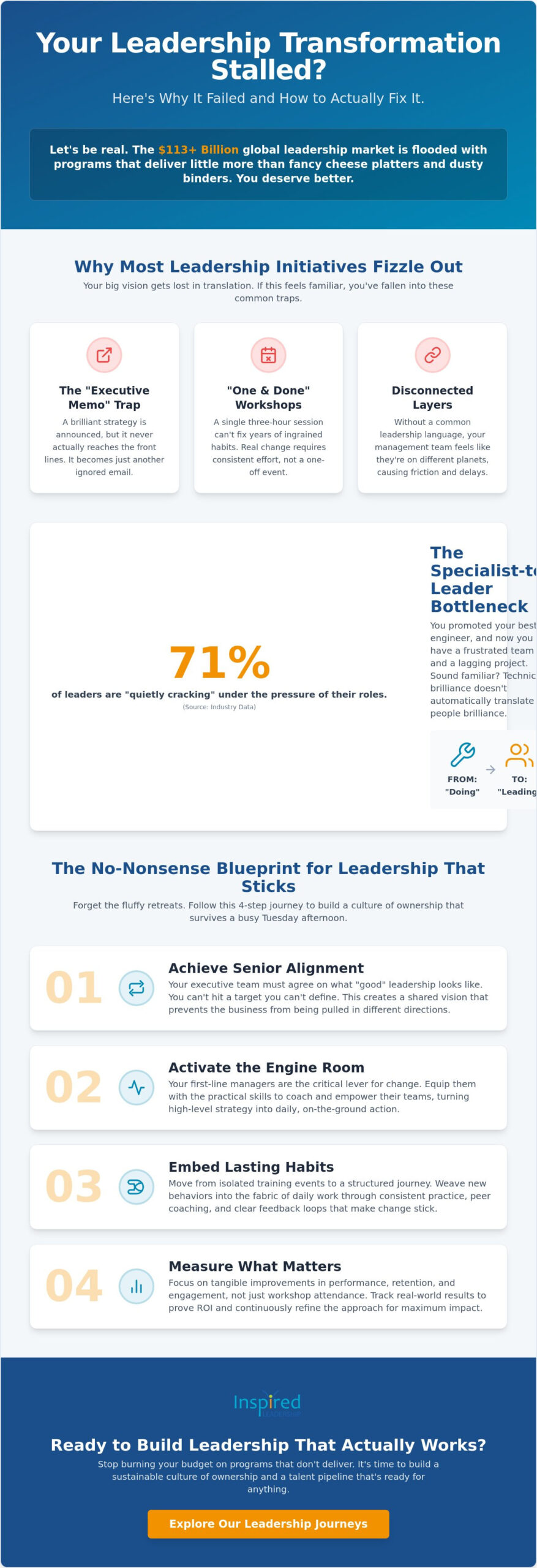
A 4-Step How-To Guide for Sustainable Leadership Journeys
Forget the fluffy retreat in the Hunter Valley. If you want an organizational leadership transformation that actually survives the first sign of a budget cut, you need a blueprint that prioritises action over theory.
Step one is about senior alignment. Your executive team must agree on what “good” looks like, or they will end up pulling the business in four different directions at once. It is about creating a shared vision that moves beyond vague buzzwords and into concrete behaviours.
Step two requires shifting from isolated training events to structured journeys. Real growth happens in the spaces between sessions, where leaders have time to reflect, fail, and try again. It is a marathon, not a sprint, and your development programme should reflect that reality.
Step three is embedding real-world application. If your managers aren’t using their new skills within forty-eight hours, the knowledge is as good as gone. Finally, step four is measuring the shift from insight to tangible action, focusing on performance metrics rather than just “happy sheets” from the training room.
Translating Insight into Action
Knowledge is only potential power; it only becomes real when your managers apply it on the job. Peer coaching is a brilliant way to sustain this, as it creates a community of accountability where leaders support each other through the messy bits of behavioural change.
For those just starting their climb, our guide on new manager leadership development offers a deep dive into building these habits from day one. It is about making sure your newest leaders don’t just survive, but actually thrive in the engine room.
Creating a Culture That Thinks and Owns
Moving from a “tell” culture to a “coaching” culture is the ultimate goal. When you decentralise decision-making, you empower your team to solve problems at the source rather than waiting for permission from three levels up. If your scale-up is struggling with passive leadership behaviour, our no-nonsense checklist for developing ownership mindset in leaders walks you through exactly how to stop being the Chief Everything Officer and build a team that genuinely owns the outcome.
This shift builds a business that is responsive and resilient. If you are ready to start this journey, head over to our First Line Manager Program page and download the brochure to see how we turn managers into coaches.
Choosing Your Partner for the Leadership Journey
Selecting a partner for your organizational leadership transformation shouldn’t feel like buying a mystery box. While massive global consultancies often charge upwards of $200,000 for enterprise-level programmes, they frequently deliver little more than a polished slide deck and a hefty invoice. You need a results-driven alternative that prioritises practical change over theoretical frameworks.
We bring twenty years of battle-tested corporate experience to your business, minus the soul-crushing jargon. This isn’t about following a generic global template; it’s about understanding the specific nuances of your industry and your people. We focus on what actually moves the needle in a fast-paced Australian environment.
A structured accelerator is the most effective way to fast-track your high-potential talent before they get itchy feet and look for the exit. By providing clear pathways for growth, you ensure your best people stay engaged and ready to step up. You wouldn’t hire a plumber to fix your internet, so don’t hire a generic consultant to fix your culture. To compare your options with confidence, the 2026 buyer’s guide to leadership development for medium sized companies is an essential resource for making a well-informed investment decision.
The Inspired Leadership Difference
We don’t do boring, and we certainly don’t do “one-off” events. Our focus is on building capability at scale through structured journeys that ensure your team actually owns their actions. We help you translate that big executive vision into the small, daily habits that actually drive performance.
We believe in a cheeky and bold approach to corporate challenges because, frankly, life is too short for dry, dusty leadership models that put everyone to sleep. Our methods are designed to be engaging, memorable, and just a little bit provocative to get the best out of your team.
We help you lead an organisation that is resilient, responsive, and ready to tackle the future head-on. If you’re tired of the usual corporate fluff and want a partner who actually gets it, we should talk. Visit our Senior Leadership and Executive Journeys page and download the brochure to start your real transformation today.
Ready to Build a Culture That Actually Owns Its Future?
Leadership isn’t about the plaque on the wall or a fancy retreat in the Blue Mountains. It is about the daily habits of your managers and the way your team solves problems when you aren’t in the room. A successful organizational leadership transformation requires a shift from directive control to genuine coaching and ownership.
We have spent twenty years stripping away the jargon to create specialised journeys that turn technical experts into people leaders. Our no-nonsense methodology focuses on building capability at scale, ensuring your vision doesn’t just sit in an executive memo gathering dust.
You don’t have to navigate this journey alone. Ready to transform your team? Visit our First Line Manager Program page and download the brochure to see how we make change stick. Let’s get to work on building a business that is as bold and resilient as you know it can be.
Frequently Asked Questions
What is the biggest mistake companies make during organisational leadership transformation?
The most common blunder is treating an organizational leadership transformation as a top-down executive memo rather than a collective shift in behaviour. You can’t just announce a “new vision” and expect your front-line managers to magically know how to change their daily habits. Real transformation fails when it lacks a structured way to bridge the gap between high-level strategy and the actual work happening in the engine room.
How long does a typical leadership journey take to show results?
You will usually see immediate wins in team communication and clarity within the first ninety days, but a deep cultural shift typically takes six to twelve months. This isn’t a quick fix or a microwave dinner; it is a deliberate process of building and reinforcing new habits. Lasting results happen when these behaviours become the “way we do things around here” rather than just a special project that gets forgotten by Christmas.
Can technical experts really become great people leaders?
They absolutely can, provided they are given the right toolkit to navigate the psychological shift from “doing” to “leading”. Most technical wizards struggle because they try to fix people like they fix code or machinery, which usually leads to frustration. Once they learn to influence and coach rather than micromanage, their analytical minds often make them some of the most fair and effective leaders in the business.
How do we measure the ROI of a leadership development program?
You measure ROI by tracking tangible improvements in employee retention, project delivery speed, and the health of your internal talent pipeline. With 71% of leaders currently reporting high levels of stress and “quiet cracking”, a successful organizational leadership transformation should also show a clear reduction in burnout and turnover costs. Investing in your people is far cheaper than the constant cycle of recruitment and onboarding caused by poor management.
What is the difference between a leadership workshop and a leadership journey?
A workshop is a single event where people learn a theory; a journey is a structured, long-term process where people build actual habits. Think of a workshop as a first date and a journey as a committed relationship that actually goes somewhere. If you’re ready to move past one-off events and build real capability, visit our Senior Leadership and Executive Journeys page and download the brochure to see how we make change stick.