
Your best technical performer just became a manager. The decision felt logical; they delivered results consistently, demonstrated technical mastery, and earned peer respect. The organisation assumed the transition would follow naturally from past performance. Six months later, the team is struggling. Productivity has slowed. Frustration is building. The person who once solved every technical problem now seems unable to delegate, avoids difficult conversations, and spends more time doing the work than leading people.
This pattern appears across organisations with predictable regularity. Strong technical performers are promoted into management roles based on expertise rather than leadership readiness, and shortly after promotion, capability gaps surface across teams. A talented engineer struggles with performance conversations. A brilliant architect becomes defensive when questioned. A reliable problem-solver micromanages every decision, creating bottlenecks rather than removing them.
The organisation typically attributes the struggle to individual shortcomings, perhaps they weren’t “ready” or lack natural leadership ability. In reality, this is a leadership system failure. The organisation promoted based on past performance in a different role, without assessing or developing the fundamentally different capabilities required for management. This reveals where leadership pipeline fragility enters the organisation: at the critical transition point where technical excellence must transform into people leadership.
Why are promoted managers failing?
The decision to promote someone into management typically follows predictable logic: reviewing past performance, considering tenure, and evaluating technical expertise. Yet the assumption underlying this decision, that strong technical performance naturally translates into strong leadership performance, is rarely questioned.
This is not because promotion criteria are irrelevant. The problem is that they measure the wrong capability. Technical performance indicates how well someone solves problems and delivers individual results. Leadership readiness indicates how well someone develops others, delegates effectively, and creates conditions for team performance. These are fundamentally different capabilities. When organisations promote based on technical performance alone, they select for a skillset the role no longer requires while ignoring the skillset it depends on.
The result is predictable leadership pipeline fragility. Capable people are placed into roles they were never prepared for, without the capability assessment or development support the transition demands. Organisations observe symptoms, inconsistent leadership behaviour, declining team performance, managers reverting to technical work, and typically frame these as individual failures. In reality, the system unintentionally set them up to fail. The promotion decision gap is not a hiring mistake. It is a leadership system failure, and it is both measurable and preventable.
Why are managers doing and not leading?
The behaviours that follow promotion are predictable. Newly promoted managers continue doing technical work, often spending more time solving problems than developing people. They struggle to delegate, either because they believe they can deliver faster results themselves or because they have never been shown how delegation functions as a leadership capability. Difficult conversations are postponed or avoided entirely.
The organisation begins to notice symptoms. Team productivity slows as decisions bottleneck through a single person. Frustration builds among team members who expected leadership but received micromanagement instead. The newly promoted manager, now overwhelmed by both technical and people responsibilities, reverts to what feels safest: the work they already know how to do well. The result is manager burnout, as they attempt to do the work they are good at, fix everyone else’s problems and attend countless meetings that have magically added to their load. Leadership behaviour becomes inconsistent across teams because each manager constructs their own version of what leadership means, without operational definition or structural support.
This is not an isolated occurrence. It is a system outcome. When promoted managers underperform, organisations typically frame the struggle as individual failure. In reality, the transition from individual contributor to manager was never supported by the system. The role changed completely, yet the organisation provided neither preparation nor reinforcement.
The Hidden System Failure
When this pattern appears repeatedly across different teams, functions, and levels, the explanation shifts. This is not an individual failure. This is a leadership system failure, and it is both predictable and preventable.
The system design problem begins long before promotion. Most organisations only begin developing leadership capability after someone becomes a manager. By then, the pressure is already high. The newly promoted manager is expected to deliver team results immediately while simultaneously learning an entirely new skillset. No transition support exists. No diagnostic assessment preceded the promotion decision. No structural reinforcement follows the role change.
This reveals the deeper infrastructure problem. When organisations treat leadership development as something that happens after promotion rather than before it, leadership pipeline fragility becomes embedded into the promotion process itself. The organisation selects for technical performance, promotes without assessing leadership readiness, and provides no systemic support for the transition. The result is exactly what decision-makers observe: inconsistent leadership behaviour, declining team performance, and capable people struggling in roles they were unintentionally set up to fail in.
What does a Strong Leadership Pipeline Look Like?
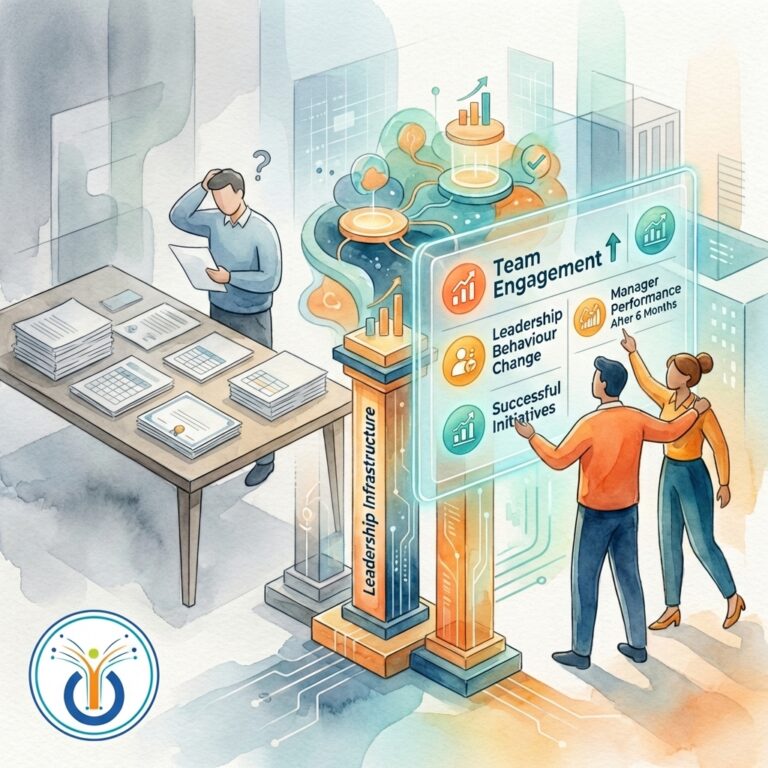
Organisations with strong leadership systems build infrastructure that most others never consider. They identify emerging leaders earlier, assessing leadership capability gaps while people are still individual contributors. Development begins before the transition from individual contributor to manager occurs, not afterwards, when pressure is already high, and expectations are fixed.
These organisations do not treat leadership as an event. They build leadership journeys, structured pathways where capability is developed progressively, reinforced consistently, and supported systemically. Rather than waiting for vacancies to appear, they maintain continuous visibility of emerging talent across departments and functions. Measurement infrastructure exists to assess leadership capability across the population, revealing exactly where leadership pipeline fragility is entering the system and where investment should be directed.
The most mature organisations also build feedback loops into their leadership development, allowing them to refine their approach based on real outcomes. They recognise that leadership capability requires ongoing investment, coaching, and environmental support to sustain performance at higher levels.
Conclusion
Leadership is not a promotion; it is a career pivot. Treating it as a “next step” on a technical ladder is a structural error that guarantees inconsistency. To build a resilient organisation, leadership development must move from a reactive “post-promotion” event to a proactive “pre-promotion” infrastructure. When you assess readiness early and support the transition systemically, you don’t just fill vacancies – you build a sustainable engine for organisational performance.
Build a pipeline, not just a list of names. Don’t wait for a management vacancy to start developing your leaders. Learn how to implement a pre-transition development journey that ensures your managers hit the ground running.
Frequently Asked Questions
Why are promoted technical experts often failing as managers?
The failure stems from a “Promotion Decision Gap.” Organisations typically promote based on technical mastery and past results, which are fundamentally different from the skillsets required for leadership. By using technical performance as the primary metric, the system selects for a role the individual is no longer performing while ignoring the people-development capabilities the new role demands.
Why do new managers revert to doing the work rather than leading?
When overwhelmed by a new role without proper training, managers revert to what feels safest: the technical work they already know how to do well. This leads to micromanagement, decision bottlenecks, and burnout, as they attempt to solve everyone else’s problems rather than delegating and developing their team.
Is leadership struggle an individual failure or a system failure?
It is a system failure. When the same patterns of poor delegation and avoided conversations appear across different teams, it indicates that the organisation has failed to provide the necessary diagnostic assessments, transition support, and structural reinforcement required for a successful career pivot.
When should leadership development actually begin?
Development must begin before the transition occurs. Most organisations wait until a vacancy appears or after someone is already in the role. A strong system identifies and develops emerging leaders while they are still individual contributors, ensuring they have the required capability before the pressure of the new role begins.
How do you build a resilient leadership pipeline?
A resilient pipeline is built on proactive infrastructure rather than reactive events. This includes continuous visibility of emerging talent, structured leadership journeys, and measurement systems that identify exactly where fragility enters the pipeline, allowing for data-driven investment.
What is the "Hidden System Failure" in most organisations?
The hidden failure is treating leadership development as a post-promotion event. This embeds fragility into the promotion process itself, setting managers up to learn a brand-new skillset under high-pressure conditions with zero transition support.
What is the difference between technical performance and leadership readiness?
Technical performance measures how well an individual solves problems and delivers results. Leadership readiness measures how well an individual develops others, delegates effectively, and creates the systemic conditions necessary for team-wide performance.