Attendance rates. Completion rates. Satisfaction scores. Post-workshop feedback forms. Reports proudly show 95% completion and 4.5-star ratings. Yet when the CFO asks what actually changed in the business, the answers tend to focus on activity rather than outcomes. The spreadsheet looks impressive until the most important question is asked: Did performance improve?
Why is there a growing gap between HR metrics and C-suite expectations?
The gap between what HR measures and what the C-suite expects has widened significantly. Finance leaders are looking for reduced turnover in critical roles, faster time-to-productivity for newly promoted managers, and measurable gains in team performance. They want data connected to revenue, retention, and operational efficiency. Instead, they are often presented with participation metrics and feedback scores. Measuring leadership development by attendance is similar to evaluating a fitness programme by counting gym visits rather than tracking improvements in health indicators.
What happens when credibility meets misalignment?
Over time, this misalignment creates a credibility challenge. Each new leadership initiative becomes harder to justify because previous investments have not demonstrated clear business impact. HR leaders feel pressure to show return on investment, yet the available metrics largely prove participation, not transformation. Many know that behaviour change is short-lived, that managers revert to previous habits within weeks, but existing measurement frameworks rarely capture that regression. This is not merely a reporting issue. It reflects a deeper disconnect between how leadership development is delivered and how business results are created.
Why Isolated Training Struggles to Deliver ROI
The difficulty in proving ROI is not necessarily a reflection of weak content. It is more often a consequence of trying to measure the impact of isolated events on what is fundamentally a systems challenge.
Can a two-day event compete with years of established habits?
Leadership capability does not develop through two-day workshops or quarterly sessions alone. It evolves through consistent application, feedback, and refinement over time. When leadership is treated as an event, organisations expect a single intervention to produce lasting behavioural change within a complex system that naturally reinforces established habits.
Why do managers revert to old patterns so quickly?
Consider what typically happens once a leadership programme concludes. Participants return to environments without structured support for new behaviours, without accountability mechanisms to reinforce application, and without ongoing measurement to track transfer into the workplace. The pressures, team dynamics, and organisational constraints that shaped previous behaviours remain unchanged. In the absence of systematic reinforcement, managers revert. Not because learning did not occur, but because isolated training cannot compete with daily operational realities.
Is the lack of ROI a content problem or a design problem?
This is why ROI often remains elusive. It is difficult to measure the business impact of something that is never embedded into how work actually gets done. The training event ends, yet the capability gap persists because no system was designed to close it. There is no continuous diagnosis of leadership challenges, no structured application to real business priorities, no feedback loops, and no accountability for sustained behavioural change.
What Systemic Leadership Development Looks Like
1. Clarity of Expectation: What is the stable core of our leadership?
Systemic leadership development begins with defining a stable core of behaviours required for operational execution at every level. While strategic goals may fluctuate, these core leadership requirements remain the constant foundation for what effective leadership looks like in practice. This alignment ensures that every leader understands exactly what is expected of them in their current role and identifies the specific capabilities required to progress to the next. Rather than relying on generic competency frameworks that sit unused, expectations are tied to observable behaviours and measurable business outcomes.
2. Diagnostic Measurement: Where are our actual capability gaps?
Once expectations are clear, the system requires a baseline assessment of leadership capability against those specific requirements. This is not an annual survey but a diagnostic that identifies the gap between current behaviour and the established standard. In a mature system, this measurement becomes a continuous pulse, providing visibility into where capability is strengthening and where gaps remain. It informs enablement priorities by highlighting exactly where the organisation needs to focus its developmental energy.
3. Enabling Behaviours: How do we build sustainable learning journeys?
Leaders are equipped to meet these expectations through structured, “slow-burn” learning journeys rather than one-offs. A critical component of this enablement is embedded peer accountability. Leadership development becomes a collective capability-building process where, in structured peer groups, leaders bring real business context, test new approaches, and report back on results. This shift from individual learning to structured collaboration is designed to increase application and reduce behavioural regression within the workflow.
4. Application Measurement: Is the learning reaching the workflow?
As development is implemented, the system measures the application of new behaviours in real-time. We move away from asking participants if they enjoyed a program and instead focus on behavioural indicators linked to business outcomes: Are managers conducting effective one-to-ones? How quickly do new leaders improve team performance? This measurement phase reassesses the leader at defined intervals, ensuring that advancement and recognition are based on demonstrated changes in decision-making and results delivery rather than courses attended.
5. Addressing Structural Inhibitors: What is getting in the way of success?
The final stage creates a closed loop by assessing the organisational processes and structures that may be hindering the very behaviours we expect. If individual leaders are not behaving as expected despite being equipped to do so, we must ask: What is getting in the way? Whether it is excessive workload, dysfunctional tools, or a meeting culture that stifles productivity, identifying and addressing these systemic barriers is essential. This ensures the burden of change does not rest solely on the individual but is supported by an environment designed for leadership success.
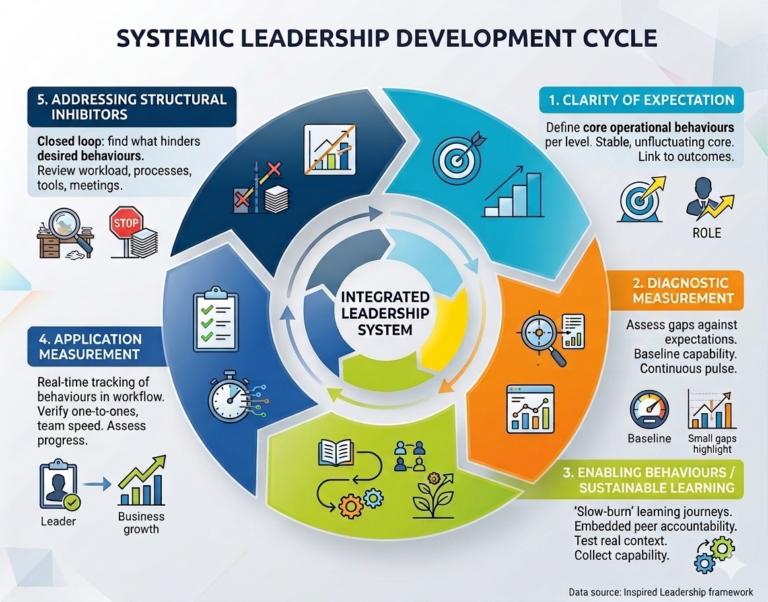
When clarity of expectation, diagnostic measurement, sustainable enablement, and the removal of structural inhibitors operate together, leadership development becomes truly embedded. ROI becomes visible because the organisation is tracking the specific leadership behaviours that directly influence retention, performance, and engagement. By treating leadership as a measurable, integrated system, capability gaps are not just identified—they are systematically closed.
Barriers HR Encounters and How to Address Them
How do we reframe the budget conversation with Finance?
Budget constraints often surface when HR proposes moving from episodic training to systematic development. Finance leaders may question additional investment when previous initiatives have not shown measurable returns. However, systematic approaches frequently reduce long-term costs by creating reusable infrastructure rather than repeatedly purchasing standalone programmes. The key is reframing the conversation: instead of proposing “more training,” present a diagnostic assessment that quantifies current leadership capability gaps in business terms.
How can we overcome executive scepticism and internal resistance?
The discussion shifts when HR moves from selling programmes to presenting systems. Demonstrate built-in accountability mechanisms and clear links to business outcomes. Executives engage when they see infrastructure designed to measure the performance variables they prioritise. Similarly, position measurement to managers not as surveillance, but as targeted support. When leaders understand that diagnostics identify specific development priorities, measurement becomes a tool for growth rather than compliance.
Starting With Diagnosis, Not Programmes
Why does a “programme-first” approach often fail?
A common reason leadership development fails to deliver ROI is that organisations begin by selecting programmes instead of diagnosing problems. Choosing solutions before identifying where capability is breaking down increases the likelihood of investing in interventions that do not address the most pressing gaps. An organisation may purchase comprehensive content on strategic thinking when the immediate issue is ineffective feedback or poorly run team meetings.
How does a mature system evolve over time?
Capability gap assessment should precede any investment. Before allocating budget, organisations need clarity on what is expected from various manager levels. In initial implementation, the priority is to equip all managers with the language and skills expected. As the system matures, measurement can diagnose which specific capabilities are missing and how those gaps affect performance.
In a business environment increasingly focused on measurable impact, HR’s strategic credibility depends on this shift. The future of leadership development lies not in delivering better events, but in building systems capable of producing, sustaining, and measuring meaningful change.
Frequently Asked Questions
How do we actually link leadership behaviour to the P&L?
In a systemic model, we stop measuring “happiness” and start measuring “indicators of operational friction.” We track specific correlations, such as how the frequency of effective 1-to-1s reduces regrettable turnover costs, or how improved decision-making clarity at the middle-manager level reduces project rework and “escalation lag.” When behaviours are standardised (Step 1) and measured (Step 4), they become lead indicators for financial outcomes like EBITDA and operating margin.
Is "systemic" development just a more expensive way of saying "long-term training"?
Quite the opposite. While traditional training is a recurring expense with high “decay” (where 80% of learning is lost within weeks), a leadership system is an investment in infrastructure. By identifying structural inhibitors (Step 5), you remove the hidden costs of productivity killers like meeting bloat or dysfunctional processes. You aren’t just paying for content; you are optimising the environment where leadership happens.
Why should we invest in measurement when we already have annual engagement surveys?
Annual surveys are “lagging indicators” – they tell you that your house is on fire after the roof has collapsed. Systemic diagnostic measurement (Step 2) provides “leading indicators.” It gives the board a real-time pulse on capability gaps before they manifest as a talent exodus or a missed quarterly target. It shifts HR from a reactive function to a predictive one.
My managers are already time-poor; how can they handle "sustainable learning journeys"?
The “slow-burn” approach (Step 3) actually saves time by moving learning into the flow of work. Instead of losing a manager for two full days to a workshop, systemic development uses micro-engagements and peer accountability groups that take your context into account in real-time. It transforms development from “extra work” into “the way we do work.” Creating not just learning for today, but developing active learning strategies that are a key future skill.
What is the biggest risk of staying with our current "event-based" training model?
The biggest risk is Sunk Cost and Behavioural Regression. Without the “closed-loop” of a system, you are essentially pouring water into a leaky bucket. You may spend thousands on world-class content, but if the internal structures (Step 5) remain hostile to those new behaviours, your managers will revert to old habits, and your investment will evaporate.