
You have invested consistently in leadership development across your organisation. The budget has been allocated, the programmes have been delivered, and the frameworks have been communicated. Yet some teams are thriving while others are struggling, and the gap between them is widening. High performance appears in pockets rather than patterns. The inconsistent leadership across teams is not a random variation; it is a signal that something structural is missing from the system.
This is not about uneven talent distribution or poor hiring decisions in particular divisions. The managers having trouble are often technically capable, well-intentioned, and committed to improvement. The problem is that leadership behaviour at scale requires more than development content and good intentions. Without the architectural infrastructure to define, develop, reinforce, and measure consistent leadership capability across the organisation, even sustained investment produces uneven outcomes. You are seeing the predictable result of desiring leadership capability without building the system designed to sustain it.
Is inconsistent leadership a people problem or a system failure?
The instinct when leadership performance varies across an organisation is to diagnose it as a capability gap in specific individuals or teams. That diagnosis leads to predictable interventions: targeted coaching for underperforming managers, additional training for struggling divisions, and performance management conversations framed around individual accountability. These interventions address symptoms while the structural cause remains untouched.
Why does leadership training fail to scale across the organisation?
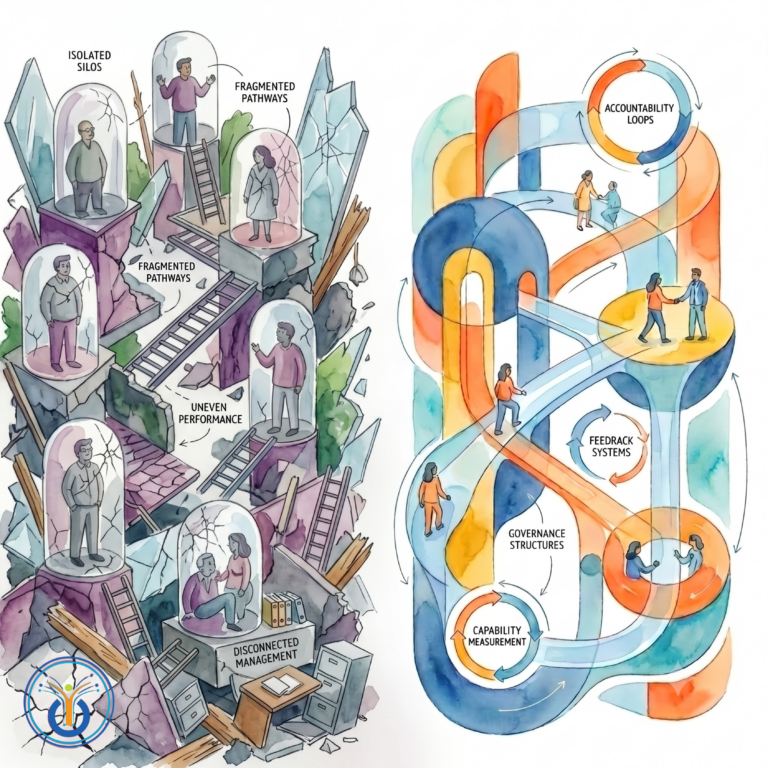
Leadership inconsistency is not primarily an individual failure. It is a system design failure. When an organisation has no shared architecture for how leadership behaviour is defined, developed, reinforced, and measured consistently, it produces variation by default, not because the managers are inadequate, but because the system was never designed to produce the required consistency.
What infrastructure is required to sustain consistent leadership behaviour?
The gap is not in the people. The gap is in the infrastructure surrounding them. Some managers succeed because they intuitively develop effective leadership practices, receive strong operational support from their direct leaders, or work in environments where informal accountability mechanisms function well. Others struggle because those conditions are absent, and no formal system exists to compensate for their absence. The organisation interprets this as a performance distribution problem when it is an infrastructure problem. Scaling leadership capability requires operational definitions of what good leadership looks like in this organisation, development journeys that equip managers with the skillsets and mindsets required, structural reinforcement that embeds those behaviours into daily work, and measurement systems that make capability visible across the population. Without that architecture, leadership development ROI remains elusive, and inconsistent leadership behaviour persists regardless of how many leadership academies, academic courses and 2 day off-site high-energy events occur.
The Three Systemic Failures
The first failure is definitional. Most organisations have defined organisational values, some have competency frameworks, and a few have aspiration statements that describe what leadership should look like. Far fewer have operational definitions of leadership behaviour that are observable, measurable, and contextually specific to each manager level in the organisation. Without operational definitions, each manager constructs their own interpretation of what good leadership means in practice. The result is not alignment but translation drift, where the same framework produces different behaviours across different teams. Leadership consistency cannot exist when the system has never defined what consistency looks like in operational terms.
The second failure is structural. Even when organisations invest significantly in leadership development, that development typically arrives as content delivered separately from the operational conditions that shape actual leadership behaviour. Training occurs off-site or in dedicated sessions, disconnected from the daily decisions, interactions, and accountability structures where leadership is practised. When development sits outside the system rather than being embedded within it, individual learning evaporates without structural reinforcement. Developing leadership capability requires more than 2 days off-site and a binder full of good intentions. It requires organisational architecture that reinforces desired behaviour through workflow design, decision rights, operational habits, and managerial accountability mechanisms that persist long after the training session ends.
The third failure is diagnostic. In the absence of a measurement infrastructure that assesses leadership capability across the entire manager population, organisations cannot see where capability gaps actually exist or how they are distributed. Investment decisions are guided by perceived problems rather than diagnosed ones, by anecdotal evidence rather than population-level data. Without diagnostic visibility, resources flow toward the most visible symptoms or the most vocal stakeholders rather than toward the structural points where intervention would produce the greatest systemic impact. You cannot improve what you cannot see, and most organisations have never built the measurement infrastructure required to make leadership behaviour visible, trackable, or improvable in any systematic way.
What does Consistent Leadership Actually Require?
Leadership consistency is not achieved through better frameworks or more intensive development programmes, although that is a start. It is achieved through architecture: the operational definitions, governance structures, and diagnostic systems that make consistent behaviour structurally possible rather than individually heroic. This requires three foundational elements that most organisations have never built. First, operational definitions that translate leadership aspiration into observable, measurable behaviour at each organisational level. Second, structural reinforcement mechanisms that embed those definitions into decision-making processes, accountability rhythms, and workflow design so that the system actively produces the behaviour it claims to value. Third, diagnostic infrastructure that makes leadership capability visible across the entire manager population, enabling investment decisions to be guided by data rather than intuition. Without these three elements functioning as an integrated system, scaling leadership capability remains structurally impossible regardless of development investment.
The gap between aspiration and consistency is an infrastructure gap, not a content gap. Organisations that achieve leadership behaviour at scale do not do so because their frameworks are superior or their managers more talented. They do so because they have built the governance and measurement systems required to produce consistency as a system output rather than relying on individual managers to construct it independently. This means defining leadership in operational terms specific to context and level, designing accountability structures that reinforce those definitions through regular managerial interactions, and implementing diagnostic tools that assess actual capability rather than training completion. Leadership development ROI becomes measurable only when development is surrounded by architecture designed to sustain it. The question is not whether your organisation values consistent leadership. The question is whether the system is structurally designed to produce it.
Conclusion
A binder full of good intentions is no match for a broken system. If your leadership behaviour is inconsistent, it is because your organisational architecture allows – or even encourages – that variation. The solution isn’t another off-site event; it is the hard work of building the definitions, reinforcements, and diagnostics that make great leadership the path of least resistance. You don’t need better people; you need a system that is designed to produce the behaviour you claim to value.
Design a system where excellence is inevitable. Stop chasing symptoms and start building architecture. Schedule a strategy session to identify the three systemic failures in your current pipeline and learn how to build a leadership system that actually sticks.
Frequently Asked Questions
What causes leadership inconsistency across an organisation?
Leadership inconsistency is a system design problem, not a talent or culture problem. When organisations lack operational definitions of what good leadership looks like at each level, managers construct their own interpretations. Without structural reinforcement mechanisms and diagnostic infrastructure to measure capability across the population, variation becomes the default outcome. The system was never designed to produce consistency, so it doesn’t.
Why does leadership development investment fail to produce consistent behaviour?
Development content delivered separately from operational reality evaporates without structural reinforcement. Training that occurs outside the daily accountability structures, decision-making processes, and workflow conditions where leadership is practised produces individual learning that the system doesn’t amplify. Scaling leadership capability requires an architecture that embeds development into the operational infrastructure.
What is an operational definition of leadership behaviour?
An operational definition translates leadership aspiration into observable, measurable behaviour specific to organisational context and level. Unlike values or competency frameworks that describe what leadership should look like generally, operational definitions specify exactly what good leadership means in practice within this organisation. They provide the shared reference point required for consistency, replacing translation drift with structural clarity about what the system is designed to produce.
How do you measure leadership capability at scale?
Measuring leadership capability at scale requires diagnostic infrastructure that assesses actual capability across the entire manager population, not training completion or engagement scores. This means implementing assessment systems that make leadership behaviour visible, trackable, and comparable across teams and divisions. Without population-level diagnostic data, investment decisions remain guided by perceived problems rather than diagnosed ones, and resources flow toward symptoms rather than structural intervention points.
What infrastructure is needed to scale consistent leadership behaviour?
Scaling leadership capability requires three foundational elements: operational definitions that specify observable behaviour at each level, structural reinforcement mechanisms that embed those definitions into accountability rhythms and decision-making processes, and diagnostic systems that make capability visible across the population. These elements must function as an integrated architecture, not as separate initiatives. Consistency becomes structurally possible only when the system is designed to produce it as a deliberate output.
Why is leadership performance inconsistent even with a large budget?
Inconsistency is a signal of a missing system, not a lack of talent. Without an architectural infrastructure to define, reinforce, and measure behaviour, high performance only appears in “pockets” where individuals happen to be intuitively skilled or well-supported, rather than as an organisational standard.
Is leadership inconsistency a result of poor hiring?
Rarely. Most struggling managers are technically capable and well-intentioned. The variation occurs because the organisation lacks a shared architecture. Without a system to compensate for different environments, the organisation produces behavioural variation by default.
Why doesn't targeted coaching fix organisational leadership gaps?
Targeted coaching and 2-day off-sites address individual symptoms but leave the structural cause untouched. Individual learning evaporates when it lacks “workflow reinforcement”—the accountability mechanisms and operational habits required to sustain behaviour change in a high-pressure environment.
What are the three pillars of a consistent leadership system?
To achieve consistency at scale, an organisation requires:
- Operational Definitions: Clear, measurable behaviours for every level.
- Structural Reinforcement: Embedding leadership habits into the actual daily workflow.
- Diagnostic Infrastructure: Population-level data to see where capability gaps actually exist.
What is the "infrastructure gap" in leadership development?
The infrastructure gap is the absence of governance and measurement systems. Most organisations focus on “content” (what to know), but fail to build the “architecture” (how to ensure it happens) that makes consistent leadership a predictable system output rather than an act of individual heroism.