
Most organisations have invested significantly in leadership development. Managers attend workshops, complete programmes, and return to their teams armed with new frameworks and models. Yet the same patterns repeat with striking consistency. Performance remains uneven across the organisation. Behaviour reverts to old habits within weeks. HR teams find themselves defending initiatives they know aren’t translating into results, exhausted by the persistent gap between effort and impact.
This is not about poor content or uncommitted leaders. Many programmes are well-designed, and participants are genuinely motivated. It is about a fundamental misalignment between how leadership training is delivered, typically through episodic events, and how leadership capability actually develops in practice through ongoing experience, feedback, and application. The problem is structural, predictable, and rarely diagnosed accurately. Organisations continue investing in solutions that address symptoms while the system producing those symptoms remains unchanged, creating a cycle of repeated investment with diminishing returns.
Why doesn’t event-based training work?
The familiar pattern persists because most leadership interventions are designed as events rather than systems. Organisations send managers to workshops, invest in once-off programmes, or roll out content-heavy training modules. Participants engage, take notes, and return to their roles with genuine intent. Yet within weeks, behaviour reverts. Why leadership training fails is not about the quality of the content. It is about the absence of structural support surrounding it.
Learning does not automatically translate into application. A manager may understand delegation in theory but face no accountability for practising it consistently. When the opportunity to delegate is right in front of them, they are not thinking about the training they had 3 months ago, and they certainly aren’t primed to look for delegation opportunities amidst their deluge of work. They may grasp the principles of feedback, but although they may recall feedback being critical, they can’t remember the approach, that was demonstrated and even practiced in the training course when they also learned about delegation, coaching and leadership styles!
The gap between knowing and doing is not a motivation problem. It is a system design problem. Without timely, bite-sized content, ongoing reinforcement, peer accountability, and visibility into leadership behaviour change, even well-designed training evaporates on contact with operational reality.
Organisations continue investing in solutions that address individual capability, while the conditions producing inconsistent leadership across teams remain unchanged. A single training event cannot compete with the daily pressures, competing priorities, and established norms that shape actual behaviour. Proving leadership development ROI becomes impossible when the intervention was never structured to produce measurable, sustained behaviour change. The problem is not the workshop. The problem is treating leadership capability as something that can be installed rather than something that must be built, reinforced, and measured as infrastructure.
Why is Leadership Behaviour still Erratic across the Organisation?
The problem is not that organisations lack leadership training. Most have invested heavily in programs, workshops, and coaching initiatives. The problem is that organisations lack leadership systems. They have frameworks, values, and competency models, yet no operational definition of what good leadership behaviour looks like at each level, in each context, in this organisation. Without that clarity, each manager constructs their own interpretation based on their background, experience, and assumptions. The result is the patchwork of inconsistent behaviour across teams that executives observe but struggle to diagnose. Whilst this may appear as a skills and knowledge gap. It is also an infrastructure gap.
Development arrives disconnected from the conditions that shape actual behaviour. Training occurs outside operational reality, separate from the daily pressures, competing priorities, resource constraints, and established norms that determine how managers actually lead. Even well-designed content evaporates when it encounters a system that was never structured to reinforce it. An example of this is a sales manager who has personal sales targets to meet AND the responsibility of growing the numbers of their sales team. Structural targets will drive behaviour. Imagine that same manager who has no personal target but their success is measured on the group target being obtained.
Application requires more than intent. It requires accountability structures, peer reinforcement, visible consequences, and consistent visibility into whether leadership behaviour is being practised or merely discussed academically in safe training environments. Without these mechanisms, proving leadership development ROI becomes impossible because the intervention was never designed to produce measurable change. The intervention was supported so that they could say, “We have trained our managers”.
Most critically, organisations have limited measurement infrastructure. They can track participation, satisfaction, and completion rates, yet cannot track improvement in leadership capability across the population. Investment decisions are guided by perception rather than diagnosis. Resources flow toward the loudest complaint or the most visible failure, not toward the actual breakdown in the system. The gap is not in the training content or the quality of facilitators. The gap is in the architecture required to make that content operational, accountable, and measurable across a complex organisation.
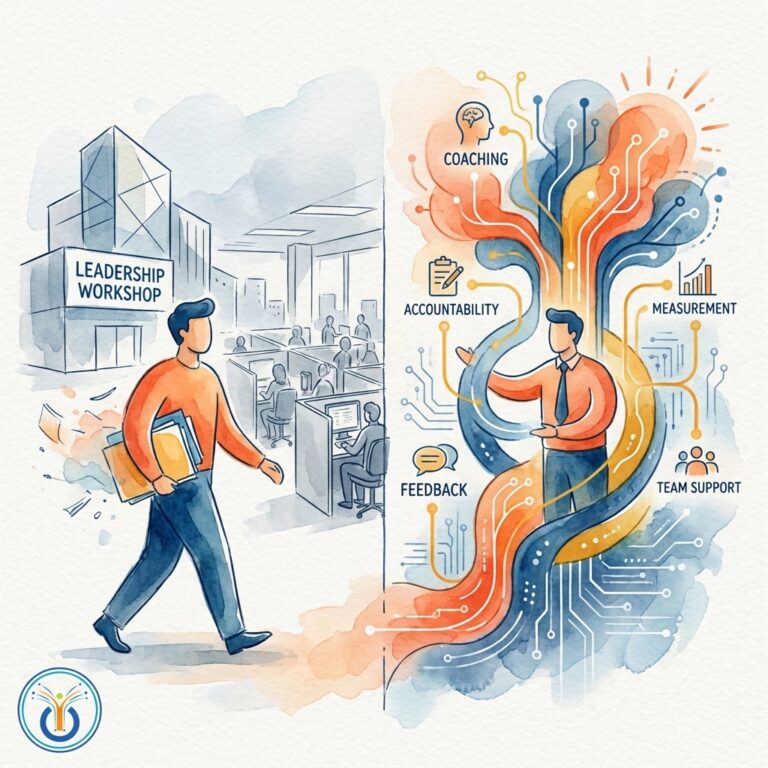
How can we derive Value from the Training Delivered?
The shift is not about better content. It is about different architecture. Organisations that solve why leadership training doesn’t work at scale do not improve the content of the workshop. They redesign how it is delivered and what surrounds it. Development becomes blended rather than episodic, woven into operational reality rather than extracted from it. Application is structured into the design, not hoped for after the fact. Accountability mechanisms are built in, not bolted on. And measurement focuses on capability demonstrated across the population, not on participation rates or satisfaction scores. This is the difference between aspiration and infrastructure.
When leadership systems are designed correctly, behaviour change becomes visible, trackable, and reinforceable. Managers do not return from training and revert because the system now holds them accountable for practising what was introduced. Peer reinforcement, manager oversight, and diagnostic visibility combine to create conditions where application is expected and measured. The question shifts from whether someone attended a session to whether their leadership capability has improved in ways the organisation can observe and quantify. Proving leadership training effectiveness becomes possible because the intervention was structured to produce evidence, not an attendance sheet.
Most critically, investment decisions become diagnostic rather than reactive. Organisations can see where leadership capability gaps exist, which populations are underperforming, and where resources will produce the highest return. This removes the guesswork that exhausts HR leaders and erodes executive confidence in leadership development ROI. The system no longer relies on hope. It operates on data, accountability, and structural reinforcement that persists beyond the training moment. When these elements align, clear metrics, embedded accountability, continuous reinforcement, and visible progress tracking, leadership development transforms from a cost centre into a strategic asset that drives measurable organisational performance and sustainable competitive advantage.
What are the Costs of Getting This Wrong?
The cost of leadership training failures is not abstract. It is measured in attrition (actively leaving an organisation or manager) or presenteeism (not leaving because of a lack of external opportunities, but not engaged) driven by poor leadership, disengagement that spreads across teams, and wasted development spend that erodes HR credibility. When managers underperform or revert to old behaviours, capable people leave (often your highest performers who have options elsewhere), teams disengage, collaboration breaks down, and performance stalls in predictable patterns that organisations observe but struggle to quantify or address systemically. Turnover compounds these losses through recruitment costs, onboarding delays, and loss of institutional knowledge.
The opportunity cost is equally high. When poor management persists across the organisation, resources flow toward reactive interventions, crisis management, conflict resolution, retention bonuses, rather than strategic capability building.
Proving leadership development ROI becomes impossible when the system was never designed to produce measurable outcomes or track behavioural change. Investment decisions are guided by perception rather than diagnosis, repeating the cycle of effort without impact while leadership systems at scale remain unbuilt.
Conclusion
The most expensive training is the one that doesn’t stick. Every time a manager reverts to old habits, you aren’t just losing the cost of the workshop – you are losing the trust of their team, the engagement of your high-potential talent, and the credibility of your development strategy. Leadership shouldn’t be a gamble based on hope; it should be a discipline backed by data. It’s time to stop checking the “trained” box and start measuring the “capability” gap.
Stop the Talent Drain. Your high performers are waiting for the leadership they deserve. If you’re ready to move from “standard training” to “systemic impact,” we’re ready to help. Schedule a call to see how we can help you design a leadership system that sticks, scales, and survives the daily grind.
Frequently Asked Questions
Why doesn’t event-based training work?
Event-based training fails because it treats leadership as a one-time “installation” rather than a built infrastructure. Without ongoing reinforcement, bite-sized content, and peer accountability, new knowledge is quickly overwhelmed by daily operational pressures and existing habits.
Why is leadership behaviour still erratic across the organisation?
Inconsistency is a symptom of a missing system. Most organisations lack an operational definition of “good” leadership at every level, leading managers to lead based on personal assumptions. Without a measurement infrastructure to track capability, the organisation cannot diagnose or fix the structural gaps causing this patchwork performance.
How can we derive real value from leadership training?
Value is created by shifting from content to architecture. This means weaving development into daily work rather than extracting leaders from it. By building in accountability mechanisms and focusing on measurable capability improvement rather than simple completion rates, leadership becomes a trackable strategic asset.
What are the costs of getting leadership development wrong?
The costs are both financial and cultural: wasted budget, high attrition of top talent, and widespread disengagement. When leadership systems remain unbuilt, organisations are forced into a cycle of “crisis management” and reactive spending rather than proactive, strategic growth.